

On this page
When a car accelerates, everything inside it wants to stay where it is. If a block is resting on a smooth floor inside the car and is attached to the dashboard by a spring, the car's sudden movement will stretch the spring. This is a classic mechanics problem because it combines simple harmonic motion with a non-inertial frame of reference.
Here is exactly what happens to the block, where its new resting point is, and how to find the amplitude of its oscillation.
What happens when the car accelerates?
To an observer sitting inside the accelerating car, an unseen force appears to push the block backwards. This is a fictitious force, often called a pseudo-force, and it arises purely because the observer's frame of reference is accelerating. The magnitude of this pseudo-force is the product of the block's mass and the car's acceleration, and it acts in the exact opposite direction to the car's motion 1.
If the car accelerates forward with an acceleration of a, the pseudo-force acting on the block is ma, pushing it towards the back of the car.
How does the equilibrium position shift?
Before the car started moving, the spring was at its natural length. There were no horizontal forces on the block. Once the car accelerates, the pseudo-force pulls the block backwards, stretching the spring.
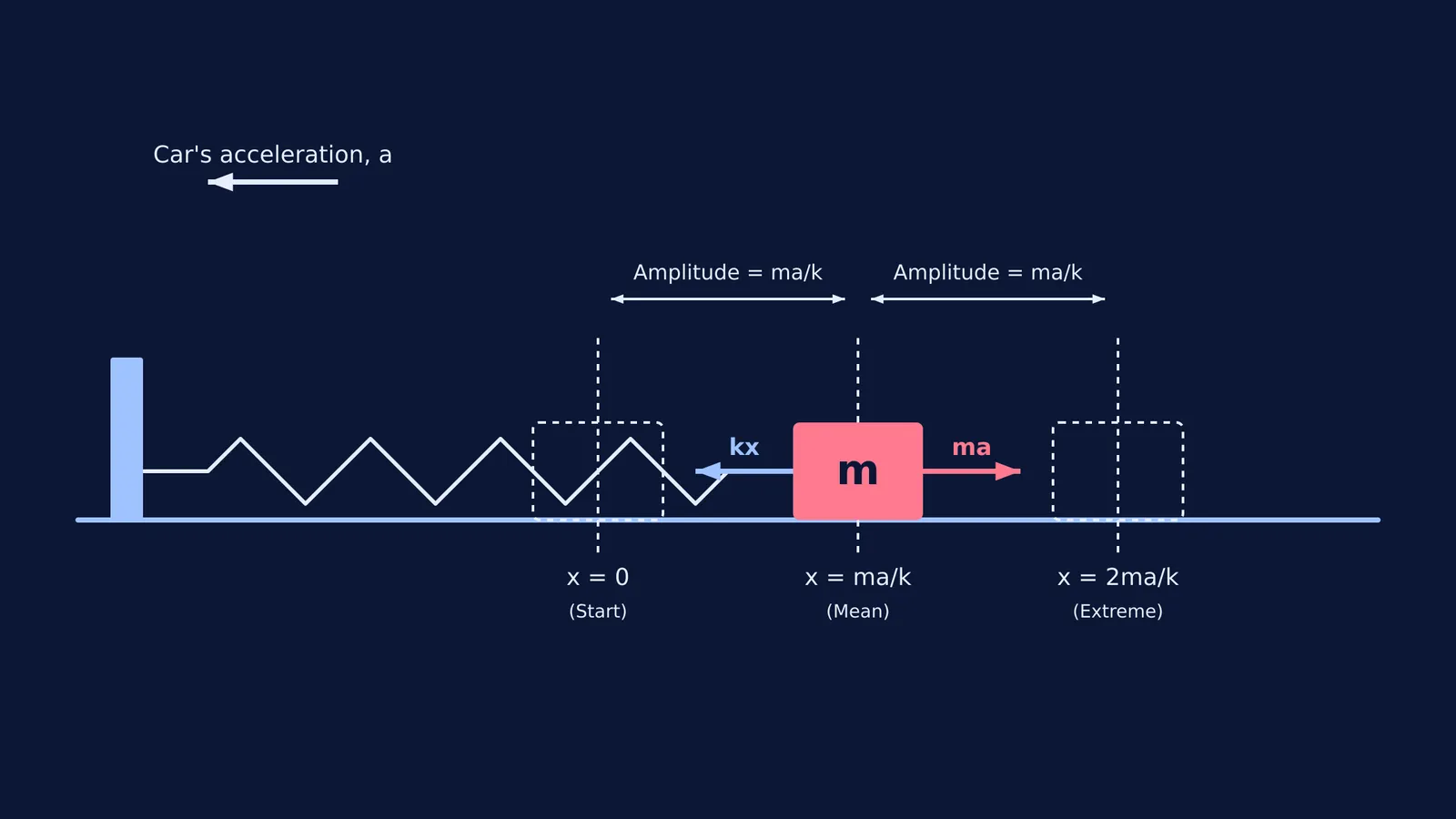
In simple harmonic motion, a spring exerts a restoring force that is proportional to its displacement from its natural length 2. The spring will continue to stretch until its restoring force, kx, perfectly balances the pseudo-force, ma.
At this new equilibrium position, the forces cancel out: kx = ma
Rearranging this gives the displacement of the new equilibrium position: x = ma/k
The block's new mean position has shifted by a distance of ma/k from its original starting point.
What is the amplitude of the oscillation?
Amplitude is the maximum displacement of an oscillating object from its mean position. Finding the amplitude in this scenario relies on understanding where the block was when the acceleration began.
When the car suddenly accelerates, the block is still at its original position (the spring's natural length). However, because the equilibrium position has instantly shifted to ma/k, the block suddenly finds itself at a distance of ma/k from the new mean position.
Since the block starts from rest relative to the car at this location, it cannot move any further away from the mean position in that direction. This initial displacement is therefore the maximum displacement. The block will oscillate about the new equilibrium with an amplitude equal to ma/k.
At the other extreme of its motion, the spring stretches by a total distance of 2ma/k from its natural state. The block comes to a momentary stop at this position before the restoring force pulls it back towards the mean position, continuing the cycle.
How to solve non-inertial frame problems?
When a problem places an oscillator inside a moving vehicle or elevator, setting up the forces correctly is the hardest part. If you get stuck applying these concepts to new scenarios, the Fermi Problem Library has worked problems with a step-by-step solver that explains the reasoning rather than printing an answer.
You can solve any constant-acceleration frame problem by following this framework:
Identify the accelerating frame and note the direction of its acceleration vector.
Apply a pseudo-force to the object in the opposite direction.
Treat the pseudo-force as a constant, real force to find the new equilibrium position.
Calculate the amplitude by finding the distance between the object's starting position and the new equilibrium.
This same logic applies to other shifting-equilibrium problems, such as a pendulum in an electric field: effective g for a charged bob or finding the immediate forces when cutting a string in a spring system: accelerations at that instant.


