

On this page
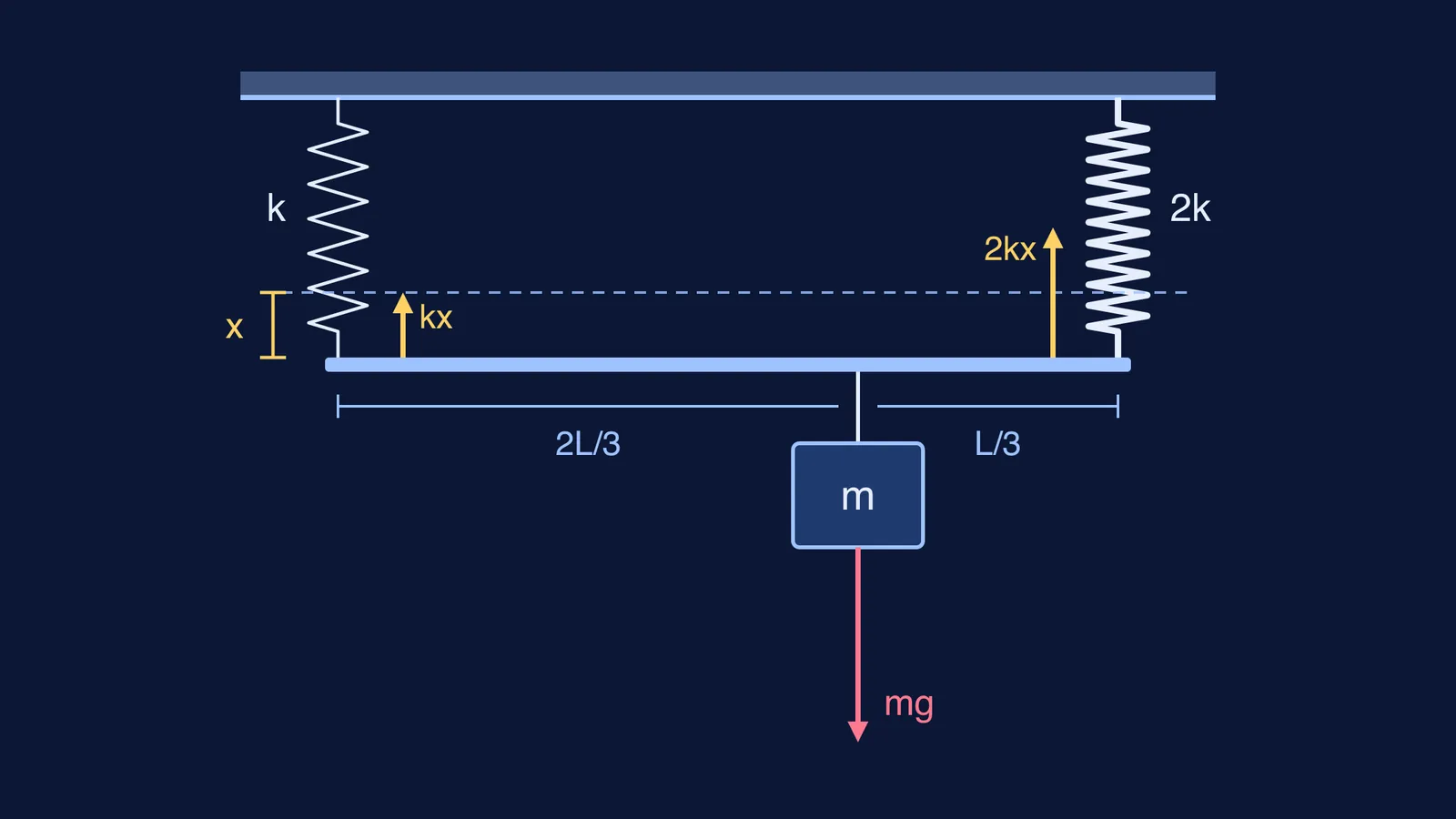
A light bar hangs from the ceiling by two springs, one soft and one stiff, and a block hangs from the bar. The question asks how much each spring stretches. Many students split the weight in half, and that is where the marks go. The key words are "the bar stays level". Once you read them properly, the problem takes three lines.
What happens when a block hangs from two parallel springs?
Each spring obeys Hooke's law: the force it exerts is proportional to how far it is stretched. In magnitude, F = kx, where k is the spring constant (OpenStax University Physics, section 7.1). k is measured in newtons per metre, and a larger k means a stiffer spring that needs more force for the same stretch.
If the bar stays level, both springs end up stretched by the same amount x. That single fact decides everything else. The soft spring pulls up with k1x, the stiff one with k2x, and together they hold the weight: k1x + k2x = mg.
Two springs side by side act like one spring of constant k1 + k2 (Western Washington University physics demonstration notes). So the shared extension is x = mg/(k1 + k2).
Why does the stiffer spring carry more of the load?
Because the stretch is the same, the forces split in the ratio of the stiffnesses: F1/F2 = k1/k2. The load is shared by stiffness, not equally.
This is the opposite of springs in series. There, both springs carry the same force and the softer one stretches more. A quick way to remember it: parallel means same stretch, series means same force.
Worked example: how far does each spring stretch?
A light bar 60 cm long hangs from a spring of k1 = 200 N/m at its left end and k2 = 400 N/m at its right end. A 3 kg block hangs from the bar, which stays level. Take g = 10 m/s².
Weight: mg = 3 × 10 = 30 N.
Combined stiffness: k1 + k2 = 200 + 400 = 600 N/m.
Shared extension: x = 30/600 = 0.05 m, so each spring stretches 5 cm.
Forces: the soft spring pulls 200 × 0.05 = 10 N, the stiff one 400 × 0.05 = 20 N. Check: 10 + 20 = 30 N.
The answer to "find each extension" is 5 cm for both springs. The forces differ, the stretches do not.
If you want to see Hooke's law before doing more of these, our post on measuring spring extension with a Hooke's law simulation walks through it.
Where must the block hang for the bar to stay level?
A level bar is in equilibrium, so two conditions hold: the net force is zero and the net torque is zero, and you may take torques about any point you like (OpenStax University Physics, section 12.1).
Take torques about the point where the block hangs, a distance d from the soft spring. The soft spring's torque is k1x × d, and the stiff spring's is k2x × (L − d). Setting them equal gives d = L × k2/(k1 + k2).
In the example, d = 60 × 400/600 = 40 cm from the soft spring, which is 20 cm from the stiff one. The block sits closer to the stiffer spring, and that is exactly why the bar can stay level. Check the torques: 10 N × 0.4 m = 4 N·m and 20 N × 0.2 m = 4 N·m.
Picking the pivot to remove unknowns is a habit worth building; our post on choosing a torque axis to kill unknowns has more practice.
What if the block hangs from the middle instead?
Then the bar tilts, and the equal-stretch shortcut no longer applies. With the block at the centre, torques about the centre force the two springs to pull equally: 15 N each. Now the stretches differ: 15/200 = 7.5 cm for the soft spring and 15/400 = 3.75 cm for the stiff one.
This is the trap. Students who split the load in half are right only when the block is in the middle, and then the bar is not level. If the problem says "level", the stretches are equal and the forces are not.
A four-step check for any parallel-spring problem
Read the condition: level bar means equal extension; a given hanging point means take torques first.
Write one force balance: sum of kx values equals mg.
Write one torque balance about the block's hanging point.
Check units and that the forces add up to the weight.
The same reasoning carries into oscillation questions, such as a block held between two springs on either side, where you again ask whether the springs share a stretch or a force.
If you get the right answer by the wrong method, the Fermi Problem Library has worked problems with a step-by-step solver that explains the reasoning rather than printing an answer. Try a spring problem there and compare each line with yours.


