

On this page
A spring is one of the few things in physics you can test with a ruler and a handful of masses. A simulation makes it even quicker. You can load a virtual spring again and again in a few minutes, swap a soft spring for a stiff one, and push past the point a real spring would never recover from. Here you predict first, check, and then find where the straight line stops being straight.
What does Hooke's law say about spring extension?
Hooke's law is written F = -kx: F is the restoring force, x is the stretch from equilibrium, and k is the force constant (OpenStax College Physics 2e). The minus sign means the spring pulls back against the stretch.
The spring constant k is measured in newtons per metre (N/m), and a larger k means a stiffer system (OpenStax).
When you hang a mass m, the force stretching the spring is its weight, mg. The standard acceleration of gravity is 9.80665 m/s² (NIST), and school problems round it to 9.8. At rest, the spring's pull balances the weight, so the extension is x = mg/k.
How do you predict extension from the spring constant?
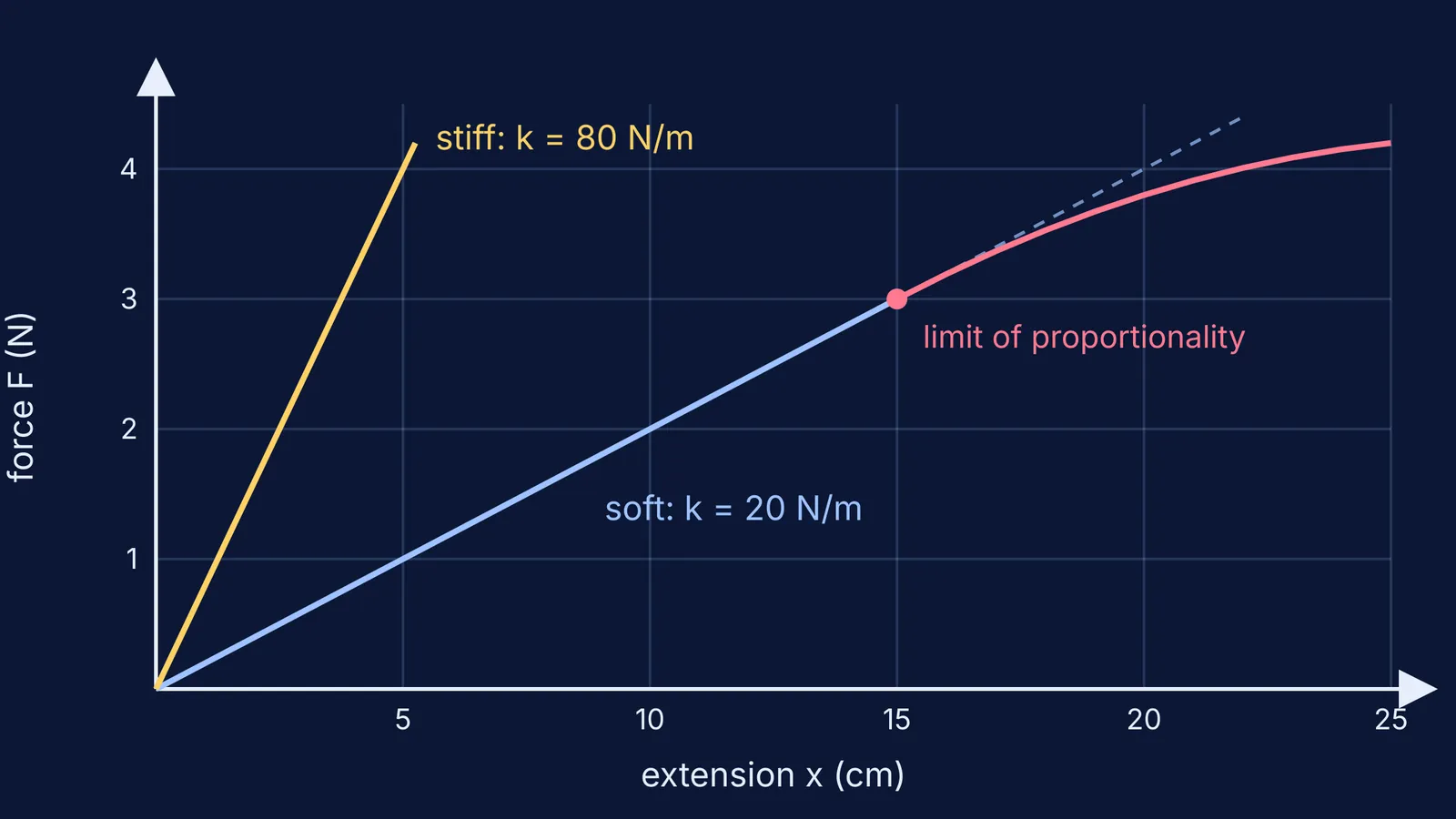
Here is a worked example you can try in any spring simulation, using x = mg/k and the units of k from OpenStax. Take two springs: a soft one with k = 20 N/m and a stiff one with k = 80 N/m. Use g = 9.8 m/s² and add 50 g masses one at a time.
50 g gives a weight of 0.49 N. Soft spring: x = 0.49 / 20 = 0.0245 m, or 2.45 cm. Stiff spring: 0.61 cm.
100 g gives 0.98 N. Soft: 4.9 cm. Stiff: 1.23 cm.
300 g gives 2.94 N. Soft: 14.7 cm. Stiff: 3.68 cm.
Two patterns stand out. Doubling the mass doubles the extension, which is what a straight line through the origin means. And the stiff spring, with four times the k, stretches a quarter as much for the same load.
Where does the elastic limit bend the line?
Real materials only follow Hooke's law for small stretches. NCERT's Class 11 chapter on the mechanical properties of solids describes the stress-strain curve in stages (NCERT, Mechanical Properties of Solids):
From the origin to the proportional limit, the graph is a straight line, Hooke's law holds and the material returns to its original size when you unload it.
Past the proportional limit, the line curves, but the material still springs back when unloaded, up to a point called the yield point or elastic limit.
Past the elastic limit, the material does not return to its original length when the load is removed. It has a permanent set, or plastic deformation.
So the line bends at the proportional limit, a little before the elastic limit; NCERT's graph marks them as separate points.
To find the bend in a simulation, keep adding 50 g and compare each reading with your x = mg/k prediction. While they agree, you are on the straight part. When the measured extension starts running ahead of the prediction, the line has bent. Then take all the masses off. If the pointer goes back to zero, you were still inside the elastic limit. If it does not, you went past it.
How do stiff and soft springs compare on the graph?
On a force-extension graph, the stiff spring's line is steeper and the soft spring's line is shallower. For the same weight, the soft spring stretches more, so it is easier to read. If you want to see what happens when you join springs end to end or side by side, our guide to springs in series and parallel works through the effective k. For the material behind a spring's stiffness, see elasticity and Young's modulus.
How do you run a spring simulation step by step?
Write down k for both springs and predict the extension for 50, 100, 200 and 300 g with x = mg/k (OpenStax) before you touch anything.
Load the soft spring and record each extension next to your prediction.
Plot force against extension, draw the best straight line through the origin and find its slope. Converted to N/m, it should come out close to k.
Repeat with the stiff spring on the same axes, and compare the two slopes.
Keep loading the soft spring until the readings drift away from your predictions. Mark that point.
Unload completely and note whether the spring goes back to zero.
We built the Fermi Simulation Lab for ideas like this, which are easier to see than to read. If a numerical on spring extension still goes wrong after that, the Fermi Problem Library has worked problems with a step-by-step solver that explains the reasoning rather than printing an answer. For what simulations do and don't help with, see the research behind interactive simulations.


