On this page
Preparing Atoms and Nuclei for JEE Main 2027? Start from the official list, which is shorter than many older guides assume.
What is in the JEE Main 2027 Atoms and Nuclei syllabus?
Unit 18 of the NTA Syllabus for JEE (Main) - 2027 lists alpha-particle scattering and Rutherford's model, the Bohr model, energy levels, the hydrogen spectrum, composition and size of the nucleus, atomic masses, the mass-energy relation, mass defect, binding energy per nucleon and its variation with mass number, and nuclear fission and fusion.
Radioactivity, the decay law and half-life are not in that list. The 2026-27 reprint of NCERT Chapter 13, Nuclei keeps a short, descriptive radioactivity section (13.6) that names the three types of decay but does not teach the decay law.
The matching chapters are NCERT Class 12 Physics Chapter 12, Atoms and Chapter 13, Nuclei. Every topic below appears in both the syllabus and these chapters.
Which Bohr model results do you need?
NCERT gives the energy of the nth level of hydrogen as En = −13.6/n² eV (NCERT Chapter 12).
The smallest orbit, the Bohr radius, is 5.3 × 10⁻¹¹ m, and orbit radius grows as n² (NCERT Chapter 12).
When the electron drops from level i to level f, the photon carries hν = Ei − Ef. For wavelength, use λ = hc/ΔE with hc ≈ 1240 eV nm, from the CODATA Planck constant of 4.136 × 10⁻¹⁵ eV s times the speed of light.
Worked example 1. A hydrogen atom drops from n = 4 to n = 2.
E4 = −13.6/16 = −0.85 eV, and E2 = −13.6/4 = −3.40 eV.
ΔE = −0.85 − (−3.40) = 2.55 eV. Check: 13.6 × 3/16 = 2.55 eV.
λ = 1240/2.55 ≈ 486 nm, a blue-green visible line.
For why the model fails beyond hydrogen, see the limitations of the Bohr model.
How do you calculate mass defect and binding energy?
Mass defect is the mass of the separate nucleons minus the mass of the nucleus; binding energy is that mass times c², with 1 u = 931.5 MeV/c² (NCERT Chapter 13). With atomic masses, use hydrogen-1 rather than the proton so the electron masses cancel.
Worked example 2. Silicon-28 has 14 protons and 14 neutrons. From the AME2020 atomic mass table: hydrogen-1 = 1.007825 u, neutron = 1.008665 u, silicon-28 = 27.976927 u.
14 × 1.007825 = 14.109550 u, and 14 × 1.008665 = 14.121310 u.
Total = 28.230860 u, so mass defect = 28.230860 − 27.976927 = 0.253933 u.
Binding energy = 0.253933 × 931.5 ≈ 236.5 MeV.
Per nucleon = 236.5/28 ≈ 8.45 MeV, matching the 8.448 MeV in AME2020.
What does the binding energy per nucleon curve tell you?
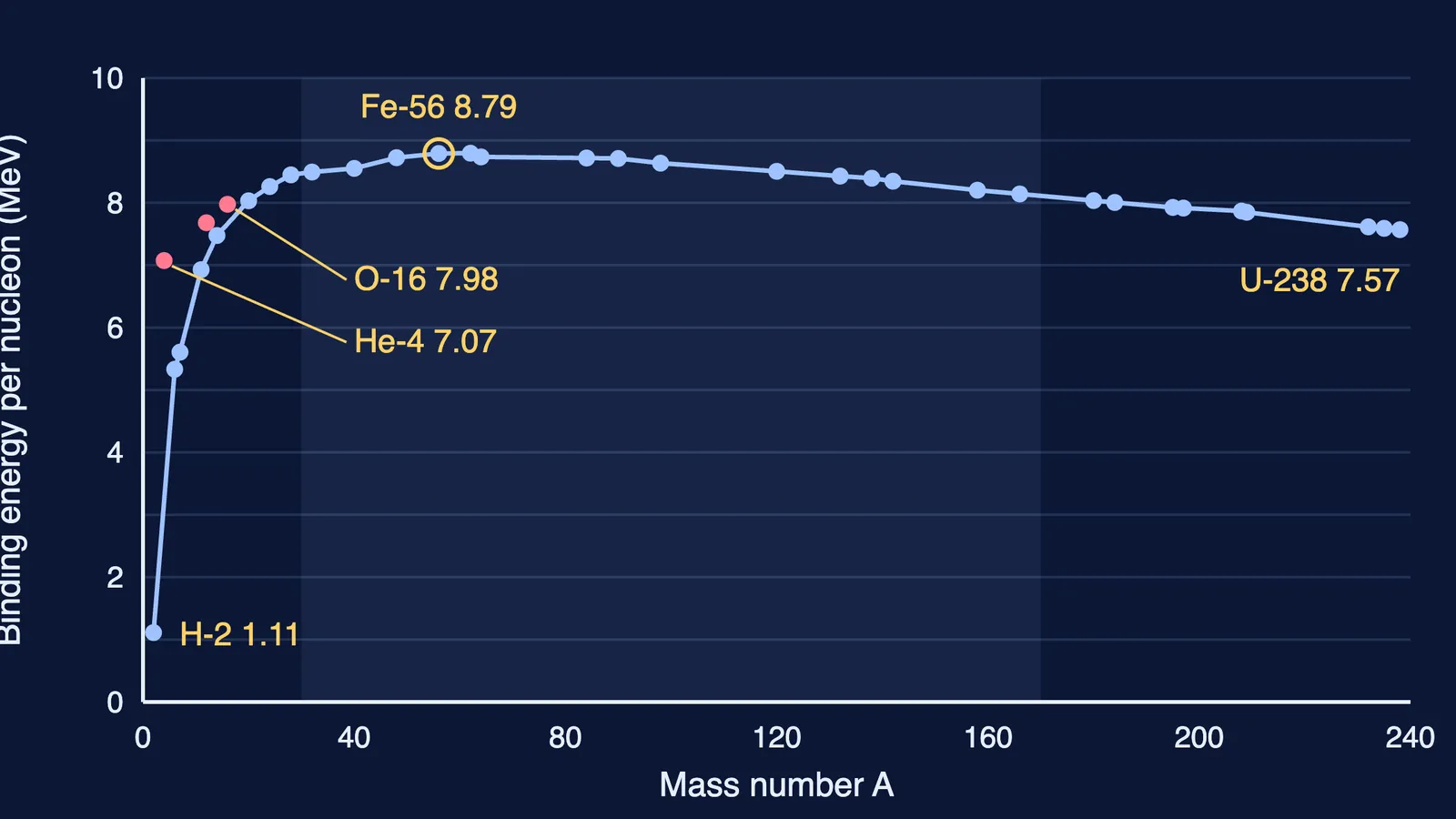
NCERT describes the curve as nearly flat for 30 < A < 170, peaking at roughly 8.75 MeV near A = 56 and falling to 7.6 MeV at A = 238 (NCERT Chapter 13). The AME2020 values in the chart above give 8.79 MeV for iron-56, 7.57 MeV for uranium-238 and 7.07 MeV for helium-4, well above its light neighbours.
Fission and fusion both move products towards the peak, so both release energy. For a uranium-like nucleus splitting in two, NCERT estimates a gain of about 0.9 MeV per nucleon, or roughly 200 MeV per fission. Go deeper with the binding energy per nucleon curve explained and the energy released when two deuterium nuclei fuse.
Nuclear size follows R = R0 A^(1/3) with R0 = 1.2 fm (NCERT Chapter 13). For aluminium-27, R = 1.2 × 3 = 3.6 fm; for A = 216, R = 1.2 × 6 = 7.2 fm. Eight times the nucleons gives only twice the radius: volume grows with A, so nuclear density is the same for all nuclei.
What are the common traps?
Mixing the proton mass with atomic masses.
Ranking stability by total binding energy instead of energy per nucleon.
Using 13.6 eV to ionise from any level; from n = 2 it is 3.40 eV.
Dropping the unit bridges: 931.5 MeV per u, 1240 eV nm.
Drilling decay-law problems the 2027 syllabus does not list.
If you keep choosing the wrong method, the Fermi Problem Library has worked problems with a step-by-step solver that explains the reasoning rather than printing an answer.
How should you practise Atoms and Nuclei in a week?
Day 1: Read NCERT 12.2 to 12.5; derive En and orbit radius by hand.
Day 2: Solve 15 transition problems: energies, wavelengths, ionisation.
Day 3: Read 13.2 to 13.4; write one page of constants.
Day 4: Work the mass defect for five nuclides and check each against AME2020.
Day 5: Practise curve reasoning, fission, fusion and R = R0 A^(1/3).
Day 6: Take a timed mixed set of 20 questions.
Day 7: Redo every wrong answer and name the trap that caught you.
If a diagram on the page is not enough, the Fermi Simulation Lab has interactive simulations for the ideas that are easier to see than to read.
Start Day 1 tonight.