On this page
In the nuclei chapter for boards, JEE Main or NEET-UG, one graph keeps coming back: binding energy per nucleon against mass number. Read it properly and it tells you which nuclei are most stable and why splitting uranium and joining hydrogen both release energy.
What does the binding energy per nucleon curve show?
Binding energy is the energy needed to pull a nucleus apart into separate protons and neutrons. A nucleus weighs less than its parts, and that mass defect multiplied by c² is the binding energy. Divide by the mass number A and you get binding energy per nucleon: how tightly each particle is held.
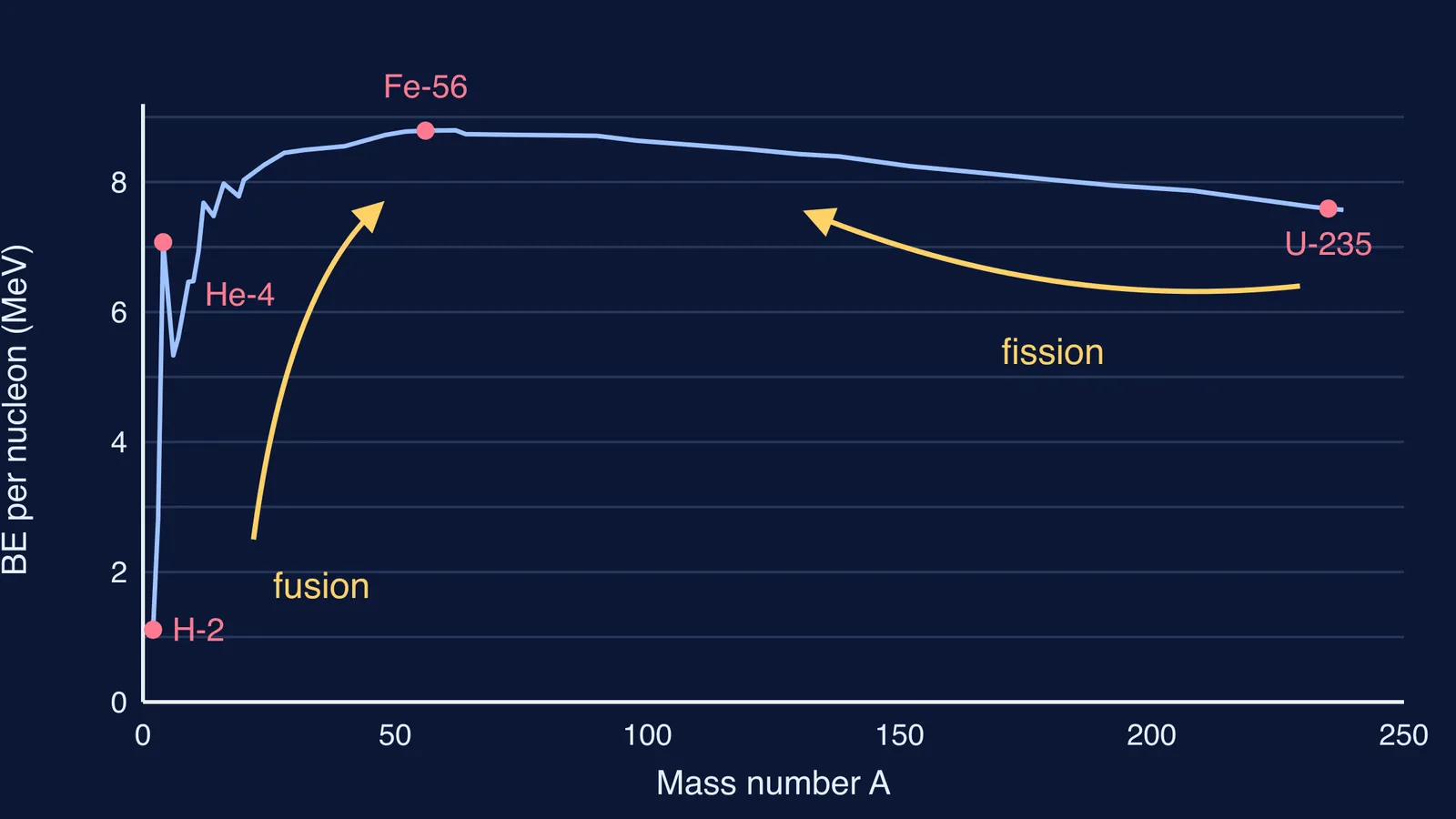
The numbers below come from AME2020, the international atomic mass evaluation (Wang et al., Chinese Physics C, 2021; AME2020 data table). Reading from left to right:
Deuterium (H-2): 1.112 MeV per nucleon, the loosely held start.
Helium-4: 7.074 MeV, a sharp spike above lithium-6, the next stable nucleus, at 5.332 MeV.
Carbon-12: 7.680 MeV; oxygen-16: 7.976 MeV.
Iron-56: 8.790 MeV, at the top.
Lead-208: 7.867 MeV.
Uranium-235: 7.591 MeV.
So the shape is a steep, jagged climb for light nuclei, a broad, nearly flat top where the most tightly bound nuclei from titanium-48 (8.723 MeV) to zirconium-90 (8.710 MeV) sit above 8.7 MeV, and a slow slide for heavy nuclei. The climb happens because the strong force is short-range: in a small nucleus, many nucleons sit at the surface with few neighbours. The slide happens because every proton repels all the others, and that repulsion grows faster than the short-range attraction.
Why is iron-56 at the peak, and is it really the top?
Iron-56 is often called the most tightly bound nucleus. Close, but not quite. In the same AME2020 table, nickel-62 has 8.795 MeV per nucleon and iron-58 has 8.792 MeV, both just above iron-56 at 8.790 MeV.
M. P. Fewell made this point in the American Journal of Physics in 1995, showing that iron-58 and nickel-62 are both more strongly bound than iron-56, and suggesting the iron-56 belief may come from studies of how stars build elements (Fewell, 1995). Saying the curve peaks around iron, near A = 56, describes the shape correctly; if asked for the single most tightly bound nuclide, nickel-62 is the precise answer.
Why do fission and fusion both release energy?
Energy is released whenever the products are more tightly bound than what you started with: on the curve, moving towards the peak from either side. Both cases, using values from the AME2020 table.
Fission. Take uranium-235 + n → barium-141 + krypton-92 + 3n. Binding energy before: 235 × 7.591 = 1783.9 MeV (free neutrons have none). After: 141 × 8.326 + 92 × 8.513 = 1174.0 + 783.2 = 1957.2 MeV. About 173 MeV is released, close to the 170 MeV the World Nuclear Association lists for this split. The usual figure for one uranium-235 fission, an average of about 200 MeV, also counts gamma rays and energy released later.
Fusion. Take deuterium + tritium → helium-4 + n. Before: 2 × 1.112 + 3 × 2.827 = 10.71 MeV. After: 4 × 7.074 = 28.30 MeV. That is 17.6 MeV, the value the World Nuclear Association gives for this reaction.
How do you calculate binding energy per nucleon?
Here is iron-56 in full, using AME2020 atomic masses (data table) and 1 u = 931.494 MeV, the CODATA 2022 value from NIST.
Count the particles: iron-56 has Z = 26 protons and N = 56 − 26 = 30 neutrons.
Mass of the parts: 26 hydrogen atoms × 1.007825 u = 26.203450 u, plus 30 neutrons × 1.008665 u = 30.259950 u. Total: 56.463400 u.
Mass defect: 56.463400 u − 55.934936 u (the iron-56 atom) = 0.528464 u.
Binding energy: 0.528464 × 931.494 = 492.26 MeV.
Per nucleon: 492.26 ÷ 56 = 8.790 MeV, which matches the AME2020 table.
Try the same steps for helium-4 (atomic mass 4.002603 u); you should get 7.074 MeV per nucleon. For more practice, try these mass defect and binding energy problems, solved step by step, and if the conversion factor feels like magic, read where 1 amu = 931.5 MeV comes from.
What should you check before answering a curve question?
Total or per nucleon? Uranium has far more binding energy in total, but less per nucleon.
Which way does the reaction move? Towards the peak releases energy; away from it costs energy.
Atomic or nuclear masses? Keep them consistent.
Did you divide by A at the end?
If your answer lands elsewhere, the Fermi Problem Library has worked problems with a step-by-step solver that explains the reasoning rather than printing an answer. To see the curve at work in a star, read how nuclear fusion powers the Sun.