On this page
Two deuterium nuclei that fuse release about 3.27 MeV if they make helium-3 and a neutron, and about 4.03 MeV if they make tritium and a proton, according to HyperPhysics. A board or JEE numerical asks you to get these from atomic masses, so below we work it through, convert to joules per kilogram, and compare with uranium fission.
How much energy is released when two deuterium nuclei fuse?
Deuterium fusion has two branches, and HyperPhysics lists their yields as 3.27 MeV for the neutron branch and 4.03 MeV for the proton branch:
D + D → ³He + n + 3.27 MeV
D + D → T + p + 4.03 MeV
We will compute the first branch in full, because most textbook questions use it, and give the second as a check.
How do you calculate the Q value for D + D fusion?
The Q value is the mass lost in a reaction, converted to energy: Q = (mass of reactants − mass of products) × c². One atomic mass unit is equivalent to 931.494 MeV, according to the CODATA value published by NIST. Here is where 1 amu = 931.5 MeV comes from.
The masses come from NIST's hydrogen isotope table, its helium isotope table and the CODATA neutron mass:
deuterium atom: 2.01410178 u
helium-3 atom: 3.01602932 u
neutron: 1.00866492 u
tritium atom: 3.01604928 u
hydrogen-1 atom: 1.00782503 u
Now the worked example:
Mass before: 2 × 2.01410178 = 4.02820356 u.
Mass after: 3.01602932 + 1.00866492 = 4.02469424 u.
Mass defect: Δm = 4.02820356 − 4.02469424 = 0.00350932 u.
Q = 0.00350932 × 931.494 = 3.269 MeV.
For the tritium branch, the mass after is 3.01604928 + 1.00782503 = 4.02387431 u, so Δm = 0.00432925 u and Q = 4.033 MeV. Both match the published yields. For the general method with other reactions, see how to calculate the Q value of a nuclear reaction.
How much energy is that per kilogram of deuterium?
Scale up with the deuterium molar mass of 2.0141 g/mol (from the NIST hydrogen table), the Avogadro constant of 6.02214076 × 10^23 per mole, and 1 eV = 1.602176634 × 10^−19 J:
Moles in 1 kg: 1000 g ÷ 2.0141 g/mol = 496.5 mol.
Atoms: 496.5 × 6.022 × 10^23 = 2.990 × 10^26.
Each fusion uses two atoms, so there are 1.495 × 10^26 reactions.
Energy per reaction: 3.269 MeV × 1.602 × 10^−13 J/MeV = 5.237 × 10^−13 J.
Total: 1.495 × 10^26 × 5.237 × 10^−13 J = 7.83 × 10^13 J.
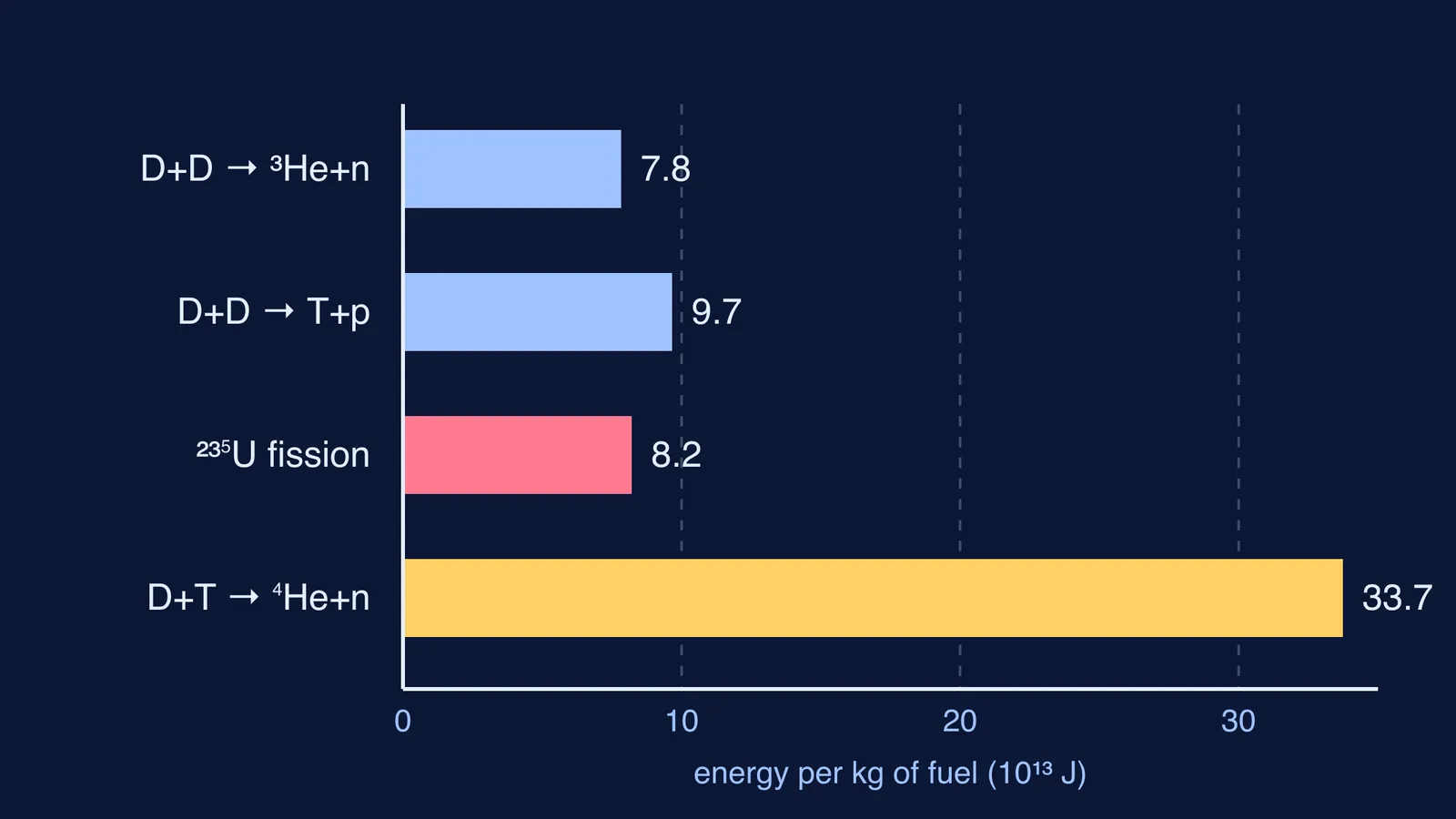
The tritium branch gives 9.66 × 10^13 J per kilogram by the same steps.
Is D + D fusion more energetic than fission per kilogram?
Not by much. The World Nuclear Association says uranium-235 fission releases on average about 200 MeV per nucleus. With NIST's uranium-235 mass of 235.0439 u:
Nuclei in 1 kg: (1000 ÷ 235.0439) × 6.022 × 10^23 = 2.562 × 10^24.
Energy: 2.562 × 10^24 × 200 MeV × 1.602 × 10^−13 J/MeV = 8.21 × 10^13 J.
So 1 kg of deuterium fused through the helium-3 branch gives about 7.8 × 10^13 J, and 1 kg of uranium-235 gives about 8.2 × 10^13 J. HyperPhysics gives a slightly higher average of 215 MeV per fission once fragment decay is counted, which raises the fission figure to 8.8 × 10^13 J. Either way, the two are the same size (more on the fission of 1 kg of uranium-235).
The reason shows up per nucleon. D + D releases 3.27 MeV across 4 nucleons, about 0.82 MeV each; fission releases 200 MeV across 236 nucleons (uranium-235 plus the neutron that hits it), about 0.85 MeV each.
Fusion's reputation for far more energy per kilogram comes from deuterium-tritium fuel. The World Nuclear Association gives D + T → ⁴He + n + 17.6 MeV; across 5.03 u of fuel that works out to about 3.4 × 10^14 J per kilogram, roughly four times fission. If a question says "fusion", check which reaction it means.
What mistakes cost marks in this numerical?
Mixing nuclear and atomic masses. If the question gives nuclear masses, use them for every particle, including a proton instead of a hydrogen atom.
Forgetting that one reaction uses two deuterium nuclei. Skipping step 3 doubles your answer per kilogram.
Rounding too early. The mass defect is the difference of two numbers that agree only to two decimal places, so keep six or more until you subtract.
Writing "fusion always beats fission per kilogram" without naming the reaction.
If a step such as moles-to-reactions keeps tripping you up, the Fermi Problem Library has worked problems with a step-by-step solver that explains the reasoning rather than printing an answer. For the idea underneath, the binding energy per nucleon, the Fermi Concept Library gives each concept its own lesson and its place in the map.
Redo the worked example once without looking, then try the tritium branch and check your answer against the per-kilogram section above.