

On this page
Where does the 200 MeV come from?
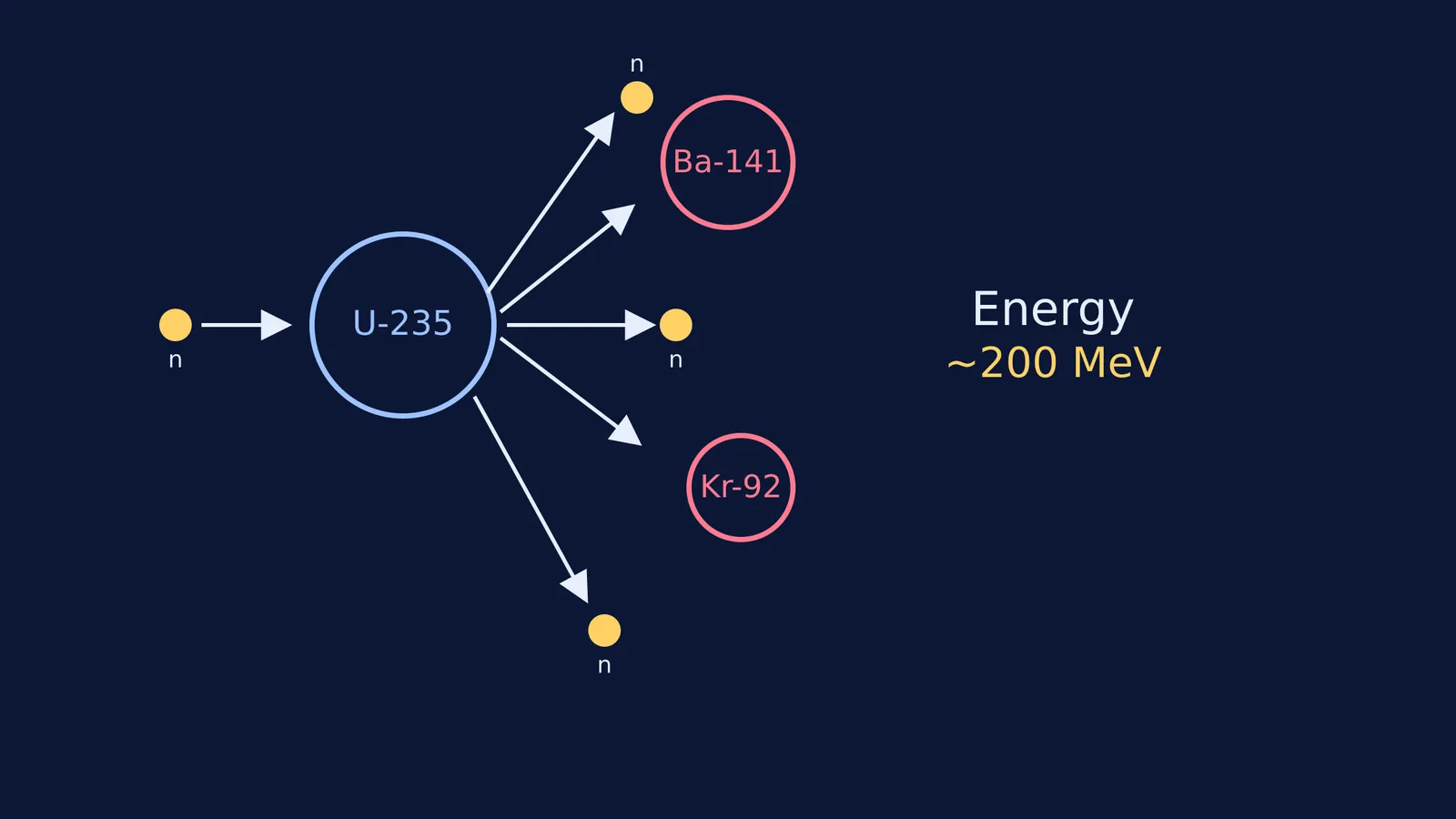
When a slow thermal neutron strikes a uranium-235 nucleus, the nucleus absorbs the neutron and becomes unstable. This intermediate state splits into two lighter nuclei, releasing additional neutrons and a vast amount of energy. On average, a single fission event of U-235 releases approximately 200 MeV (million electronvolts) of energy (Wikipedia).
The majority of this energy—about 169 MeV—appears as the kinetic energy of the flying fission fragments, such as barium-141 and krypton-92. As these heavy fragments travel through the nuclear fuel, they collide with other atoms, rapidly converting their kinetic energy into heat. The remaining energy is carried away by emitted prompt neutrons, prompt gamma rays, and the subsequent radioactive beta decay of the fission products over time.
In the Fermi Concept Library, you can see how this 200 MeV fundamentally comes from the difference in nuclear binding energy between the heavy uranium parent nucleus and its tightly bound, lighter daughter products. The mass defect—a missing 0.1% of the original mass—is directly converted into nuclear fission and fusion energy according to Einstein's mass-energy equivalence principle, E = mc².
How do we calculate the mass defect?
Before we scale up to a full kilogram, it helps to look at the mass defect of a single uranium atom. In a typical reaction, uranium-235 plus one neutron yields barium-141, krypton-92, and three neutrons. If you sum the exact masses of the reactants and subtract the exact masses of the products, the products weigh slightly less.
This missing mass is approximately 0.215 atomic mass units (amu). Since 1 amu of mass corresponds to roughly 931.5 MeV of energy (Wikipedia)), multiplying the mass defect by this conversion factor gives the expected energy release.
Energy = 0.215 amu × 931.5 MeV/amu ≈ 200 MeV.
This calculation confirms the 200 MeV figure that physicists use as a standard average for uranium-235 fission.
How to find the number of atoms in 1 kg of U-235?
To move from the microscopic scale of one atom to the macroscopic scale of one kilogram, we must determine how many atoms are present in 1 kg of pure U-235. The molar mass of U-235 is about 235 g/mol, which means 235 grams contains one mole, or Avogadro's number (6.022 × 10²³) of atoms (Wikipedia). We can avoid common mole concept errors by writing out a careful dimensional analysis.
First, convert the mass from kilograms to grams.
Convert mass to moles: 1000 g / 235 g/mol = 4.255 moles.
Multiply by Avogadro's number: 4.255 moles × (6.022 × 10²³ atoms/mole) ≈ 2.56 × 10²⁴ atoms.
What is the total energy released by the fission of 1 kg of uranium-235?
Now that we have the energy released per fission event and the total number of atoms in one kilogram, we multiply them to find the total macroscopic energy yield.
Total energy in MeV = 2.56 × 10²⁴ atoms × 200 MeV/atom = 5.12 × 10²⁶ MeV.
To make this useful, we must convert it to Joules. The conversion factor is 1 MeV = 1.602 × 10⁻¹³ Joules (Wikipedia).
Total energy in Joules = 5.12 × 10²⁶ MeV × 1.602 × 10⁻¹³ J/MeV ≈ 8.2 × 10¹³ J.
This gives us a final value of 82 Terajoules (8.2 × 10¹³ J) for the energy released by the complete fission of 1 kg of pure U-235.
How does uranium compare to burning coal?
To appreciate the scale of nuclear energy, we can compare it with conventional chemical combustion. Burning one kilogram of standard coal yields a heat of combustion of about 24 MJ, or 2.4 × 10⁷ Joules (Wikipedia).
By dividing the energy obtained from uranium by the energy obtained from coal, we find the mass equivalence:
Mass equivalence ratio = (8.2 × 10¹³ J) / (2.4 × 10⁷ J/kg) ≈ 3,400,000 kg.
The fission of just 1 kg of U-235 releases the exact same amount of energy as burning 3.4 million kilograms—or 3,400 metric tonnes—of coal. At an atomic level, the fission of a single uranium atom releases roughly 100 million times more energy than the chemical combustion of a carbon atom in oxygen (Wikipedia).
If you struggle to piece together multi-step problems like this one—from moles to atomic mass units to MeV and finally to Joules—the Fermi Problem Library has worked problems with a step-by-step solver that explains the reasoning.


