On this page
An AI tutor can give you the final velocities for a collision in seconds, and get them wrong just as fast: a dropped minus sign, a formula meant for equal masses. You don't need to solve the problem again to catch most of these. You need two totals and about two minutes.
What two checks catch most wrong collision answers?
Both come straight from the conservation laws. OpenStax University Physics puts it plainly: "A closed system always conserves momentum; it might also conserve kinetic energy, but very often it doesn't" (OpenStax, Types of Collisions).
Momentum check: add up m × v for every body before and after, with a sign for direction. The two totals must match.
Energy check: add up ½mv² before and after. In an elastic collision the totals are equal; in an inelastic collision the final total is smaller.
When bodies stick together, the loss of kinetic energy is the largest possible (OpenStax). If the AI's answer fails either test, it is wrong, however neat the working looks.
How do you check an AI's elastic collision answer?
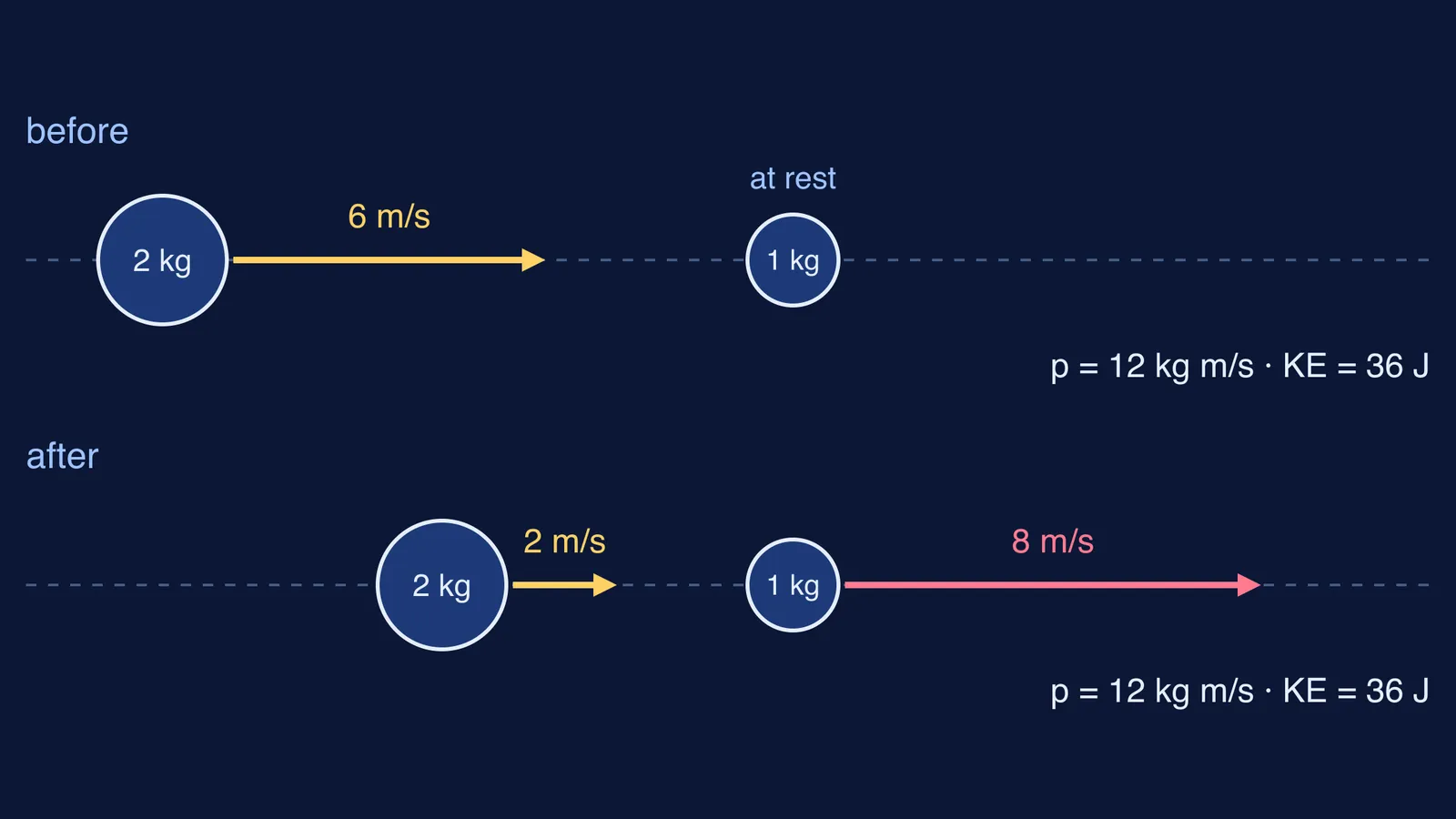
Here is a JEE-style problem. A 2 kg ball moving at 6 m/s hits a 1 kg ball at rest, head-on and elastically. Find both final velocities.
Suppose the AI replies: "The first ball stops and the second moves off at 12 m/s." That borrows the equal-mass pattern, where the first ball stops. Check it.
Momentum before: 2 × 6 + 1 × 0 = 12 kg m/s. Momentum after: 2 × 0 + 1 × 12 = 12 kg m/s. Passes.
Kinetic energy before: ½ × 2 × 6² = 36 J. After: ½ × 1 × 12² = 72 J. Fails. The energy doubled out of nowhere, which an ordinary collision cannot do (OpenStax).
The correct answer is 2 m/s and 8 m/s, both forward: momentum 2 × 2 + 1 × 8 = 12 kg m/s, kinetic energy 4 + 32 = 36 J. Both match. For why the heavy ball keeps rolling, see our explainer on elastic collision velocities when a heavy ball hits a light one.
How do you check an AI's inelastic collision answer?
Now a perfectly inelastic one, where the bodies stick together (OpenStax). A 3 kg lump of clay moving right at 4 m/s meets a 1 kg block moving left at 2 m/s. They stick. Find the common velocity.
Suppose the AI says 3.5 m/s to the right. Check it, taking right as positive.
Momentum before: 3 × 4 + 1 × (−2) = 10 kg m/s. Momentum after: 4 × 3.5 = 14 kg m/s. Fails. The AI added the block's momentum instead of subtracting it.
Kinetic energy before: ½ × 3 × 4² + ½ × 1 × 2² = 24 + 2 = 26 J. After: ½ × 4 × 3.5² = 24.5 J. Passes, because the energy fell.
The energy check alone would have let this sign error through. Always run both.
The correct answer is 10 ÷ 4 = 2.5 m/s to the right, with ½ × 4 × 2.5² = 12.5 J left, so 13.5 J went into deformation, heat and sound. Our post on kinetic energy about the centre of mass shows how much a collision is able to lose.
When can these checks mislead you?
External forces during impact. Momentum is conserved for a closed system (OpenStax). If a string or hinge pushes during impact, check momentum only along directions with no outside push.
Stored energy released. In an explosion, or when a compressed spring lets go, kinetic energy rises even though momentum is conserved; OpenStax notes such a system "will have a great deal of kinetic energy after the explosion, although it had none before" (OpenStax). The energy check is for ordinary collisions.
Two dimensions. Momentum is a vector, so check the x and y components separately (OpenStax, Collisions in Multiple Dimensions).
Passing is not proof. In a partly inelastic collision, many velocity pairs pass both checks, so these catch impossible answers, not every wrong one. For formulas, add a special-values test, such as setting the masses equal.
What is the two-minute routine?
Choose a positive direction and write every velocity with its sign.
Work out total momentum before and after. They must match.
Work out total kinetic energy before and after. After must be equal (elastic) or smaller (inelastic).
If either fails, show the AI the numbers and ask which step broke the law, not just for a new answer.
If both pass, try one limiting case, such as equal masses.
Telling an AI "your answer gives 72 J after and 36 J before" makes you both look at the physics. The Fermi Problem Library has worked problems with a step-by-step solver that explains the reasoning rather than printing an answer, so you can compare each line with your own. If energy loss in collisions still feels slippery, look it up in the Fermi Concept Library.
Next time an AI hands you two final velocities, put them back in first.