On this page
The entry post in the lower judiciary is Civil Judge (Junior Division), reached through a state judicial service exam run by the High Court or the state public service commission. Who may sit it changed twice between May 2025 and August 2026.
Can you become a judge straight after an LLB?
For a short window, yes. In May 2025 the Supreme Court restored a rule that candidates for Civil Judge (Junior Division) must first practise for three years at the Bar (All India Judges Association v. Union of India, 20 May 2025).
On 21 August 2026, the Supreme Court modified that ruling in Bhumika Trust v. Union of India (2026 INSC 904), by a 2-1 majority with Justice K Vinod Chandran dissenting. It created two regimes, based on when a recruitment notice is issued:
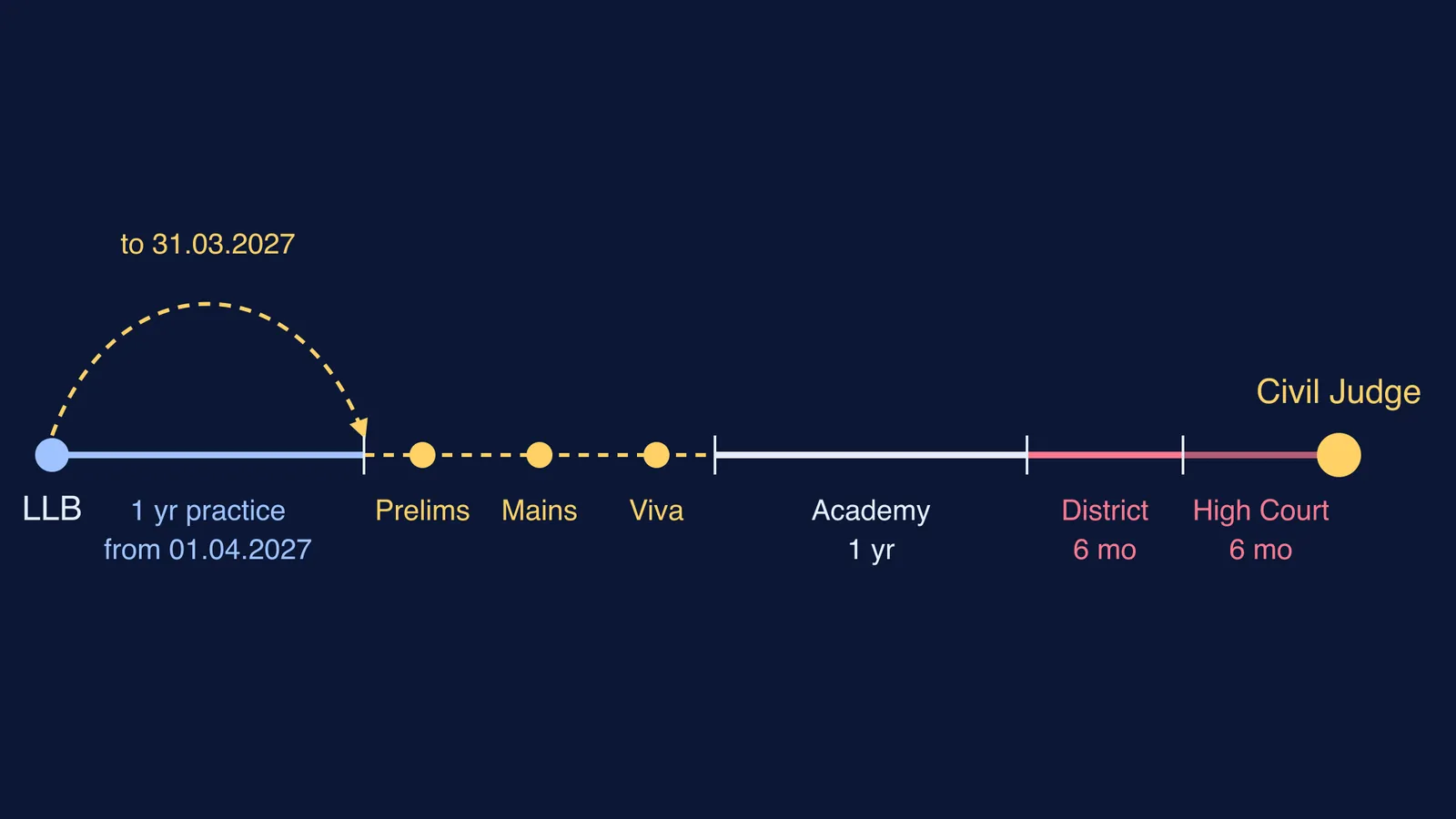
Notices issued after the May 2025 judgment and up to 31 March 2027: all law graduates are eligible to apply, are deemed to have completed one year of practice, and need no separate Certificate of Practice for that deemed year.
Notices issued on or after 1 April 2027: you need at least one year of actual practice, and your application is entertained only with a certificate showing that year was spent in the District Courts.
The certificate needs your participation in real court proceedings to have been recorded, under a mechanism each High Court sets. The Court told state governments, with their High Courts, to amend the rules within three months, and said the scheme will stay in force for five years before its working is placed back before the Court.
What are the eligibility rules for the judicial service exam?
Each state sets its own rules. In Delhi, the High Court's Delhi Judicial Service Examination 2014 instructions required Indian citizenship, being an advocate or qualified to be admitted as one under the Advocates Act, 1961, and an age of not more than 32 on the 1 January after the exam began, relaxed by 5 years for SC/ST candidates. That notice predates the practice rules above, so check your state's newest one.
District judges can also be recruited directly from the Bar, but the Delhi Higher Judicial Service Examination 2026 notice asked for seven years of continuous practice and an age between 35 and 45. To reach the bench in your twenties, take the Civil Judge route.
How do the prelims, mains and interview work?
Delhi's 2014 Civil Judge instructions and 2026 Higher Judicial Service notice both set out three stages:
Preliminary exam: objective questions (25% negative marking in the 2026 notice). It screens who sits the mains.
Mains: a written exam, where you reason through legal problems in your own words.
Viva voce: an interview for those who clear the mains.
Papers and marks differ by state, so treat your target state's last two notices as your syllabus.
What happens after you are selected?
Under the 2026 judgment, you join as a Trainee Judicial Officer. You train for one year at the State Judicial Academy, paid a fixed amount equal to half the pay of a Judicial Magistrate First Class in your state. Next comes a one-year law clerkship on the same pay: six months under a District and Sessions Judge or a member of the Higher Judicial Services, then six months under a sitting High Court judge. After that judge's evaluation report is found satisfactory, you take up a regular post on the regular pay scale. This applies in both regimes.
How the dates work out: a mid-2026 graduate can apply to any notice issued up to 31 March 2027 with no practice. A mid-2028 graduate who enrols at once must first complete a certified year in the District Courts, so their earliest notice comes around mid-2029. Either way, two years of training and clerkship follow selection.
What should you start doing in law school?
A year-by-year plan for a five-year integrated LLB (squeeze it into three years for a three-year LLB):
Years 1-2: Read the bare text of each Act alongside your course, keeping one page of notes per chapter in your own words.
Year 3: Intern at a district court, not only at law firms, and log every hearing you attend. Internships are not practice, but the certified year must be spent in the District Courts, so learn how they run.
Year 4: Write one timed answer a week from a past mains paper, and ask a teacher to mark it hard.
Final year: Pick one or two target states, check their age limits against your birth date, and plan your Bar Council enrolment and first year of practice.
If you are still in school, start with how BA LLB and BBA LLB differ, then read how science students can prepare for CLAT alongside boards and how AILET and CLAT differ. If board-exam science is crowding out your CLAT prep, Fermi's AI tutor works out what you already know and builds a plan for the session.
Your next step: open your state High Court's recruitment page and find the most recent Civil Judge notice.