On this page
Law school forms ask you to rank BA LLB and BBA LLB, and it is easy to tick one without knowing what changes. The law is the same; the other degree is not, and it shapes your first few years.
What is the actual difference between BA LLB and BBA LLB?
Both are "integrated" law degrees. The Bar Council of India's Rules of Legal Education, 2008 define an integrated degree course in law as a double degree that combines a bachelor degree in any branch of knowledge with the law degree, run together for at least five years.
The same rules say the university designs the first-degree half, while the law courses follow a minimum list set by the BCI. So at a BCI-recognised university, the LLB on your certificate counts the same for enrolment as an advocate. What differs is the BA or the BBA wrapped around it.
Three rules from the same document apply to both degrees:
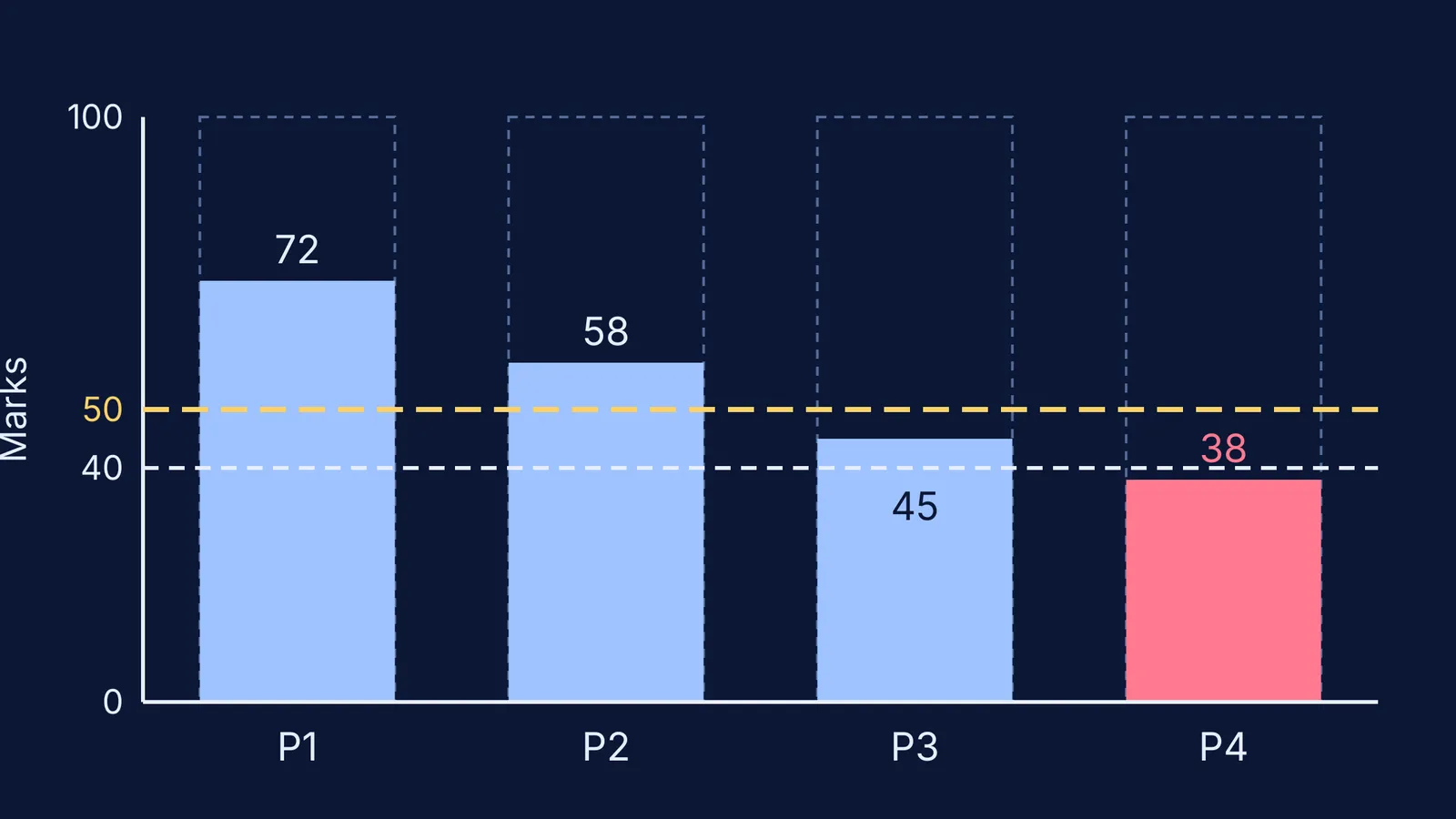
Eligibility is Class 12 (or equivalent), and the BCI may set a minimum of not below 45% of total marks for general-category applicants and 40% for SC and ST applicants. Meeting it does not guarantee a seat; colleges add their own criteria.
You must attend at least 70% of classes in a subject to sit its end-semester test. The Dean or Principal can make an exception if you attended at least 65% in that subject and 70% across all subjects.
There is no lateral exit.
Which subjects will you study in each?
At NLU Jodhpur, which offers both, the BA LLB "interweaves a plethora of Humanities and Social Science courses", including public policy, macro and microeconomics, international relations, governance and sociocultural change. Its BBA LLB courses "cover a cornucopia of topics of contemporary managerial relevance" and build towards business laws.
The same page lists 130 BA LLB seats and 66 BBA LLB seats, so BA LLB is the larger intake there.
Not every National Law University offers both. At NLSIU Bengaluru, the five-year law degree is the BA LLB (Hons). First-year students take a common core drawing on law, politics, philosophy, history, sociology, anthropology and literature, then choose a major in history, economics, politics, or sociology and anthropology.
Which careers does each degree fit?
Both end in the same LLB, so neither closes a door: a BA LLB graduate can do corporate law, and a BBA LLB graduate can argue in court. The first degree changes what feels familiar early on.
BA LLB suits you if you like reading, arguing about how society works, and writing. It lines up with litigation, constitutional and criminal law, public policy, human rights and research.
BBA LLB suits you if you like how companies run and numbers in a business context. It lines up with corporate and commercial law, compliance, contracts and in-house legal teams.
A seven-question checklist: is BA LLB or BBA LLB better after 12th?
Questions 1 to 3 test your interest. Answer each with A (BA) or B (BBA):
Which Class 11-12 subject did you choose to read about when no test was coming: history or politics (A), or business studies, accounts or economics of firms (B)?
Would you rather write a long essay (A) or build a spreadsheet model (B)?
Does a court case (A) or a company merger (B) make you more curious?
Questions 4 to 7 are practical checks:
Which campuses on your list offer the BBA LLB at all? If none, the choice is made.
At each college, which programme has more seats in your category?
Have you read one first-year course list for each degree on the college website?
Which fourth-year elective can you picture choosing, and which degree leads to it?
Three of the same letter is a clear lean. A 2-1 split means either will work; let seats, campus and course lists decide.
The Consortium of National Law Universities has fixed CLAT 2027 for Sunday, 6 December 2026, from 2 pm to 4 pm; applications closed on 31 October 2026. Check its site for counselling rules.
A worked example: how one student might decide
Ananya (a made-up student) is in Class 12 commerce and enjoys debates. Ananya's first three answers read A, B, A: a mild lean towards BA. Ananya's first-choice NLU offers both, so BA LLB goes first and BBA LLB second at that campus, keeping both options alive.
If you are a science student weighing law alongside boards, read how to prepare for CLAT from the science stream. If you plan to sit more than one test, see how AILET and CLAT differ. And if boards maths or physics is the worry eating your prep time, Fermi's AI tutor can work out what you already know and build a plan for the session, so the hours you save go to law prep.
Fill in the checklist with a parent before you lock your preferences.