

On this page
Every year, many Class 11 and 12 students taking Physics, Chemistry, and Mathematics (PCM) or Biology (PCB) realize their core interests lie outside engineering or medicine. Wondering whether switching to law is feasible without repeating a year, many ask if a science background puts them at a disadvantage.
The answer is that science stream students are fully eligible for premier law admissions in India. The Common Law Admission Test (CLAT), administered by the Consortium of NLUs, evaluates comprehension, logic, and analytical aptitude rather than prior legal knowledge. In practice, analytical habits built in science subjects provide distinct strengths in modern law entrance exams.
Can science stream students appear for CLAT?
The Consortium of NLUs imposes no stream restrictions for the Undergraduate CLAT (CLAT UG). Students from PCM, PCB, commerce, or humanities take the same test:
Qualifying examination: Candidates must have passed or be appearing for Class 12 (10+2) from any recognized board. There is no upper age limit.
Minimum marks: General, OBC, PwD, and NRI candidates require at least 45% aggregate marks in Class 12; SC and ST candidates require 40%, as stipulated in the official Consortium of NLUs guidelines.
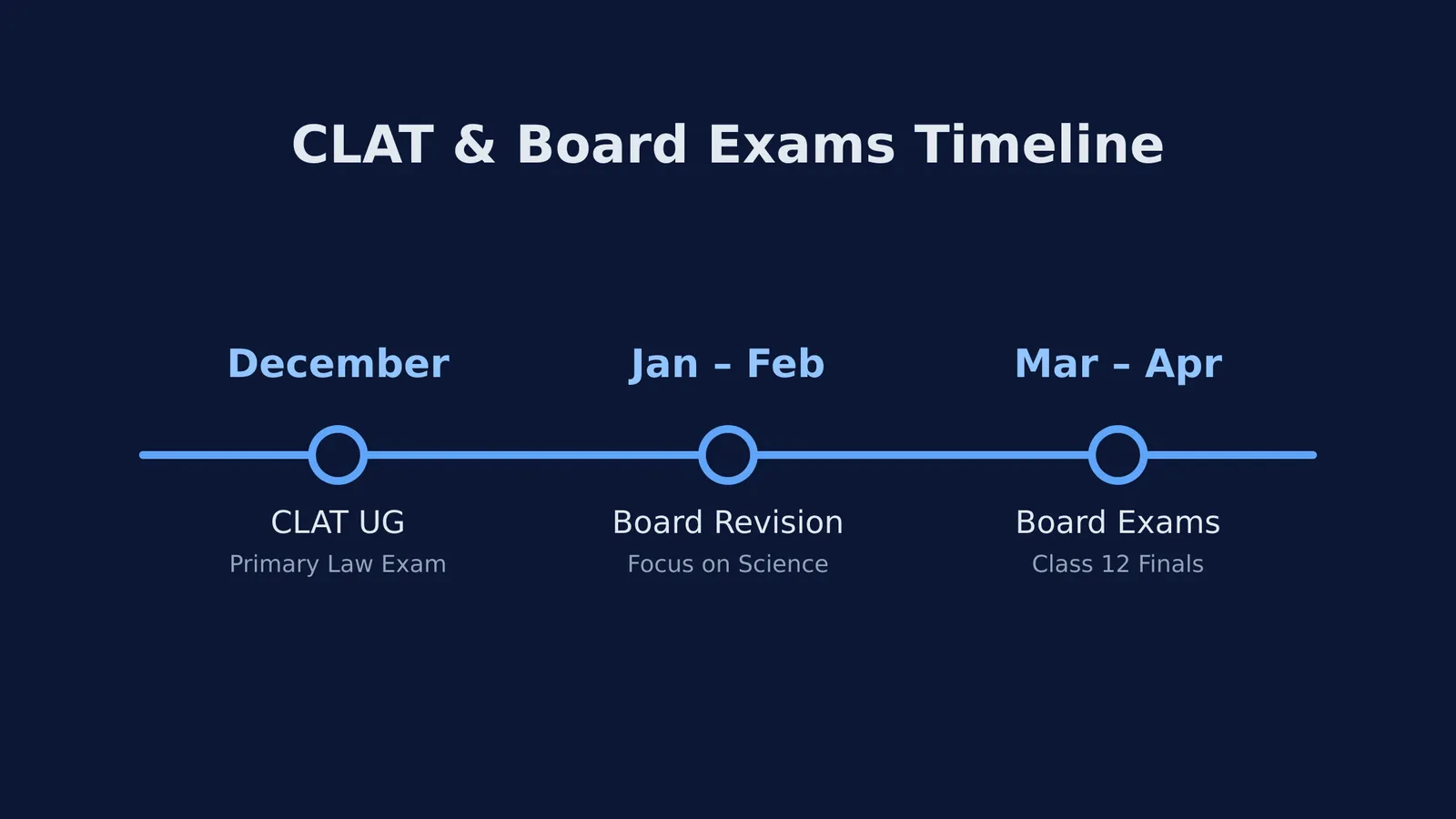
Class 12 board timeline: If you sit for your board exams in March or April, you remain eligible to appear for CLAT in December, presenting proof of qualifying marks during admission counselling.
A competitive score unlocks admission across 26 National Law Universities for five-year integrated programs, including B.A. LL.B. (Hons.), B.B.A. LL.B. (Hons.), and science-tailored B.Sc. LL.B. (Hons.) tracks.
What does the CLAT UG exam test?
The official Consortium of NLUs syllabus outlines a 2-hour offline test containing 120 multiple-choice questions for 120 marks. Each correct response earns 1 mark, with a 0.25 mark penalty for wrong answers.
The paper tests reading comprehension and reasoning across five sections:
English Language (22–26 questions, ~20%): Passages of roughly 450 words testing comprehension, vocabulary, and inference.
Current Affairs and GK (28–32 questions, ~25%): Passages drawn from journalistic and non-fiction sources covering contemporary national and global events.
Legal Reasoning (28–32 questions, ~25%): Fact scenarios paired with legal principles. The Consortium of NLUs confirms no prior legal knowledge is required; candidates apply the supplied rule to the facts.
Logical Reasoning (22–26 questions, ~20%): Passages of about 300 words testing argument structure, assumptions, and conclusions.
Quantitative Techniques (10–14 questions, ~10%): Caselets and data interpretation based on Class 10 arithmetic.
What advantages do PCM and PCB students have in CLAT?
According to the test structure established by the Consortium of NLUs, science training offers two specific advantages:
Quantitative Techniques score buffer: Non-mathematics students frequently struggle with data interpretation or skip it. Science students who handle calculations daily can reliably secure a strong score in this section. In an exam where fractions of a mark determine cutoffs, this provides a vital rank buffer.
Deductive rigor: Legal reasoning is not an argumentative essay; it is an exercise in rule application. Science students trained to apply physical laws to boundary conditions readily treat legal rules as given axioms, avoiding personal bias.
The primary hurdle is reading volume. The Consortium of NLUs question paper contains dense prose. Students accustomed to compact formulas must train to read quickly.
Which law degrees and career paths suit science graduates?
While science students can join standard B.A. LL.B. programs, several NLUs offer specialized five-year B.Sc. LL.B. (Hons.) degrees:
GNLU Gandhinagar: Offers a B.Sc. LL.B. (Hons.) exclusively for students with 10+2 science.
WBNUJS Kolkata: Provides a B.Sc. LL.B. (Hons.) in Criminology and Forensic Science.
NLIU Bhopal: Runs a B.Sc. LL.B. (Hons.) specializing in Cyber Security.
Pairing scientific literacy with law creates valuable techno-legal expertise. Under Section 126 of The Patents Act, 1970, registering as a patent agent before the Indian Patent Office requires a degree in science, engineering, or technology. Science-trained lawyers also drive corporate practices in pharmaceutical regulation, artificial intelligence governance, data privacy, and environmental compliance.
How can you prepare for CLAT alongside Class 12 board exams?
Preparing for CLAT alongside Class 12 boards requires disciplined time management rather than exhausting schedules.
Drawing on entrance schedules from the Consortium of NLUs, a consistent weekly budget is sufficient:
Daily reading: Read the editorial page of a national daily like The Hindu or The Indian Express to build Current Affairs knowledge and reading pace.
Weekday practice: Solve Legal and Logical Reasoning passages, applying weekly time blocking for school and exam prep to preserve science revision hours.
Weekend timed mock: Take one 2-hour mock test under timed conditions, spending time logging errors.
To keep board preparation efficient, use tools that focus on reasoning. The Fermi Problem Library provides worked problems with a step-by-step solver that explains the reasoning rather than printing an answer, helping you resolve science questions without delay. For unfamiliar topics, the Fermi Concept Library covers every concept in physics, chemistry, biology, mathematics and computing, each with its own lesson and its place in the map.
By building a sustainable study routine and balancing Class 12 board exams with competitive entrance preparation, science students can turn their analytical skills into a strong law school rank.


