On this page
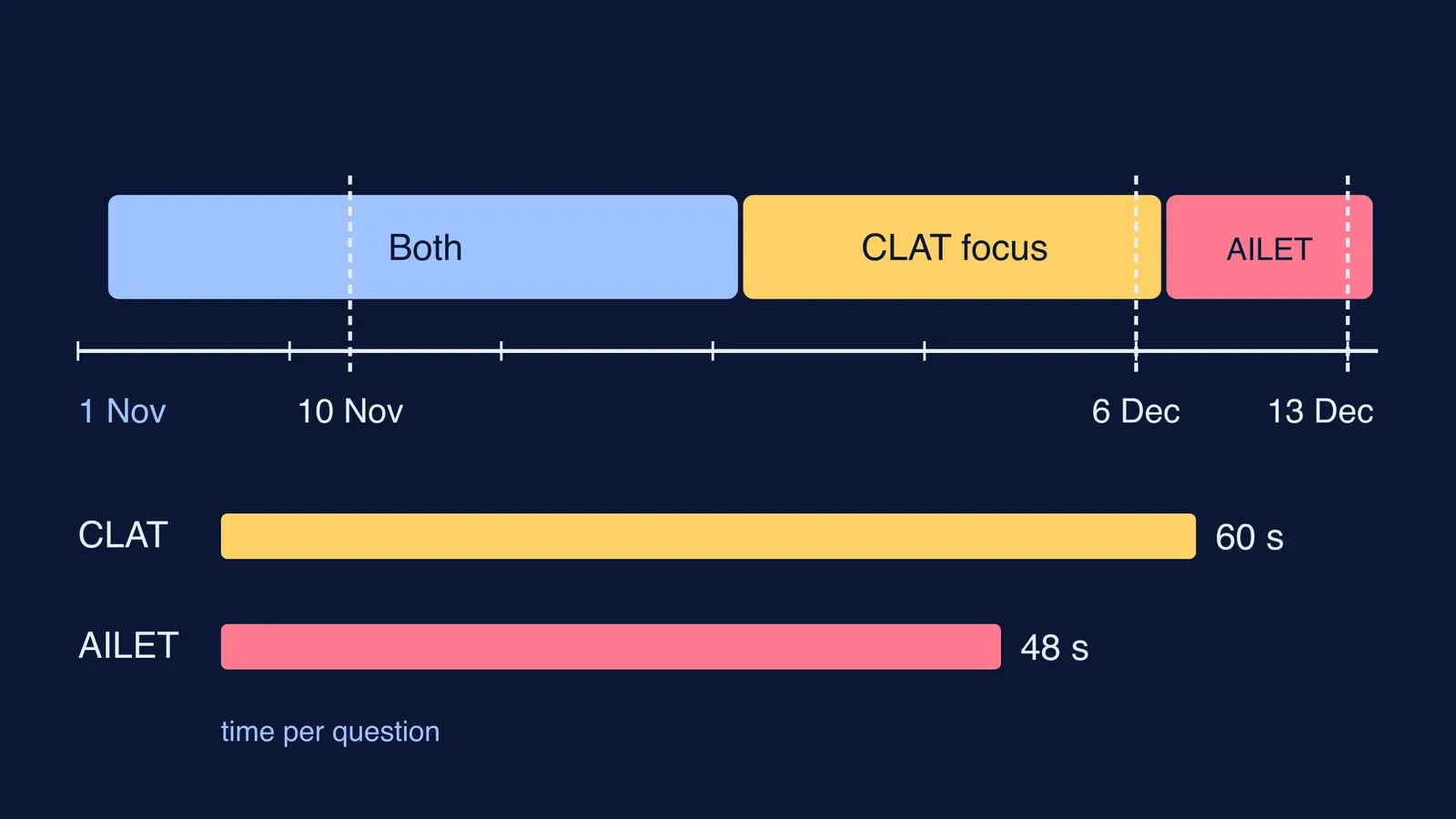
If you are taking both big law entrance tests this winter, they are one week apart. CLAT 2027 is on Sunday 6 December 2026, from 2 to 4 pm, according to the Consortium of NLUs press release. Its application window closed on 31 October, so this plan is for students who have already applied. AILET 2027 is on Sunday 13 December 2026, also from 2 to 4 pm, according to NLU Delhi's admission announcement, and its online form is open until 10 November 2026. That leaves six weeks from today to prepare for both without doing everything twice.
How is AILET different from CLAT?
The two papers look alike. Each is a two-hour multiple-choice test that takes 0.25 marks off for a wrong answer. CLAT's rule is in the CLAT 2027 UG syllabus. For AILET it is in NLU Delhi's instructions to AILET 2026 candidates, which also say answers are marked on an OMR sheet in ballpoint pen. Three differences change how you prepare:
Pace. CLAT 2027 has 120 questions in 2 hours, according to the CLAT 2027 UG syllabus, which is one minute a question. The B.A.LL.B. paper in AILET 2026 had 150 questions, according to NLU Delhi's final answer key, which is 48 seconds a question.
Sections. CLAT has five: English, current affairs, legal reasoning, logical reasoning and quantitative techniques. Guides such as Careers360's AILET pattern page list three for AILET: English (50 questions), current affairs and general knowledge (30) and logical reasoning (70). That guide puts legal reasoning inside logical reasoning, and there is no maths section. Before you start, confirm the pattern on the AILET website.
Seats. AILET fills 110 B.A.LL.B. seats on AILET merit, according to NLU Delhi's admission announcement. That is one university, not a consortium.
Is AILET harder than CLAT?
Neither body publishes a difficulty rating, so be wary of anyone who gives you one. AILET gives you 20% less time per question: 48 seconds against 60, from the 150 questions in NLU Delhi's AILET 2026 answer key and the 120 in the CLAT 2027 UG syllabus, each paper lasting two hours. It also admits to a single university's seats. Mostly, "harder" means faster, and pace can be trained.
What can you prepare once for both papers?
English reading, current affairs and logical reasoning are in both papers, so most of your hours count twice. In CLAT, every section except maths is built on passages of about 450 words, and the English passages are pitched so that a Class 12 student can read one in about 5 to 7 minutes, according to the CLAT 2027 UG syllabus. CLAT's logical reasoning asks you to find an argument's premises and conclusion, and in the Careers360 breakdown logical reasoning is also AILET's largest section.
Only quantitative techniques is clearly for CLAT alone. It uses 10th standard maths: ratios and proportions, basic algebra, mensuration and statistical estimation. CLAT's separate legal reasoning section also needs its own practice, though the syllabus says it needs no prior knowledge of law.
If ratios or statistics feel rusty, the Fermi Concept Library has its own lesson for every mathematics concept, so you can patch one gap and move on.
A six-week plan for CLAT and AILET together
Weeks 1 to 3 (2 to 22 November), the shared base. Every day: one English passage set, 30 minutes of the newspaper with a one-line note per story, and one logical reasoning set. On alternate days, add a legal reasoning set or a quantitative techniques set. Sit one full mock each week, alternating CLAT and AILET.
Before 10 November, check that your AILET form is submitted.
Weeks 4 and 5 (23 November to 6 December), CLAT focus. Sit two timed CLAT mocks a week. For every mistake, write down whether it was reading, reasoning or a rushed guess.
Week 6 (7 to 13 December), the AILET switch. Drop maths practice. Sit two AILET-length mocks of 150 questions in 120 minutes, the length of the 2026 paper, and revise your current affairs notes.
Should you guess when there is negative marking?
Both papers give +1 for a right answer and take 0.25 off for a wrong one, according to the CLAT 2027 UG syllabus and NLU Delhi's AILET instructions, whose sample answer sheet shows four options. For a four-option question:
Blind guess: 1/4 x 1 minus 3/4 x 0.25 = +0.06 marks on average.
One option ruled out: 1/3 x 1 minus 2/3 x 0.25 = +0.17.
Two options ruled out: 1/2 x 1 minus 1/2 x 0.25 = +0.38.
So a blind guess is worth almost nothing, but a guess after ruling out two options is worth more than a third of a mark. In AILET, where every second counts, mark those and move on.
Pick your first mock date today and write it at the top of the plan.