On this page
The entry test for India's Company Secretary course changed in 2026. The CSEET moved from a remote-proctored online test to four offline exams at test centres, and three of the four papers now need written answers, as Free Press Journal reported when the Institute of Company Secretaries of India (ICSI) announced the change in November 2025. If you are in Class 12 or have just finished it, here is the route, the new pattern and a plan you can follow.
What are the stages of the CS course after Class 12?
The CS qualification is run by ICSI, and from Class 12 the path has four parts:
CSEET. Indian nationals who have passed Class 12, or are appearing for it, can register (Free Press Journal). Graduates and holders of some other qualifications are exempt.
Executive Programme. Two modules of papers, with exams in June and December (Careers360). Under the 2022 syllabus each paper carries 100 marks, and the papers cover company law, securities law, tax, labour law and corporate accounting (CA Test Series).
Training. After the Executive stage comes a one-month Executive Development Programme, then 21 months of full-time practical training, then a Corporate Leadership Development Programme (Taxmann).
Professional Programme. The final exam level, open once both Executive modules are cleared (Careers360).
What is the CSEET exam pattern now?
The restructured CSEET has four papers of 100 marks each, according to Careers360's guide to the June 2026 session:
Paper 1, Business Communication: written answers, 3 hours.
Paper 2, Fundamentals of Accounting: written answers, 3 hours.
Paper 3, Economic and Business Environment: written answers, 3 hours.
Paper 4, Business Laws and Management: multiple choice on an OMR sheet, 2 hours, with no negative marking (Free Press Journal).
The CSEET is held three times a year, in February, June and October. Registration costs Rs 7,500 and the exam fee is Rs 1,500 per session, according to Free Press Journal. Each paper is held on a separate day (Careers360).
How do you pass the CSEET?
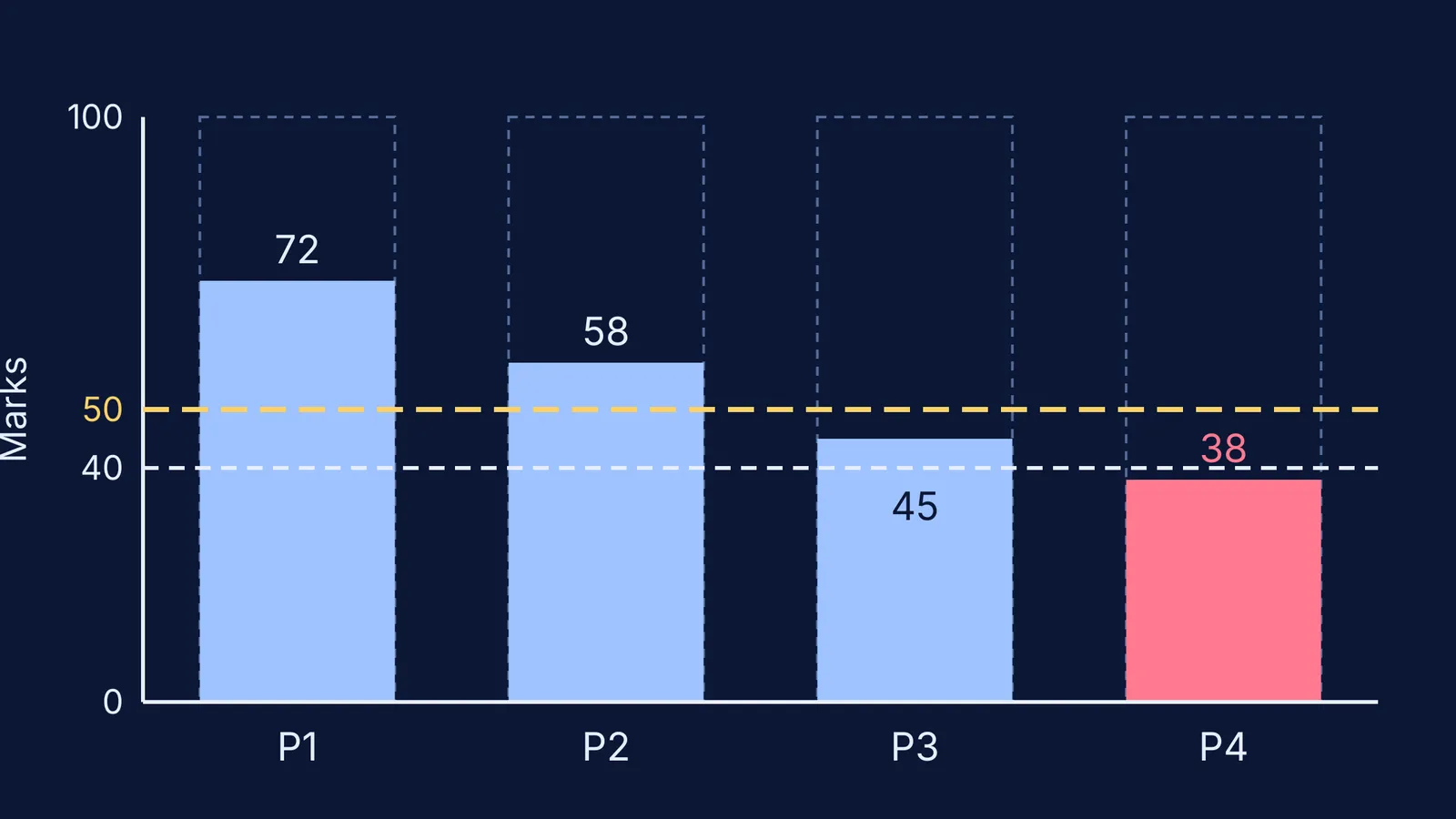
To pass, you need at least 40% in every paper and at least 50% across all four, in one sitting (Free Press Journal). Marks do not carry forward between sessions (Careers360). Two made-up results show why both halves of the rule matter:
Riya scores 72, 58, 45 and 38. Her total is 213 out of 400, or 53.25%, but she fails because Paper 4 is below 40.
Arjun scores 45, 42, 48 and 60. Every paper clears 40, but his total is 195, or 48.75%, so he misses the aggregate.
So you cannot give up on any paper, and you need one or two strong ones to lift the total.
What is a realistic CSEET study plan?
This plan assumes 16 weeks, about two hours on weekdays and four on weekend days, which fits alongside college or Class 12. Weight it by the marks: in Paper 3, economics and the business environment carry 50 marks each, and in Paper 4, law carries 60 and management 40 (iProledge).
Weeks 1 to 2: Read the official syllabus. Attempt one sample paper per subject, untimed, and list your weak topics.
Weeks 3 to 8: Learn. Do accounting every weekday, because it is a practice subject. Give economics three days a week, law and management two, and write one business communication piece each weekend.
Weeks 9 to 12: Practise. Write full answers by hand against a 3-hour clock, and do OMR sets for Paper 4.
Weeks 13 to 15: One full mock per paper each week, on four separate days, as in the real exam. Score each mock against the 40% and 50% rule.
Week 16: Revise only your mistakes, sleep properly, and check your admit card and centre.
Science or commerce: what should you change?
Science students start with no accounting. The paper includes recording transactions, depreciation, final accounts, and partnership and company accounts (iProledge), so build up in that order: journal, ledger, trial balance, then final accounts. Your maths helps with percentages and graphs in economics. If ratios or reading a curve feel shaky, the Fermi Concept Library has a lesson on every concept in mathematics.
Commerce students have seen accounts and economics, so the risk is the writing. Business Communication tests grammar, vocabulary, comprehension and business correspondence (same source). Write one letter or email a week and ask a teacher to mark it.
Your next step: open icsi.edu, confirm the registration deadline for the next session, and put week 1 of this plan in your calendar.