On this page
Stand between two mirrors in a salon or a lift and you see a corridor of copies on both sides. Board and JEE questions turn that corridor into numbers: where is the third image, and how far apart are they?
Why do two parallel mirrors form infinite images?
A plane mirror forms an image as far behind it as the object is in front of it, which OpenStax University Physics writes as do = −di.
With two mirrors, the image in the first mirror can act as an object for the second mirror, as the same OpenStax chapter on plane mirrors explains. When the mirrors face each other in parallel, every new image sits in front of the other mirror, so it gets reflected again. The chain has no last step, so there is no last image. In practice each reflection loses a little light, so far images fade from view.
How do you find the position of each image?
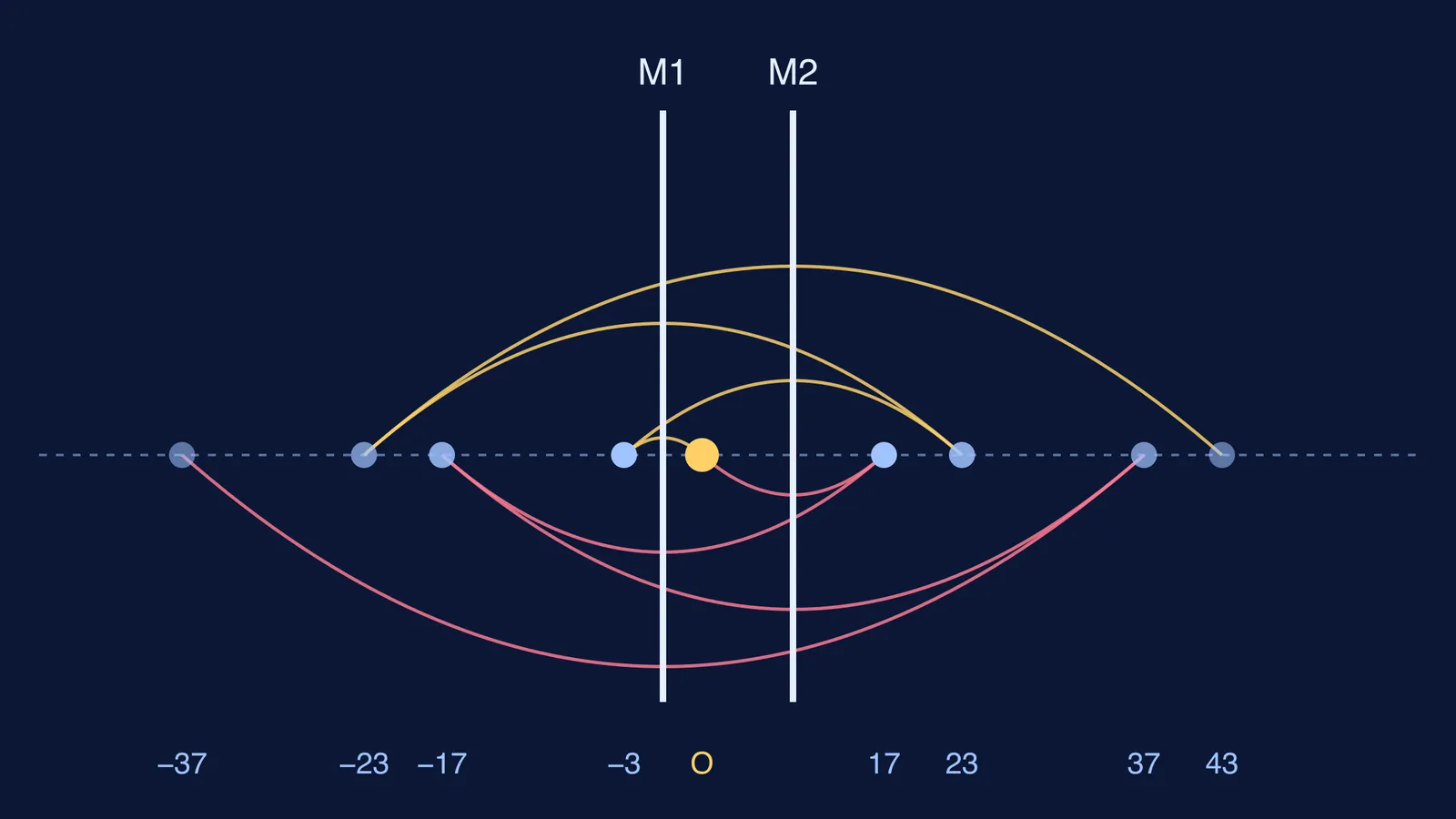
Set-up: two plane mirrors, M1 and M2, face each other 10 cm apart. A small object O is 3 cm from M1, so it is 7 cm from M2. Measure everything from M1, positive towards M2: M1 is at 0, M2 at +10 cm, O at +3 cm.
One rule does all the work. Reflecting in M1 (at 0) sends a point at x to −x. Reflecting in M2 (at 10) sends x to 20 − x. Each step, the previous image is the new object.
Chain A, where light meets M1 first:
O at +3 reflects in M1: image at −3, 3 cm behind M1.
That image is 13 cm in front of M2, so M2 puts it 13 cm behind: 20 − (−3) = +23.
+23 reflects in M1: −23.
−23 reflects in M2: +43.
+43 reflects in M1: −43.
Chain B, where light meets M2 first:
O at +3 reflects in M2: 20 − 3 = +17, 7 cm behind M2.
+17 reflects in M1: −17.
−17 reflects in M2: +37.
+37 reflects in M1: −37.
Now sort the images by side:
Behind M1: −3, −17, −23, −37, −43 and onwards, that is 3, 17, 23, 37 and 43 cm behind M1.
Behind M2: +17, +23, +37, +43 and onwards, that is 7, 13, 27 and 33 cm behind M2.
The first image on each side needs one reflection, the second needs two, the third needs three. That is why the nearer images look brighter.
What is the spacing between images in parallel mirrors?
In general, take mirrors d apart and an object a from M1. Every image lies at x = 2nd ± a, where n is any whole number (n = 0 with the plus sign is the object itself). With d = 10 and a = 3 you get exactly the list above.
That gives the spacing on each side at a glance:
Gaps between neighbouring images alternate between 2a and 2(d − a). Behind M1: 14 cm, 6 cm, 14 cm. Behind M2: 6 cm, 14 cm.
Measured from the object, images behind M1 are 6, 20, 26 and 40 cm away; those behind M2 are 14, 20, 34 and 40 cm away.
If the object is exactly midway (a = d/2), both gaps equal d and the images are evenly spaced: with d = 10 cm they sit at −5, ±15, ±25 and onwards.
All of these images are virtual: they lie behind a mirror, where no light actually goes. For more on that, see our explainer on whether a plane mirror can form a real image.
How does this connect to the 360/θ − 1 formula?
For two mirrors inclined at an angle θ, the image count is worked out from n = 360/θ (n − 1 images when n is an even whole number), as our post on the number of images between two inclined mirrors shows. As θ shrinks towards zero, 360/θ grows without limit. The formula does not cover θ = 0 itself, but the trend fits the endless chain above.
To revise the single-mirror rules underneath all this, the Fermi Concept Library gives every physics concept its own lesson and its place in the map.
Which mistakes cost marks here?
Measuring from the wrong mirror. Each step's object distance is measured from the mirror doing the reflecting.
Reflecting in the same mirror twice in a row. That only returns the point you started from.
Assuming equal spacing. It holds only at the midpoint.
Mixing up chains. Keep the M1-first and M2-first lists separate before sorting by side.
If your numbers drift at step 2 or 3, the Fermi Problem Library has worked problems with a step-by-step solver that explains the reasoning rather than printing an answer, so you can see which distance went wrong.