On this page
Kinetic theory questions in JEE Main and school exams love one small trap: three different "speeds" for the same gas, all with nearly the same formula. Here is how they compare and how to remember the order.
What is the ratio of most probable, average and rms speed?
All three speeds come from the Maxwell-Boltzmann distribution of molecular speeds, and OpenStax University Physics Volume 2 derives each one from it:
Most probable speed: vmp = √(2RT/M), the speed at the peak of the curve.
Average (mean) speed: vavg = √(8RT/πM).
Root mean square speed: vrms = √(3RT/M).
Here R is the gas constant, T the absolute temperature and M the molar mass in kg/mol. Since RT/M is common to all three, it cancels in the ratio:
vmp : vavg : vrms = √2 : √(8/π) : √3 ≈ 1.414 : 1.596 : 1.732 ≈ 1 : 1.128 : 1.225.
Try it on nitrogen (M = 0.028 kg/mol) at 300 K, using R = 8.314 J mol⁻¹ K⁻¹ from NIST's CODATA value of the molar gas constant. RT/M comes to about 89,080 m²/s², so vmp ≈ 422 m/s, vavg ≈ 476 m/s and vrms ≈ 517 m/s. Divide each by 422 and you get back 1 : 1.13 : 1.22.
Where do the three speeds sit on the Maxwell curve?
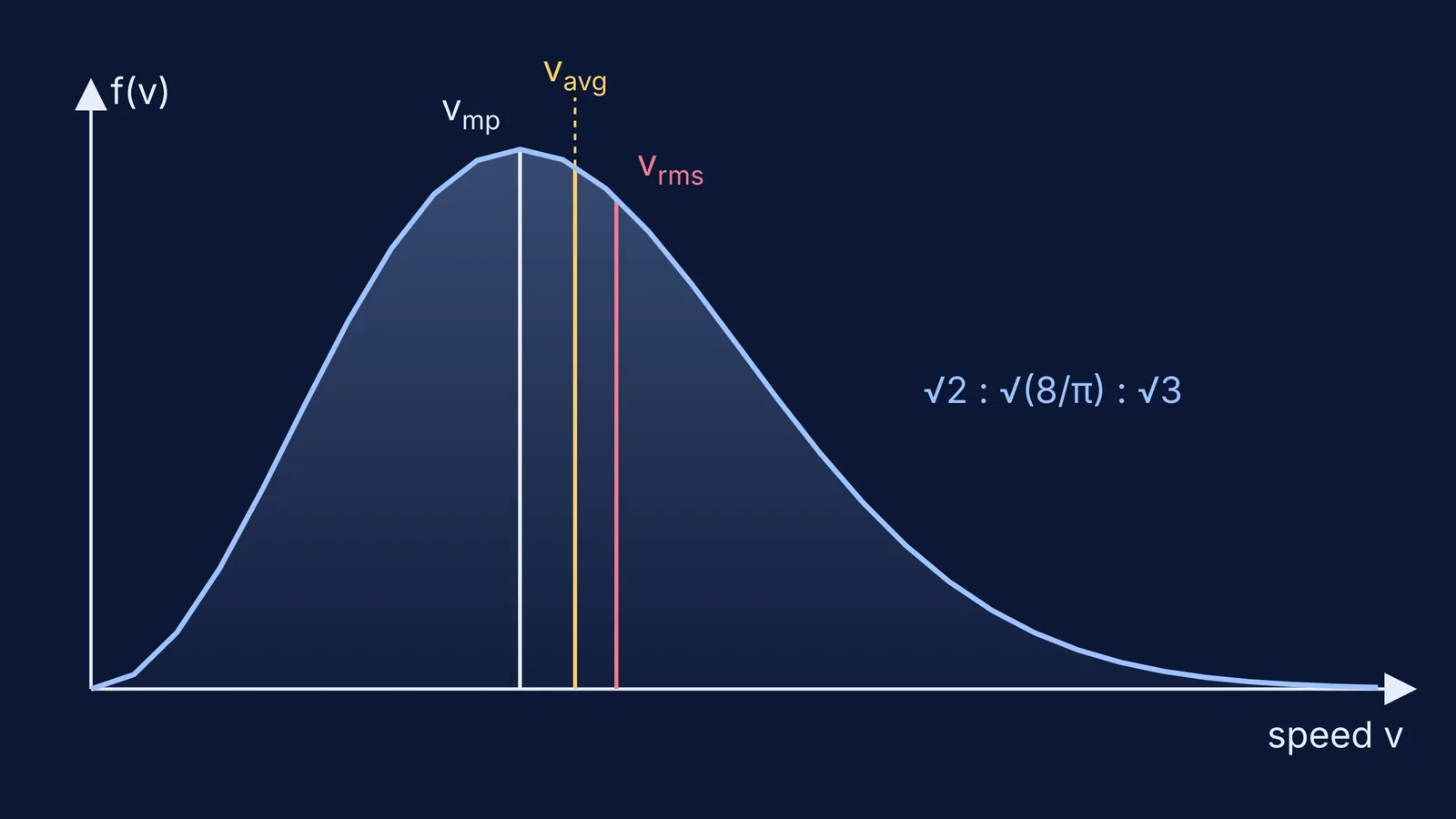
The Maxwell speed curve rises from zero, peaks, then falls away slowly with a long tail towards high speeds. The OpenStax chapter states that the most probable speed is the speed at the peak, and that the rms speed is greater than both the most probable and the average speed.
So, reading the curve from left to right:
vmp at the peak, where the most molecules are.
vavg a little to the right of the peak.
vrms further right still.
The hero diagram above draws this curve to scale, with the three lines placed at 1, 1.128 and 1.225 times vmp. If you want to watch the whole curve flatten and shift right as the gas heats up, our post on the Maxwell speed distribution graph shows it in a simulation.
Why is the average speed bigger than the most probable speed?
The curve is lopsided. On the left it is cut off at zero, because no molecule can have a negative speed. On the right there is a long tail of fast molecules. Those few fast molecules pull the average to the right of the peak, the way one very high salary pulls up the average income of a small office.
The rms speed goes further because of the squaring. You square every speed before averaging, so fast molecules count for much more. Squaring 2 gives 4, but squaring 4 gives 16. That is why vrms always beats vavg. The same formula explains why hydrogen's rms speed is four times oxygen's at the same temperature: in the OpenStax formula vrms = √(3RT/M), only M changes, and √(32/2) = 4.
Worked example: six molecules you can count
Suppose a tiny "gas" has six molecules with speeds 1, 2, 2, 2, 3 and 4 km/s. Find vmp, vavg and vrms.
Most probable speed: the speed most molecules have. Three molecules move at 2 km/s, so vmp = 2 km/s.
Average speed: add and divide by the number. (1 + 2 + 2 + 2 + 3 + 4)/6 = 14/6 ≈ 2.33 km/s.
Rms speed: square, average, then take the root. Squares are 1, 4, 4, 4, 9, 16, which add to 38. 38/6 ≈ 6.33, and √6.33 ≈ 2.52 km/s.
The order matches the curve: 2 < 2.33 < 2.52.
One warning for small sets like this. The rms speed is always at least the average (it is equal only when every molecule has the same speed). But the most probable value is not always the smallest. For speeds 1, 4 and 4, the mode is 4, the average is 3 and the rms is √11 ≈ 3.32. The rule vmp < vavg < vrms is a property of the Maxwell curve for a real gas, not of every list of numbers. If an exam gives a list, calculate each one; do not assume the order.
If you keep slipping on steps like squaring before averaging, the Fermi Problem Library has worked problems with a step-by-step solver that explains the reasoning rather than printing an answer.
How do you remember the order in an exam?
Look only at the number under the root sign in the OpenStax formulas: 2, then 8/π, then 3. Since π is about 3.14, 8/π is about 2.55, which sits between 2 and 3. So the order is fixed by 2 < 2.55 < 3.
If the idea of a distribution of speeds still feels shaky, start with our overview of kinetic theory, rms speed and degrees of freedom, or look up kinetic theory in the Fermi Concept Library, where each concept has its own lesson and its place in the map.