

On this page
Most physics textbooks start optics chapters with a strict, straightforward rule: plane mirrors and convex mirrors always form virtual images. When you look at your reflection in a bathroom mirror or check a car's convex side mirror before changing lanes, the image appears to sit securely behind the glass. But in optics, the word 'always' usually comes with a hidden condition. If you change the nature of the light rays before they hit the surface, both of these mirrors are entirely capable of producing a real image.
The trick lies in how the light rays are behaving when they reach the mirror. Real objects emit diverging light, but optical systems can create converging light, changing the outcome entirely.
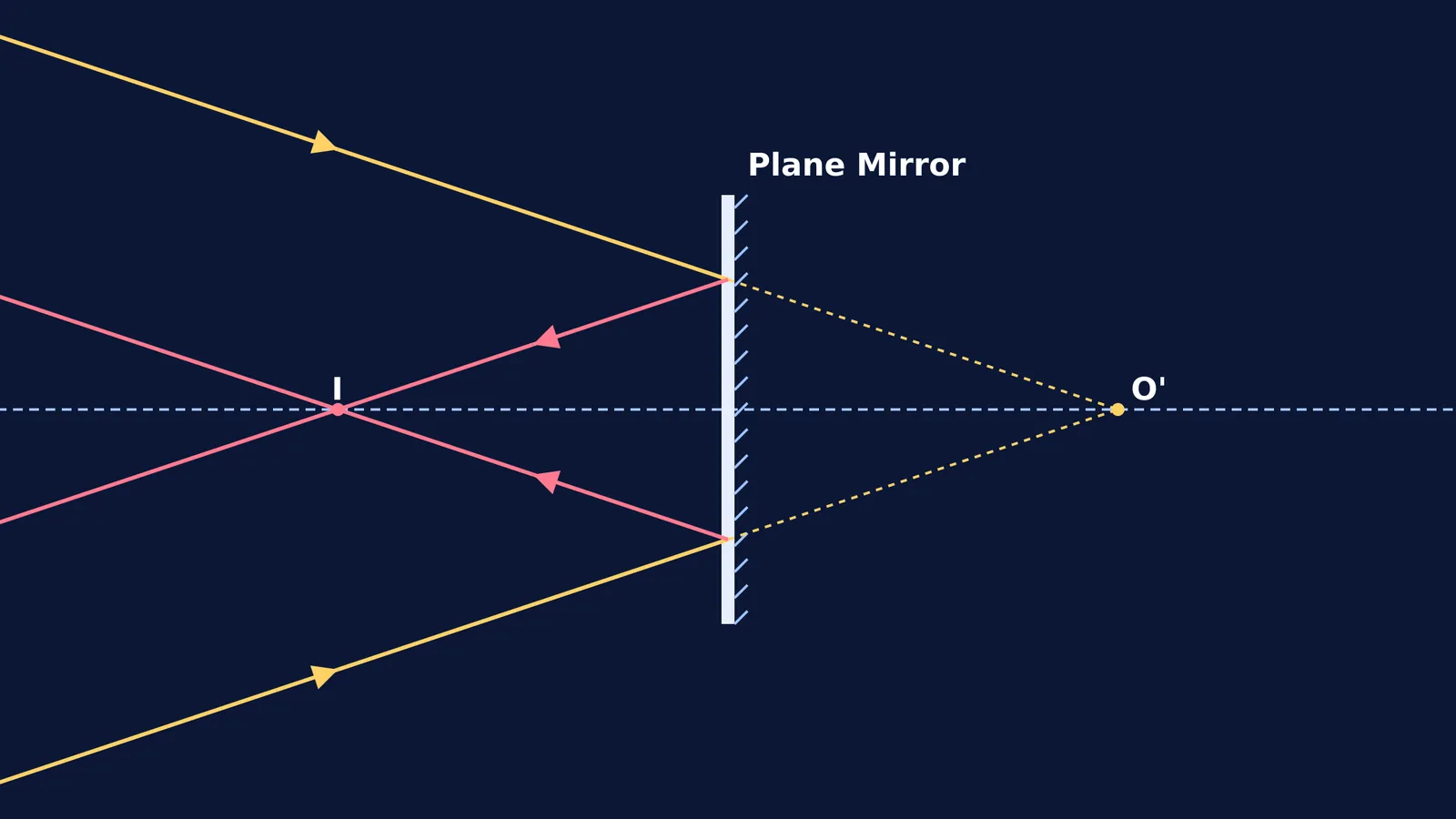
Can a plane mirror form a real image?
Yes. A plane mirror can form a real image, but only when the object is a virtual object.
To understand this, it helps to define what makes an image real or virtual. A real image is formed when light rays physically converge at a point, meaning it can be projected onto a screen. In contrast, a virtual image is formed when light rays only appear to diverge from a point behind the mirror and cannot be projected.
When you place a standard physical item—a real object—in front of a plane mirror, its light rays spread out (diverge) as they travel toward the glass. The mirror reflects them, and they continue to spread out in the surrounding room, never actually meeting. Your brain traces these diverging rays backward in straight lines, creating the illusion of a virtual image standing behind the glass.
However, if light rays are already converging when they strike the plane mirror, the geometry changes completely. The point where those incoming rays would have met if the mirror had not been in the way acts as a virtual object. The plane mirror bounces these converging rays back. Because the law of reflection preserves their inward angle, the rays physically intersect in front of the mirror. This exact intersection point is a real image, and if you placed a piece of paper there, you would see it clearly projected.
Can a convex mirror form a real image?
Yes, a convex mirror can also form a real image under similar conditions, though the mathematical requirements are slightly stricter.
A convex mirror is naturally designed to be a diverging mirror. It bulges outward toward the light source. When a real object sits in front of it, the mirror spreads the already-diverging light out even further. This guarantees a virtual, upright, and diminished image every single time—which is why they are used for wide-angle security mirrors and car side mirrors.
But if you direct converging rays at the convex mirror, you are providing it with a virtual object. The convex mirror will still try to spread these rays out, fighting against their inward path. Whether a real image forms depends on a competition between the incoming convergence of the rays and the mirror's natural divergence:
If the virtual object is closer than the principal focus: The rays are converging so sharply that the convex mirror cannot diverge them enough to separate them entirely. They still manage to meet in front of the mirror, successfully forming a real image.
If the virtual object is farther than the principal focus: The mirror's diverging power wins the battle. The rays reflect and spread apart, creating a virtual image behind the mirror.
How do converging rays create a virtual object?
How do you get converging rays in the first place? You cannot simply buy a 'virtual object' at a store and place it on a desk. They are created dynamically by placing another optical element, like a converging convex lens, in the path of the light before it reaches the mirror.
Imagine using a strong magnifying glass to focus bright sunlight onto a wall. The lens takes the parallel light from the sun and converges it toward a sharp focal point. If you slide a plane mirror into the light's path just before it hits the wall, the intended spot on the wall becomes your virtual object. The mirror intercepts these rays and redirects them to a new, physical meeting point in front of it.
This is a classic setup in entrance exam physics problems involving a lens and mirror set apart. In any multi-stage optical system, the image formed by the very first element automatically acts as the object for the second element.
Tracing rays through multiple elements is where sign conventions often trip students up. If you are struggling to picture where the rays go or whether an image should be real or virtual, the Fermi Concept Library holds a lesson for every concept in physics and its place in the map, so you can see exactly how the geometry works. You can also explore how these setups change in motion by calculating the velocity of an image in moving mirrors. By breaking the system into one element at a time, what seems like a trick question becomes a straightforward application of the rules.


