

On this page
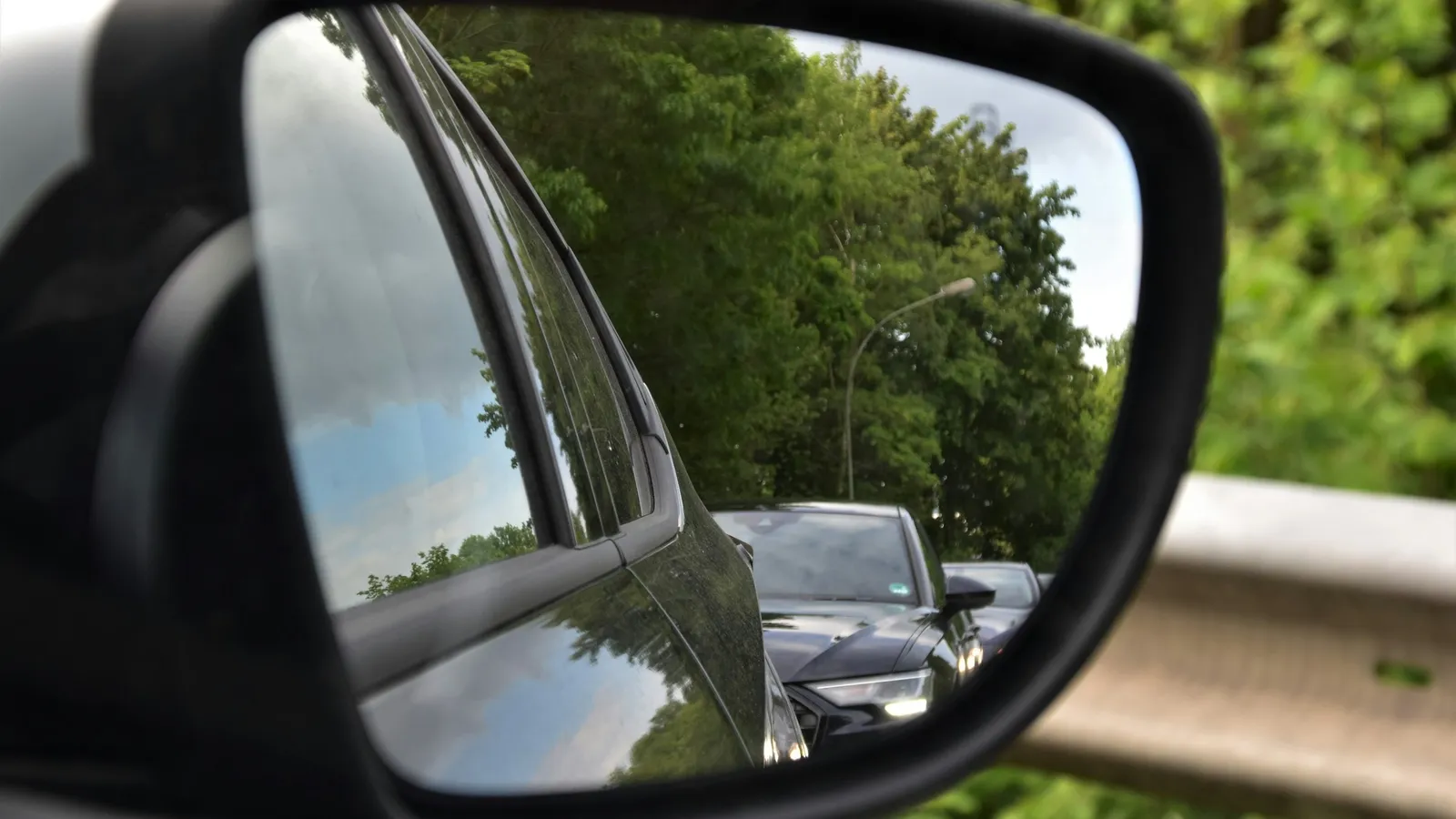
A car's side mirror shows a runner who barely seems to move at first, then rushes towards you as they get close. NCERT turns this into an example, and JEE turns it into questions about how fast an image moves. This post gives the plane-mirror rules, derives the result for spherical mirrors, and reworks NCERT's numbers to show the difference between average and instantaneous speed.
Where is this in the syllabus?
The JEE (Main) 2026 syllabus lists reflection, spherical mirrors and the mirror formula in Unit 16, and the JEE (Advanced) 2026 brochure lists reflection at plane and spherical surfaces. The NCERT chapter Ray Optics and Optical Instruments has the jogger problem as Example 9.4. Check your own exam year's syllabus.
How does an image move in a plane mirror?
A plane mirror's image is the object reflected through the mirror's surface. So, measured relative to the mirror:
the velocity component parallel to the mirror is the same for object and image;
the component perpendicular to the mirror is reversed.
If you walk towards a wall mirror at 1.5 m/s, your image walks towards the mirror at 1.5 m/s from the other side, so it approaches you at 3.0 m/s.
If the mirror moves instead, work in the mirror's frame first. A mirror moving at 0.5 m/s towards a person standing still makes the image move at 1.0 m/s in the ground frame, twice the mirror's speed.
What is the rule for spherical mirrors?
Start from the mirror equation in NCERT's sign convention, 1/v + 1/u = 1/f (Eq. 9.7), and differentiate with respect to time, keeping f fixed:
−(1/v²)(dv/dt) − (1/u²)(du/dt) = 0, so dv/dt = −(v²/u²)(du/dt).
Magnification is m = −v/u, so v²/u² = m². Therefore:
Along the axis: v_image = −m² × v_object.
The minus sign means that, along the axis, image and object always move in opposite directions in the coordinate frame. For motion perpendicular to the axis at a fixed distance, the image height is m times the object height, so
Across the axis: v_image = m × v_object.
Worked example 1: NCERT's jogger, reworked
A convex side mirror has R = 2 m, so f = +1 m. A jogger approaches at 5 m/s. NCERT finds the image positions one second apart and gets average image speeds of 1/280 m/s starting at 39 m and 1/10 m/s starting at 9 m.
Now use the instantaneous formula. For a mirror, m = f/(f − u).
At 39 m: m = 1/(1 + 39) = 1/40, so the image speed is 5 × (1/40)² = 1/320 m/s, about 3 mm/s.
At 9 m: m = 1/10, so the image speed is 5 × (1/10)² = 0.05 m/s, or 1/20 m/s.
At 4 m: m = 1/5, so the image speed is 5 × (1/5)² = 0.20 m/s.
NCERT's 1/10 m/s for the second starting at 9 m is an average: the jogger goes from 9 m to 4 m, and the instantaneous image speed climbs from 0.05 to 0.20 m/s over that second. The m² formula gives the speed at one instant; finding two positions gives the average over an interval. Both are correct for what they measure.
Worked example 2: a concave mirror
A concave mirror has f = −20 cm. An object 30 cm in front moves towards the mirror at 2 cm/s.
Image position: 1/v = −1/20 + 1/30 = −1/60, so v = −60 cm.
Magnification: m = −(−60)/(−30) = −2.
Along the axis: moving towards the mirror means du/dt = +2 cm/s. So dv/dt = −m² × 2 = −8 cm/s. The image moves away from the mirror at 8 cm/s.
If the object instead moves 1 cm/s upwards, perpendicular to the axis, the image moves at m × 1 = −2 cm/s, that is 2 cm/s downwards, because the image is inverted.
Which mistakes cost marks?
Using m instead of m² along the axis.
Losing the direction. Keep the signs from the Cartesian convention to the end.
Using ground-frame speeds when the mirror moves. Convert to the mirror's frame, apply the rule, then convert back.
Applying the derivative to a big jump. The m² result is instantaneous; over a finite interval, find both positions.
Mixing axial and sideways parts. Split the object's velocity into the two components first.
A practice routine
Day 1: Derive both rules from the mirror equation without notes.
Day 2: Redo the jogger at 29 m and 19 m, and compare with NCERT's averages of 1/150 and 1/60 m/s.
Day 3: Solve two moving-mirror problems in the mirror's frame.
Day 4: Do one problem with an object moving at an angle to the axis, then read our list of ray optics mistakes. For lenses and mirrors combined, see silvered lens problems.
Day 5: Take a mixed test. Dunlosky and colleagues (2013) rated practice testing and spaced practice as the most useful study techniques.
If the signs keep tangling, the Fermi Problem Library has worked problems with a step-by-step solver that explains the reasoning rather than printing an answer.
Next time you are in a parked car, watch a person approach in the side mirror and notice when the image starts to speed up.


