On this page
The shortcut most students learn for ray optics is that two mirrors at angle θ make 360/θ − 1 images. It is often right, but not always. To find where it breaks, run the experiment yourself: set an angle, place the object, count, and only then check the formula.
What is the formula for the number of images between two inclined mirrors?
V. M. Kulkarni, of Walchand College of Engineering, set out four rules that cover every case in the American Journal of Physics in 1960 (Kulkarni, Am. J. Phys. 28, 317). His abstract notes that no single formula holds for every angle. A Stony Brook University page on multiple reflections restates his rules in terms of 180/θ. Written with n = 360/θ, they come out like this:
n is an even whole number (90°, 60°, 45°, 30°): you get n − 1 images, wherever the object is.
n is an odd whole number (120°, 72°, 40°): you get n − 1 images if the object sits on the angle bisector, and n images anywhere else.
n is not a whole number (say 50°): the count depends on which part of the gap between the mirrors the object sits in, so there is no single answer.
So the shortcut is the even case. The odd case is the one to watch, because whether the object is placed symmetrically changes the answer. In 1971 the same journal returned to the question with a paper by An-Ti Chai, "The Number of Images of an Object between Two Plane Mirrors".
Why does the 360/θ − 1 rule work?
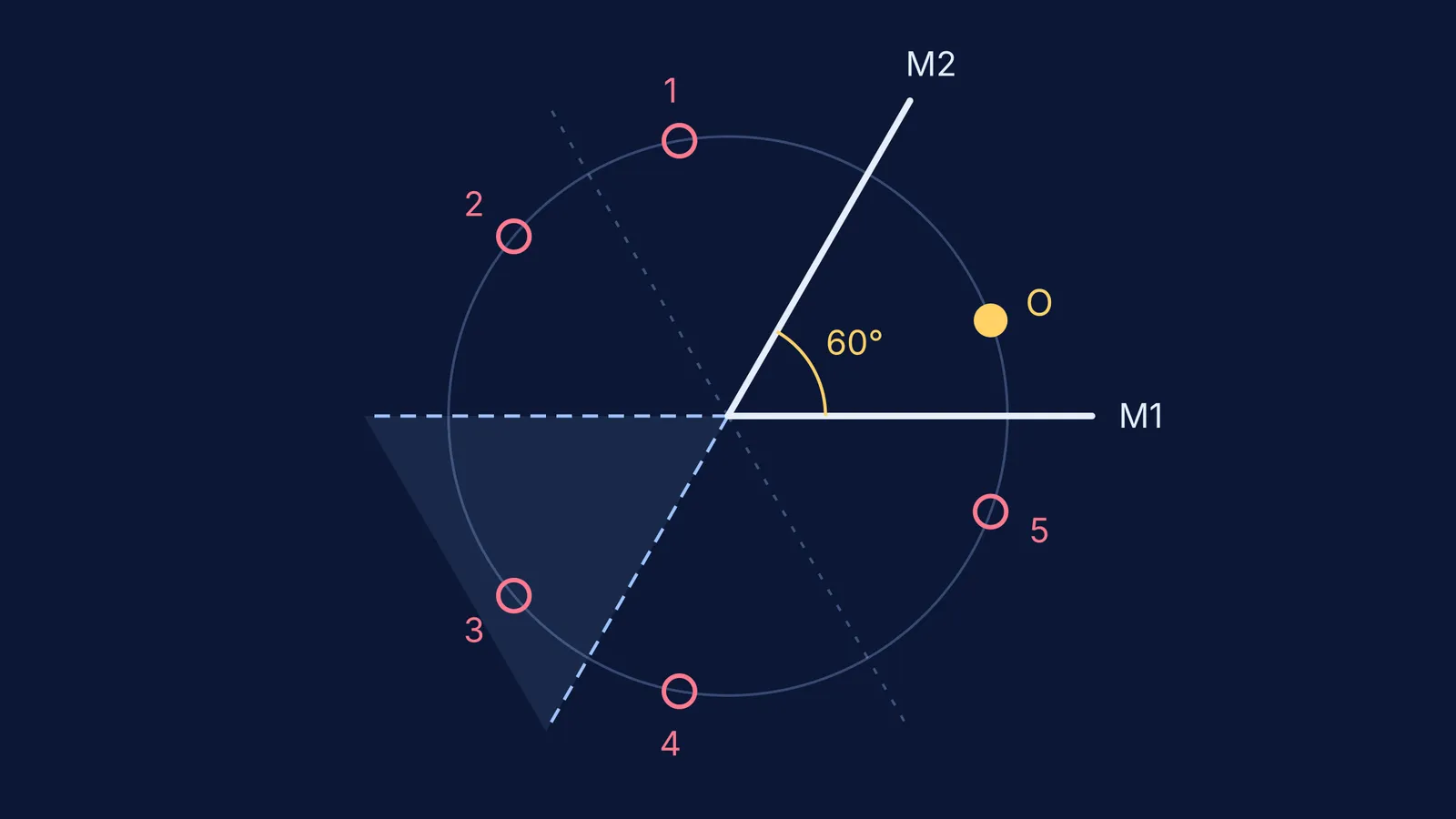
Every image sits on a circle through the object, centred on the hinge, and each new image is the last one reflected in the other mirror. Two chains of images start at once, one from each mirror, and run in opposite directions. Each chain stops when an image lands in the region behind both mirrors, between their extensions, where neither mirror can reflect it again. When n is even, that region is one of n equal slices around the hinge, and the two chains end at the same point in it, so the slices hold the object plus n − 1 images. When n is odd and the object is off-centre, the two final images fall at different points behind the mirrors, which gives one extra image.
Worked example: mirrors at 60°, object at 20°
Put mirror M1 along 0° and mirror M2 along 60°. Place the object 20° above M1. Here n = 6, so the rule predicts 5. Count them yourself:
Reflect in M1: the image is at −20°, which is 340°.
Reflect that in M2 (twice 60°, minus 340°): −220°, which is 140°.
Reflect that in M1: −140°, which is 220°. That is behind both mirrors (180° to 240°), so this chain stops.
Start the other chain. Reflect the object in M2 (120° − 20°): 100°.
Reflect that in M1: −100°, which is 260°. Reflect in M2: 120° − 260° = −140°, which is 220° again. The chains have met.
The distinct images are at 100°, 140°, 220°, 260° and 340°: five, as predicted. Now try 72° with the object at 20°. You will reach images at 124°, 164°, 196°, 236° and 340°. That is 5, equal to n, not n − 1. Move the object to 36°, the bisector, and you get 108°, 180°, 252° and 324°: 4.
How do you test it in a simulation or with two mirrors?
Predict first, write the number down, then count.
90°, object anywhere: predict 3.
60°, object anywhere: predict 5.
72°, object on the bisector: predict 4.
72°, object close to one mirror: predict 5.
50°: predict nothing yet. Move the object across the gap and note where the count changes.
With no simulation, use two pocket mirrors taped at the hinge, a protractor and a coin. Real mirrors are only so long, so images at the back can fall outside what your eye can see. If you count one fewer than predicted, move your head before deciding the rule is wrong.
A wrong prediction is the useful result, because it shows you which case you hadn't understood. That is the habit behind using an AI tutor with a physics simulation.
For ideas like this that are easier to see than to read, the Fermi Simulation Lab has interactive simulations. Stuck partway through a chain? Fermi's AI tutor can draw the figure and run the simulation with you, checking your understanding as it goes.
Where does this show up next?
The same slices explain the symmetric patterns in a toy: see how a kaleidoscope makes its patterns. For more practice in exam format, work through these multiple-image problems with inclined mirrors.
Tonight, pick one angle from the plan, write your prediction, and count.