

On this page
Physics simulations let you see invisible forces, but clicking sliders on a screen is not enough to master a concept. To actually change the way your brain understands physics, you need to commit to an answer before the simulation runs.
Combining an AI tutor with interactive simulations through a "Predict-Observe-Explain" loop is one of the most effective ways to study. A 2025 study from Harvard University involving 194 students found that an AI tutor using these methods produced more than double the learning gains of an active-learning classroom source. The study also noted the AI group learned this material in 49 minutes instead of the 60 minutes needed in class.
Here is how you can use an AI tutor with a physics simulation together to recreate this effect at home.
Why does passive simulation watching fail?
If you watch a block slide down an incline or planets orbit a star without forming a hypothesis first, your brain falls into the illusion of fluency. You see the outcome and immediately think, "I knew it would do that," even if you actually held a completely different mental model seconds before.
This happens because the brain rewrites its own memory to avoid the discomfort of being wrong. As Carl Wieman: why a Nobel physicist moved beyond the lecture showed, students learn best when they confront their misconceptions head-on.
How to use an AI tutor with a physics simulation together?
To force your brain to confront what it doesn't know, use a framework called "Predict-Observe-Explain" (POE). Here is the script for your next study session:
Predict: Ask the AI tutor for a scenario without giving you the answer. For example, "I am studying projectile motion. Give me a setup and ask me what happens if I increase the launch speed, but do not tell me the answer." Write down your prediction.
Observe: Open an interactive simulation and test your exact scenario. If you are struggling to build the experiment yourself, Fermi's AI tutor can run the simulation for you in the Fermi Simulation Lab while checking your understanding as it goes.
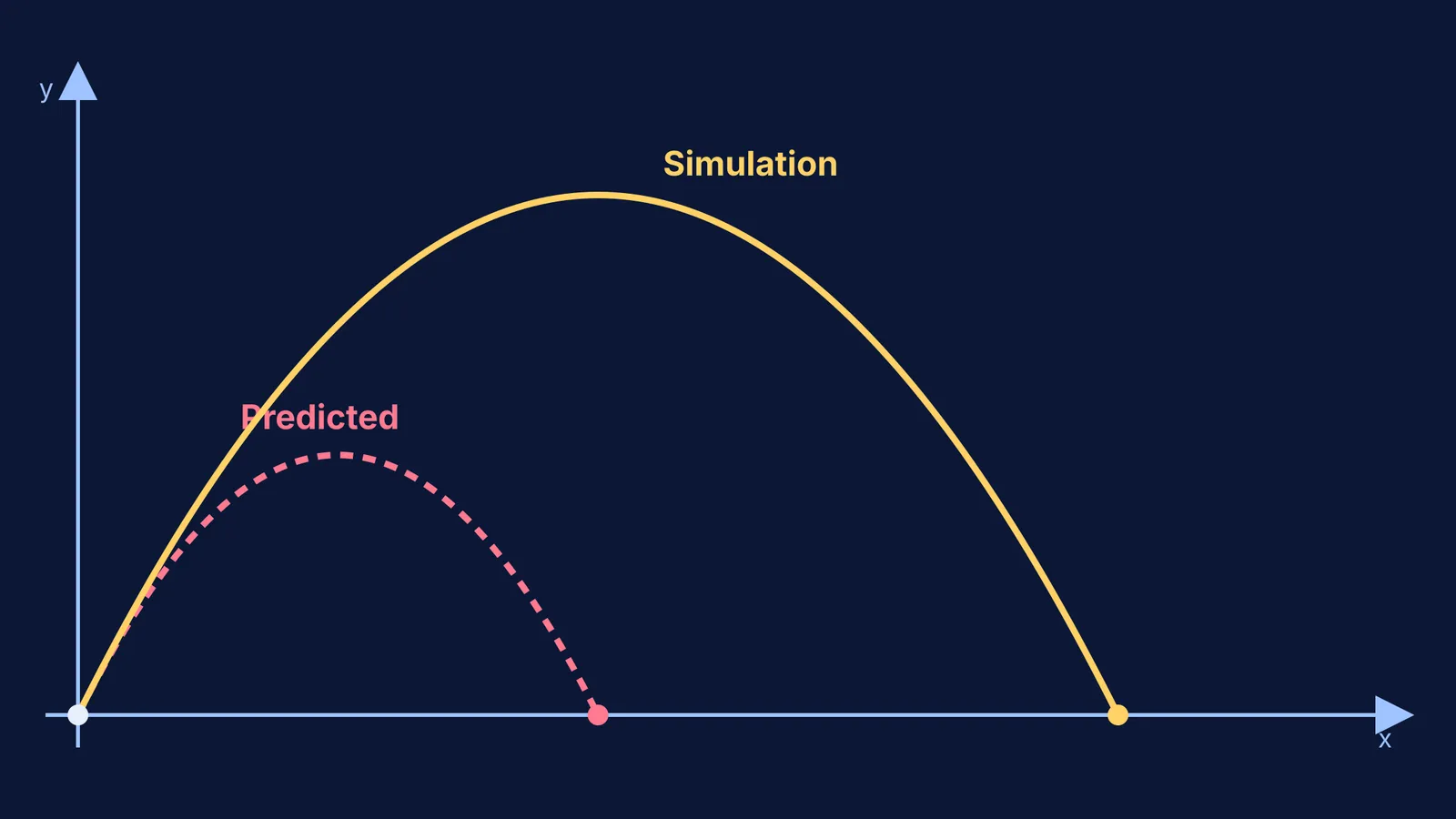
Explain: Tell the AI tutor your result. If the simulation contradicted your prediction, ask the tutor to explain the gap: "I predicted the range would increase proportionally, but the simulation showed it increased much more. Walk me through the maths of why this happens."
How does the projectile mass test work?
Let's see this in practice with a common physics misconception: the effect of mass on a projectile in a vacuum.
Your prompt: "Test me on projectile motion and mass." AI tutor: "You fire a standard cannonball at a specific speed and angle. If you fire a much heavier cannonball with the exact same speed and angle, will it land shorter, at the same spot, or further away?" Your prediction: "It will land shorter because it is heavier and gravity will pull it down faster."
Now, you test it in the simulation. You launch both cannonballs and see they follow the exact same path and land at the exact same mark.
Your follow-up: "The simulation showed they land in the same place. Why doesn't the heavier mass pull it down faster?"
The AI tutor will then guide you through the physics: while the force of gravity scales with the heavier mass, its inertia scales up by the same factor. The mass cancels out, leaving the acceleration exactly the same for both.
This simple loop takes just minutes, but it breaks the misconception in a way that chatbots that just give answers cannot. The next time you sit down to study a tricky concept, do not just read the textbook—predict what will happen, run the simulation, and let the AI tutor explain the difference.


