

On this page
Few scientific toys captivate like a kaleidoscope. With a gentle turn, loose shards of coloured glass rearrange into radiant, symmetrical rosettes. Scottish physicist Sir David Brewster invented the instrument in 1816 while studying light polarisation by multiple reflections between glass plates, patenting it on 10 July 1817 (British Patent No. 4136). He coined the name from Greek roots: *kalos* (beautiful), *eidos* (form), and *skopein* (to view), as recorded in the Encyclopaedia Britannica. His 1819 treatise showed that this spectacle is governed by strict laws of reflection and geometry, which also led to the polarisation angle explored in David Brewster and the angle of perfect polarisation.
How does multiple reflection create kaleidoscopic patterns?
When light strikes a single plane mirror, it forms one virtual image located directly behind the reflecting surface. Placing two plane mirrors at an angle θ fundamentally changes the optics. Light reflected by the first mirror strikes the second, making the first virtual image act as a virtual object for the second mirror. The second mirror reflects it again, sending rays back toward the first mirror or into the viewer's eye.
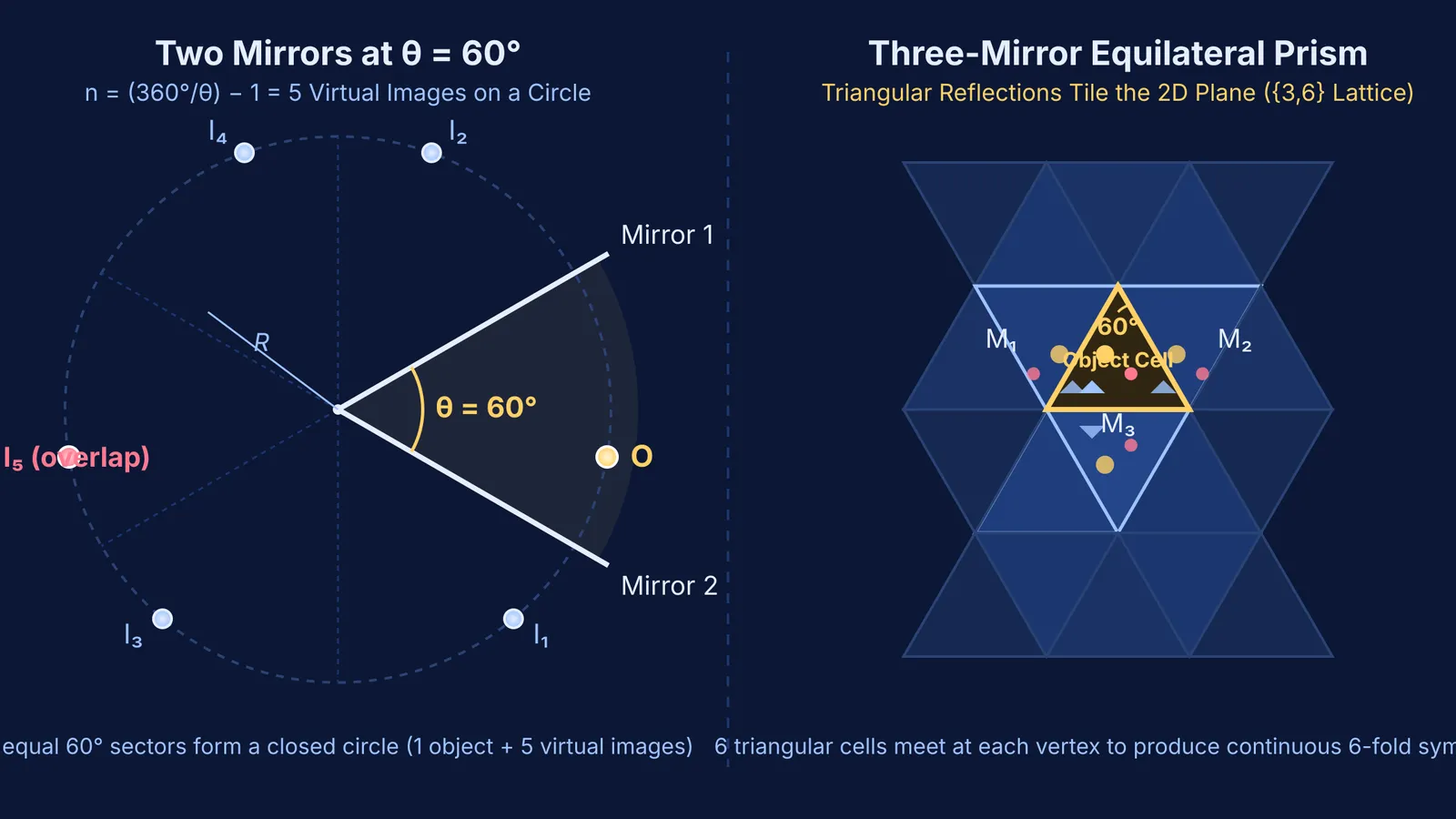
As demonstrated by Vivek Lohani and Praveen Pathak (2023) in *Physics Education* (DOI: 10.1088/1361-6552/acb8fa), every virtual image formed by two inclined mirrors lies on a circle whose centre is the vertex line where the mirrors meet. If an object sits at distance R from that vertex, all successive reflections appear at radius R. The mirror angle θ divides this circle into equal sectors, turning loose beads into a coordinated ring of images, as detailed in Images formed by two inclined plane mirrors: counting them.
What formula predicts the number of images in inclined mirrors?
The total number of virtual images, n, depends on the mirror angle θ. As recorded in the Encyclopaedia Britannica, calculating the ratio m = 360/θ determines the symmetry:
When 360/θ is an even integer: n = (360/θ) − 1, regardless of object position.
When 360/θ is an odd integer: n = (360/θ) − 1 if the object sits on the angle bisector, and n = 360/θ if placed asymmetrically.
For standard angles:
At θ = 90°: 360/90 = 4 (even) → n = 3 images, forming a 4-fold square pattern with the object.
At θ = 60°: 360/60 = 6 (even) → n = 5 images, completing a 6-fold hexagonal rosette.
At θ = 45°: 360/45 = 8 (even) → n = 7 images, producing an 8-fold octagonal star.
The formula subtracts 1 because one sector holds the real object, while the final images from both reflection sequences overlap at the back of the circle. When two mirrors meet at 60° with their bisector along the horizontal, an object placed 10° above the bisector yields two reflection branches whose final virtual images coincide at 170°, completing the 6-fold ring with 5 virtual images and the object.
On the Fermi Simulation Lab, you can adjust mirror angles in interactive simulations for ideas easier to see than read, watching virtual rays converge in real time.
Why do three 60-degree mirrors tile an entire visual field?
Two mirrors produce a single circular rosette surrounded by darkness. To fill the entire field of view, Brewster connected three rectangular mirrors into an equilateral triangular prism with 60° angles, as documented in his 1819 treatise.
Each corner is a 60° vertex producing a 6-fold rosette. Because three mirrors enclose the object cell, reflections do not stop at a boundary. As physicist Thomas B. Greenslade Jr. highlights in *The Physics Teacher* (DOI: 10.1119/1.3204110), each mirror face acts as a virtual mirror reflecting into adjoining space.
This repeated reflection generates an unbroken triangular grid ({3, 6} tessellation), where six triangular cells meet at each vertex to extend hexagonal symmetry across the tube.
How can you build a working kaleidoscope at home?
Constructing a kaleidoscope is a classic activity in the NCERT Class 8 Science curriculum (Chapter 13, Activity 13.6). You can assemble one with basic materials:
Form the prism: Tape three rectangular plane mirrors (about 15 cm long and 4 cm wide) face-inward along their long edges to form an equilateral triangular tube.
Fit the casing: Slide the prism into a circular cardboard tube slightly longer than the mirrors, securing it with paper padding.
Add the eyepiece: Close one end with a cardboard disc having a central peep hole of 5 mm to 8 mm.
Build the object chamber: At the opposite end, place a clear circular glass disc against the mirrors, add small pieces of coloured glass bangles or beads, and cap it with a translucent ground glass disc that admits diffused daylight.
Rotating the tube tumbles the loose pieces into random configurations that never repeat exactly, yet the mirrors instantly transform them into ordered symmetry, as explored in Light in Class 8: laws of reflection, mirrors, and the human eye.
For students working through ray optics or inclined mirror problems, the Fermi Problem Library provides worked problems with a step-by-step solver that explains the reasoning rather than printing an answer.


