On this page
AI chatbots write formulas confidently, and the tone never tells you which answer is the slip. In a 2026 preprint, three physics experts graded four AI systems on AP Physics free-response questions using the official College Board guidelines, and mean scores were 82-92% (Paul and colleagues, arXiv). The same study found recurring error patterns across all four, including wrong reasoning about vector direction. A 2025 study of four models on arithmetic, algebra and number theory tasks built to be hard for them found procedural slips were the most frequent error (Zhang and Graf, arXiv).
You need a ten-second check that needs no answer key. Special values are that check.
What is the special-values test?
The special-values test means substituting a value where you already know the answer, such as zero length, one term or a right angle, and seeing whether the formula agrees.
Sanjoy Mahajan, who taught the Street-Fighting Mathematics course at MIT, states the rule in its free textbook on MIT OpenCourseWare: "A correct solution works in all cases, including the easy ones." He calls it the method of easy cases, and notes that it can reject a formula whose dimensions are perfectly correct, which a units check alone cannot do. Use both.
Which special values should you try?
Pick a value that makes the answer obvious:
0 for a length, time or variable x: the quantity often vanishes or returns to its starting value.
n = 1 and n = 2 for sums, sequences, nth terms and series.
θ = 0° and θ = 90° for anything with angles: inclined planes, components, projectiles.
Equal values, such as a = b or m₁ = m₂: a symmetric situation needs a symmetric answer.
Extreme values, such as one mass far heavier than the other. Our guide to checking a physics answer with limiting cases goes deeper on these.
How do you check an AI formula with special values?
Three worked examples, each with a wrong AI formula:
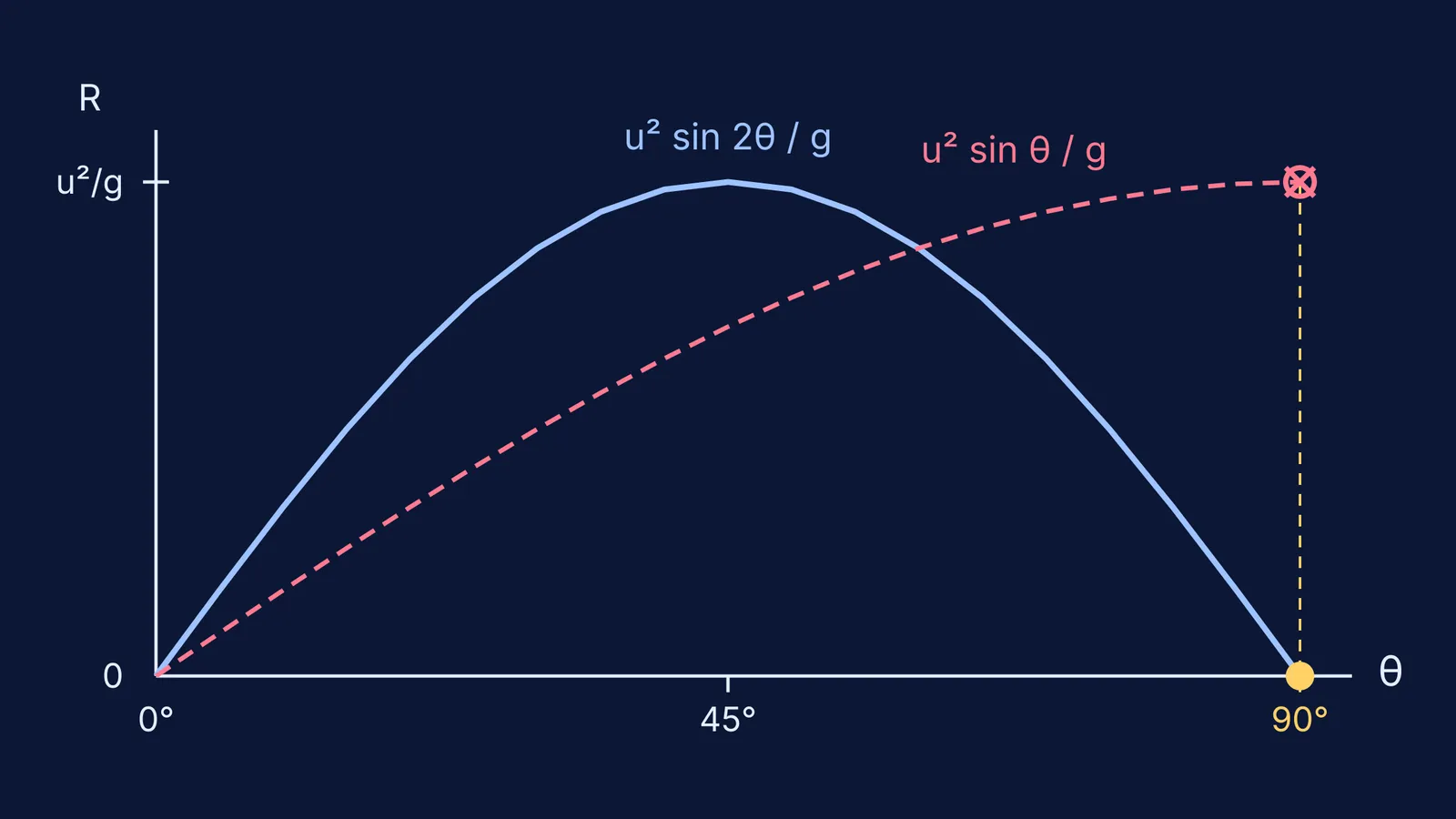
Projectile range at θ = 90°. Suppose an AI says the range of a projectile is R = u² sin θ / g. Before substituting, picture θ = 90°: the ball goes straight up and lands where it was thrown, so R must be 0. The formula gives u² sin 90° / g = u²/g. It fails. The standard result, R = u² sin 2θ / g, gives sin 180° = 0 and passes.
Notice that θ = 0° would not have caught this, because both formulas give 0 there. One passed test means little, so always try at least two values.
Sum of squares at n = 1. An AI says 1² + 2² + ... + n² = n(n + 1)(2n + 1)/3. At n = 1 the sum is just 1, but the formula gives 1 × 2 × 3 / 3 = 2. Wrong. The correct n(n + 1)(2n + 1)/6 gives 1 at n = 1 and 5 at n = 2, matching 1 + 4. The same small-case idea works for binomial terms: see how to verify AI general term formulas with a small expansion.
A trig identity at A = 0. An AI writes sin(A + B) = sin A cos B − cos A sin B. Put A = 0: the left side is sin B, the right side is 0 − sin B = −sin B. The sign is wrong. With a plus sign both sides give sin B, and B = 0 checks out too.
What should you do when the formula fails?
Predict first. Write down what the answer must be in the easy case, from the picture, before you substitute.
Substitute into the AI's formula exactly as written.
If it fails, quote the failure back. Try: "Your formula gives R = u²/g at θ = 90°. A ball thrown straight up lands where it started, so R should be 0. Which step went wrong?" A specific failed case is harder to talk around than "are you sure?"
If it passes, try a second, different special value and check the units.
Before a formula goes into your notes, confirm it against your textbook or your own derivation.
If you keep finding errors and cannot see where the method goes wrong, the Fermi Problem Library has worked problems with a step-by-step solver that explains the reasoning rather than printing an answer. Fermi's AI tutor notices where you are stuck and checks understanding as it goes.
When can special values miss a wrong formula?
Some mistakes hide from easy cases. If an AI gives a pendulum's period as T = π√(l/g) instead of 2π√(l/g), the obvious easy case, l = 0, gives 0 for both, and the dimensions match too. Here you need a different check, such as comparing with a value you trust or checking the AI's number with a rough estimate.
Next time an AI hands you a formula, give it ten seconds and two easy cases before you trust it.