

On this page
You have just finished a full page of algebra to find the acceleration of a complex pulley system, or perhaps an AI chatbot has handed you a long formula. Is the answer actually right?
Re-reading every line of maths to spot a dropped minus sign is slow and frustrating, especially under exam pressure. Professional physicists use a much faster trick: limiting case analysis. By testing your final equation at extreme values, you can instantly flag impossible answers without redoing the work.
What is a limiting case?
A limiting case involves taking one variable in your final formula—such as a mass, an angle, or a distance—and pushing it to an extreme where the physical result is already obvious.
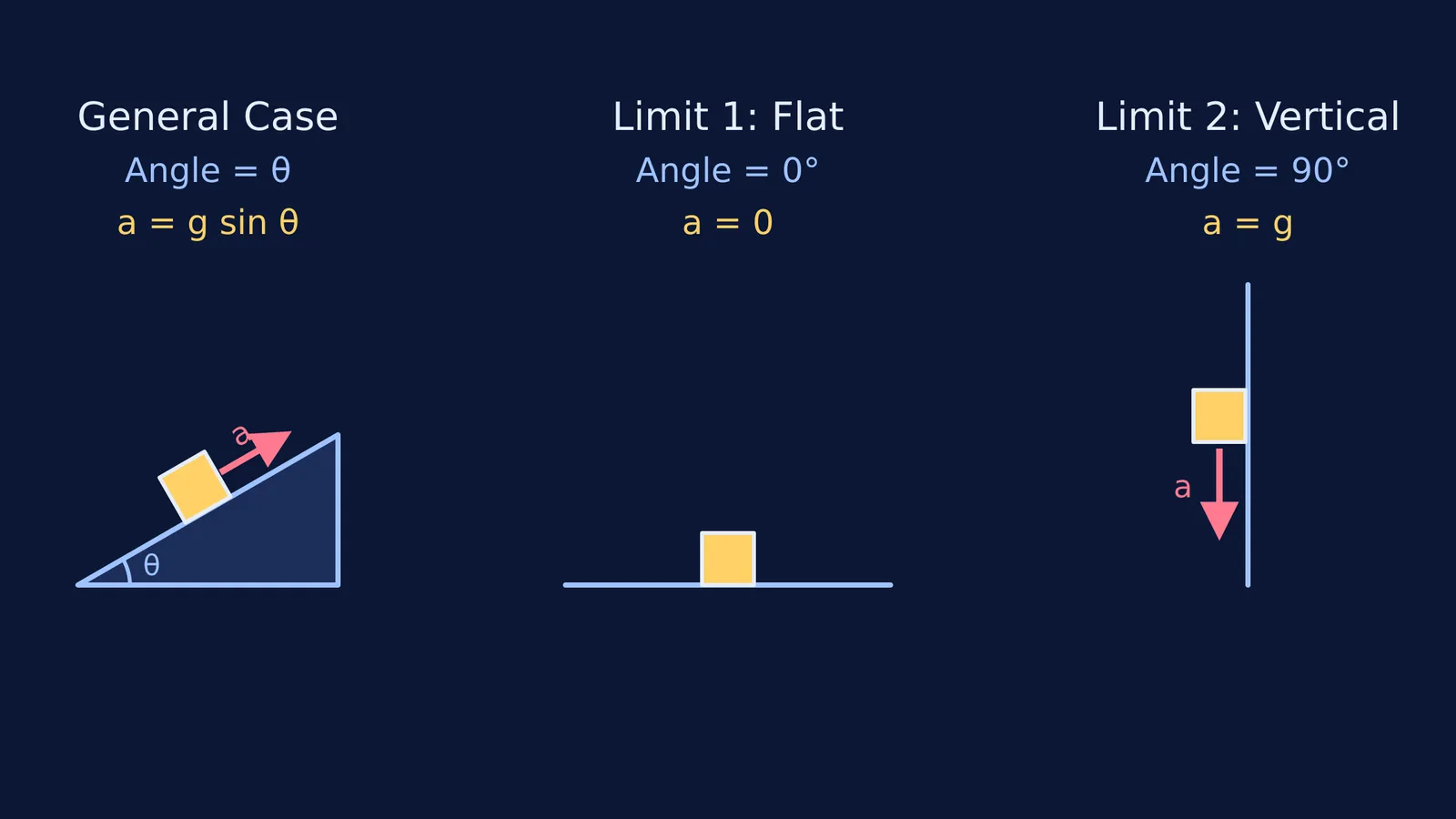
For example, suppose you derive the acceleration of a block sliding down a frictionless ramp at an angle θ. You arrive at the answer a = g sin θ. You can test this formula at two extremes:
Flat ground (θ = 0°): The math says sin 0° = 0, giving a = 0. Physically, a block sitting on a flat floor should not slide. The formula passes the test.
Vertical wall (θ = 90°): The math says sin 90° = 1, giving a = g. Physically, a block falling parallel to a vertical wall is simply in free fall. The formula passes again.
If you had accidentally derived a = g cos θ, checking the flat ground case would give a = g, which is physically impossible. You would immediately know the formula was wrong, saving you from losing marks.
Why do limiting cases build real intuition?
Checking limits does more than just catch sign errors; it forces you to think about the physical story hidden behind the mathematical symbols. A 2023 study published in *Physical Review Physics Education Research* found that exploring limiting cases helps students build "adaptive expertise." The process forces learners to reconcile their mathematical results with physical reality.
Despite its usefulness, this habit does not come naturally to most learners. A classic study of university physics students found that only 8% made a spontaneous attempt to check their solutions by reflecting on limits or units. Most students stop thinking the moment they put a box around their final equation. Learning to run a dimensional analysis or a limiting case check is a critical skill that sets top students apart.
How can you test an AI's answer?
General-purpose AI chatbots can sometimes hallucinate physics equations or lose track of a derivation midway through. You can use limiting cases to catch them out.
When an AI gives you a complicated formula, do not just accept it blindly. Instead, prompt the AI to verify its own work:
> "What extreme cases (such as mass going to zero, or an angle going to 90 degrees) must this physical result satisfy? Now test your final formula against them."
If the AI's formula breaks down when friction vanishes or a mass becomes infinitely heavy, you know it has made a mathematical error. When AI gets physics wrong, asking it to check the extremes is the fastest way to expose the mistake and force a correction.
This is also why purpose-built learning platforms use a fundamentally different approach. Fermi's AI tutor is designed to teach rather than just print answers. It holds a line of reasoning across a whole session. If you make a mistake in a derivation, Fermi might proactively ask you, "What does your formula predict if the second mass is zero?"—guiding you to spot the impossible physics and correct the error yourself.
Which common limits should you test in exams?
If you are preparing for competitive exams, get into the habit of checking these common limiting cases:
Zero mass (m = 0): What happens if a connected block disappears entirely?
Equal masses (m₁ = m₂): Does the pulley system balance out perfectly to give zero acceleration?
Infinite distance (r → ∞): Does the electric or gravitational force drop to zero when objects are infinitely far apart?
When you understand physics theory but still fail numericals, the missing link is often this translation between math and reality. Make limiting cases your final step, and you will never hand in an impossible answer again.


