

On this page
Why do language models fail at basic math?
Language models are designed to predict the next word in a sequence based on patterns in their training data. They do not have an internal calculator.
When you give an AI a problem involving large numbers or multiple steps, it tokenises the digits. This means it splits numbers into unpredictable chunks, completely ignoring place value. While it might successfully guess the first few digits of the answer, every extra digit gives it a chance to slip. A 2020 study found that while the GPT-3 language model achieved near-perfect accuracy on two-digit addition, its performance collapsed to just 9.3% for five-digit addition (Brown et al., 2020).
This token-prediction method leads to errors that shift the result by a whole order of magnitude. The AI might drop a zero, hallucinate an extra digit in the middle of a string, or misplace a decimal point. Because the text reads confidently, students often copy the answer without realising it is off by a factor of ten or a hundred.
What is a Fermi estimate?
A Fermi estimate, or order-of-magnitude estimation, is a quick way to find the approximate scale of an answer before you do the exact maths. The technique is named after the physicist Enrico Fermi, who famously used dropping scraps of paper to estimate the energy yield of the 1945 Trinity atomic test (Wikipedia).
The goal is not to find the perfect decimal, but to get within a power of ten. You simplify every number to a single digit and its power of ten, and run the calculation in your head. When you are converting a quantity between unit systems using dimensions, these ten-second checks stop you from writing down a mass in kilograms when the answer should be in milligrams. It forces you to build a physical model of the problem rather than just trusting an algorithm.
How to check an AI numerical answer by a rough estimate?
Before you hit send on your prompt, look at the values you are giving the AI and do a ten-second check. Let us look at a worked example.
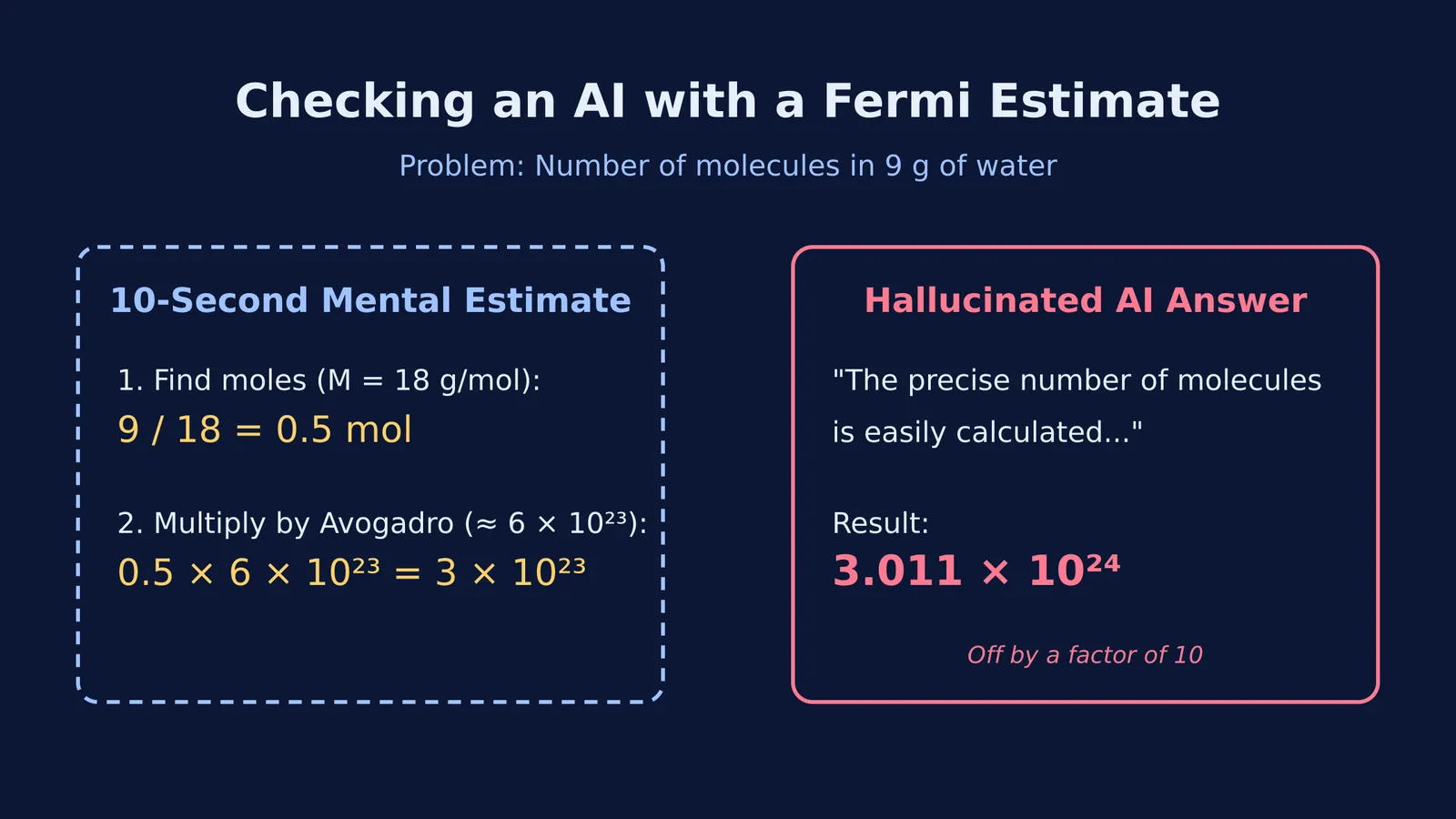
Suppose you are calculating the number of water molecules in 9 grams of water.
Find the moles: The molar mass of water is 18 g/mol. Your mass is 9 g, which is exactly 0.5 moles.
Multiply by Avogadro's number: You need to multiply 0.5 by 6.022 × 10²³.
Do the rough estimate: Half of 6 is 3. The exponent does not change. Your estimate is 3 × 10²³.
If the AI answers with 3.011 × 10²⁴, you instantly know it hallucinated an extra digit and shifted the magnitude by a factor of 10.
The same logic applies to shortcuts. If you use the photon-energy formula in eV and nm (E = 1240/λ), a wavelength of 400 nm means 1240/400. You know 1200/400 is exactly 3, so the energy must be around 3 eV. If the AI outputs 30 eV or 0.3 eV, it has misplaced a decimal. By doing the rough estimate first, you turn yourself from a passive reader into an active checker.
How does a Fermi estimate work for orbital speed?
Let us try a harder example where the powers of ten are large. Imagine you want to find the orbital speed of the Earth around the Sun. You know the orbital radius is roughly 1.5 × 10¹¹ m, and the time for one orbit is one year, which is about 3.15 × 10⁷ s.
The speed formula is v = 2πr / T.
Simplify the numbers: 2π is roughly 6. The radius is 1.5 × 10¹¹. The time is about 3 × 10⁷.
Calculate the top: 6 × 1.5 = 9. So the top is 9 × 10¹¹.
Divide: 9 / 3 = 3. Subtract the exponents: 11 − 7 = 4.
Final estimate: 3 × 10⁴ m/s, or 30 km/s.
If an AI chatbot tells you the Earth moves at 300 km/s, your rough estimate tells you that it is wrong by a full order of magnitude.
Why use Fermi's AI tutor for physics and maths?
Most learning tools answer questions by printing a final number, leaving you to spot their mistakes. Fermi's AI tutor takes a different approach. The tutor teaches rather than answers: it holds a line of reasoning across a session, notices where you are stuck, and decides whether to explain, ask, or show.
Instead of generating a block of text, Fermi writes on a board, draws the figure, and checks your understanding as it goes. It works out what you already know and builds a plan for the session. Because you are working through the problem step by step with the tutor, you learn to catch magnitude errors yourself and build the physical intuition you need for your exams.


