On this page
AI tutors can do the heavy lifting of complex algebraic expansions, but accepting their answers blindly can lead to mistakes. When you ask an AI to find a coefficient using a general term formula, its algebraic steps remain a mathematical conjecture until you verify them. According to George Pólya's 1945 heuristic of "specialization" (Wikipedia), testing a general formula against a small case like n = 2 helps verify whether the underlying logic is sound. Expanding this small case by hand confirms the AI's method before you apply it to a much larger problem.
How does an AI find a coefficient from a general term?
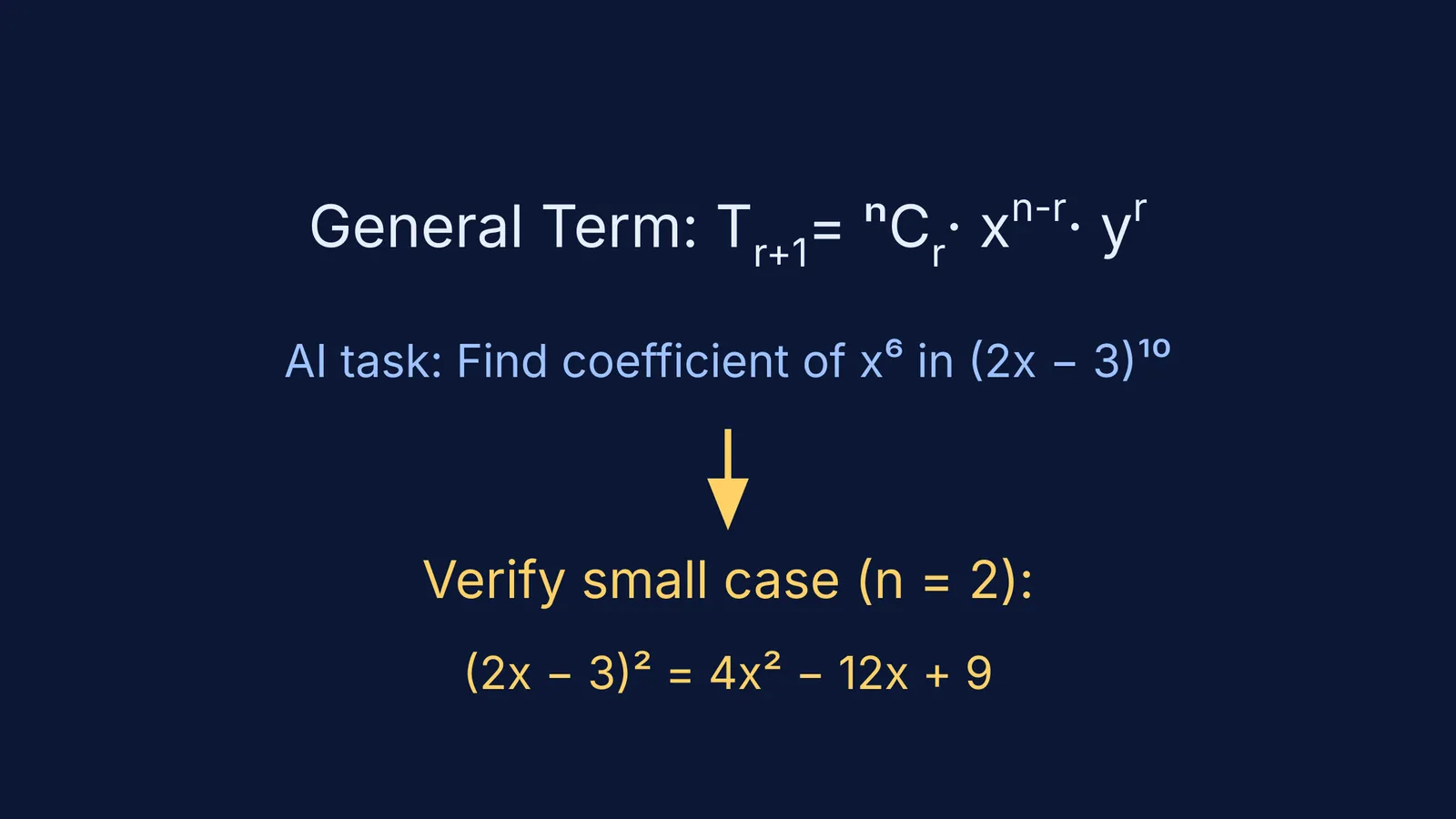
In topics like the binomial theorem, exam questions frequently ask for a specific, isolated part of a massive expression. A common problem might ask you to find the coefficient of x⁶ in the expansion of (2x - 3)¹⁰. Expanding the brackets ten times by hand is effectively impossible in a timed test.
Instead of brute force, an AI tutor will set up the general term formula. For an expansion of (a + b)ⁿ, the general term is typically written as T_(r+1) = ⁿC_r (a)^(n-r) (b)^r.
To find the x⁶ term, the AI isolates the x variables, sets their combined power to equal 6, and solves for the index r. It then plugs that r value back into the full general term to calculate the final numerical coefficient.
While the AI is exceptionally fast at isolating these variables, the abstract nature of the ⁿC_r formula carries a high "intrinsic cognitive load" — the inherent mental difficulty of processing complex interacting mathematical symbols. According to John Sweller's cognitive load theory (Wikipedia), working memory has a strictly limited capacity. Breaking a complex symbolic task into a smaller, concrete sub-schema prevents your working memory from being overwhelmed. This is exactly where testing a small case comes in.
How do you verify a small expansion by hand?
When Fermi's AI tutor works through a problem with you, it explains the mathematical reasoning rather than just printing a final answer. However, if you are unsure about the algebraic rule the AI applied, the absolute best way to check it is by applying the exact same rule to a case small enough to multiply out yourself.
George Pólya's 1945 book *How to Solve It* describes "specialization" — the act of testing a small, restricted case like n = 1 or n = 2 — as a primary mathematical heuristic. Pólya noted that checking small cases not only verifies general solutions but also helps students identify the hidden patterns inside abstract formulas.
Here is exactly how you verify a binomial coefficient using specialization:
Ask the AI to show its general term setup for a much simpler version of the exact same problem, such as (2x - 3)².
According to the AI's general term formula for n = 2, the coefficient of x¹ (where r = 1) would be computed as ²C₁ (2x)¹ (-3)¹.
Calculate that specific term: 2 × (2x) × (-3) = -12x. The formula predicts a coefficient of -12.
Verify this logic by expanding the small case manually on a piece of paper: (2x - 3)(2x - 3) = 4x² - 6x - 6x + 9 = 4x² - 12x + 9.
Check your manual result. The x coefficient is indeed -12.
Because your manual expansion exactly matches the AI's general term calculation, you can be confident that the AI's setup is correct. You can now trust the logic to find the coefficient of x⁶ for n = 10, knowing the underlying algebraic method is completely sound.
Building active learning habits with small cases
Verifying an AI general term formula with a small expansion does more than just check the machine for errors. It forces you into a state of active learning. By calculating the n = 2 case yourself, you anchor the highly abstract ⁿC_r symbols to a concrete, physical reality on your page. This prevents you from falling into the trap of passive reading, where you might nod along to a solution without genuinely understanding how the variables interact.
If you struggle to set up the combinations in the first place, the Fermi Problem Library provides step-by-step guidance on how to correctly isolate powers of x. You can also review how these specific combinations behave by looking at Sums of binomial coefficients: C₀ + C₁ + … and alternating sums. Just remember that whether you are finding a complex binomial coefficient or Recovering aₙ from a formula for Sₙ: the subtraction trick, running a quick small-case check will always help reveal if your mathematical reasoning is on the right track.