On this page
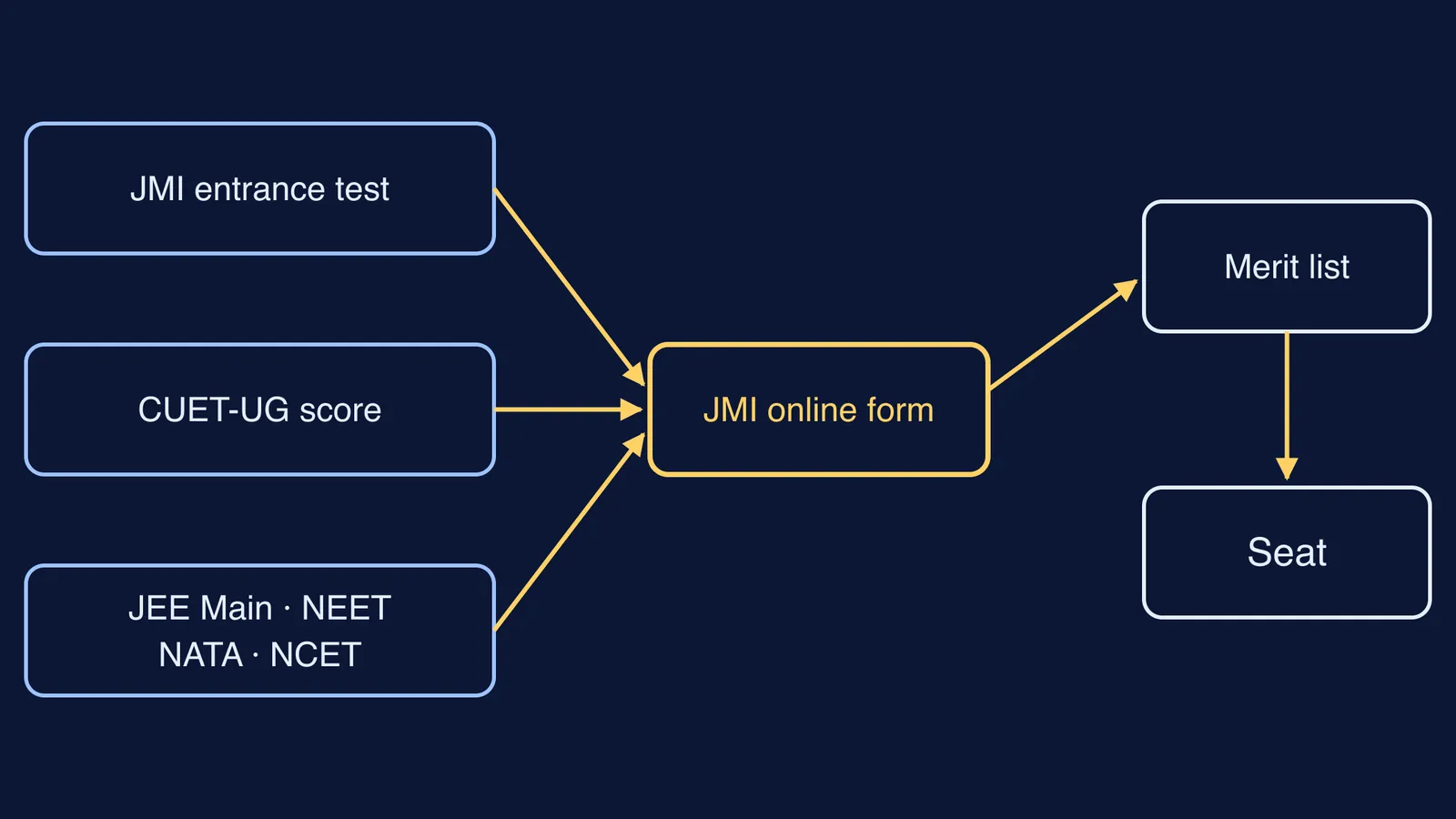
Jamia Millia Islamia runs three undergraduate admission processes, and your course decides which one you face. The Jamia Millia Islamia Prospectus 2026-27 splits UG programmes into Jamia-test, CUET-UG and national-exam courses. On almost every route you also fill a form on Jamia's admission portal; a good national score does not count without it.
Which Jamia UG courses use JEE Main, NEET or other national exams?
The 2026-27 prospectus names the exam behind each professional course:
B.Tech: JEE Main; you enter your JEE application number in the Jamia form, and Jamia ranks by final JEE Main rank and its reservation policy.
B.Arch: NATA, conducted by the Council of Architecture.
BPT (Bachelor of Physiotherapy): NEET-UG.
ITEP B.Sc. B.Ed and ITEP B.A. B.Ed: NCET, conducted by NTA.
BDS: NEET-UG through MCC counselling, with no separate Jamia form; admitted students sign a Rs 3,00,000 bond, payable if they leave in the first or second year or break MCC or Jamia rules.
Which Jamia courses admit through CUET-UG?
Annexure VI of the prospectus gives these UG programmes and their CUET papers:
BA (Hons) Turkish, French and Francophone, Spanish and Latin American, and Korean: General Aptitude Test (501)
BA (Hons) Hindi: Hindi (102); BA (Hons) Urdu: Urdu (113)
BSc (Hons) Applied Mathematics: Mathematics or Applied Mathematics (319)
BSc (Multidisciplinary): Physics (322), Chemistry (306) or Mathematics (319)
After CUET, you apply on Jamia's portal, and seats go by CUET normalised score. Check this list before choosing your CUET papers.
Which courses need Jamia's own entrance test?
Most other UG courses. In the prospectus, programmes such as BSc (Hons) Physics, BSc (Hons) Chemistry, BA (Hons) Economics, BA LLB and BBA/BCom (Hons) have test centres in cities including Lucknow, Patna, Kolkata, Srinagar and Calicut; other Jamia tests are held in New Delhi. Where an interview is part of the test, Jamia calls four to five times the seats in each category.
What are the reserved categories at Jamia?
Jamia is a minority educational institution under Article 30(1) of the Constitution. Its prospectus sets these reservations in each programme:
30% of seats for Muslim applicants
10% for Muslim women
10% for Muslim OBCs (non-creamy layer, central list certificate) and Muslim Scheduled Tribes
5% for persons with disabilities (at least 40% disability, 5% relaxation in qualifying marks, UDID details at admission)
5% in UG programmes for internal students who passed Class 10 or 12 as regular students of Jamia schools
Kashmiri migrants, candidates from Jammu and Kashmir and outstanding sportspersons get limited extra seats (no sports seats in Engineering, Law, Dentistry, Architecture, Management and some others). You can claim only one category, and a high enough rank also puts you in General merit.
What are the steps from form to seat?
The prospectus sets out this sequence:
Register on admission.jmi.ac.in with an email, Aadhaar, and a photo and signature (JPG, up to 100 KB).
Choose programmes and pay the non-refundable fee: Rs 1,000 for faculties such as engineering, law and management, Rs 700 for most others. One form per programme.
Fix errors in the editing window; name and date of birth cannot be changed after registration.
Print two copies of the admit card, issued about a week before a Jamia test.
Take the test. The answer key appears within 5 working days; challenges cost Rs 200 per question within 48 hours of the key.
Watch the merit lists, waiting lists and spot rounds. You are offered only programmes whose form you completed.
Report with original documents, category certificate and fee; hand in your transfer or migration certificate within 60 days.
Withdraw 15 or more days before the last date of admission and you get a full refund; more than 30 days after it, you get nothing.
A worked example: one PCM student, three routes
Say a PCM student wants B.Tech Computer Engineering, with BSc (Hons) Physics and BSc (Multidisciplinary) as back-ups.
B.Tech: take JEE Main, then fill the Jamia form after the result and enter the JEE application number.
BSc (Hons) Physics: fill the Jamia form by the March deadline and sit Jamia's own test; in 2026 Jamia's tests started on 26 April.
BSc (Multidisciplinary): choose CUET Physics, Chemistry or Mathematics when filling the CUET form, then apply on Jamia's portal after the CUET result.
That is three applications, three deadlines and a CUET subject choice made months earlier, so keep every date on one calendar. Our guide on applying to central universities after CUET covers the portal side.
All three routes lean on school physics, chemistry and mathematics. The Fermi Concept Library gives every concept its own lesson, so you can close gaps one topic at a time.
If you are also weighing AMU, see how AMU's own entrance tests and quotas work. If anyone offers a Jamia seat for money, read what to check when an agent promises a college seat; seats come only through Jamia's merit lists.