On this page
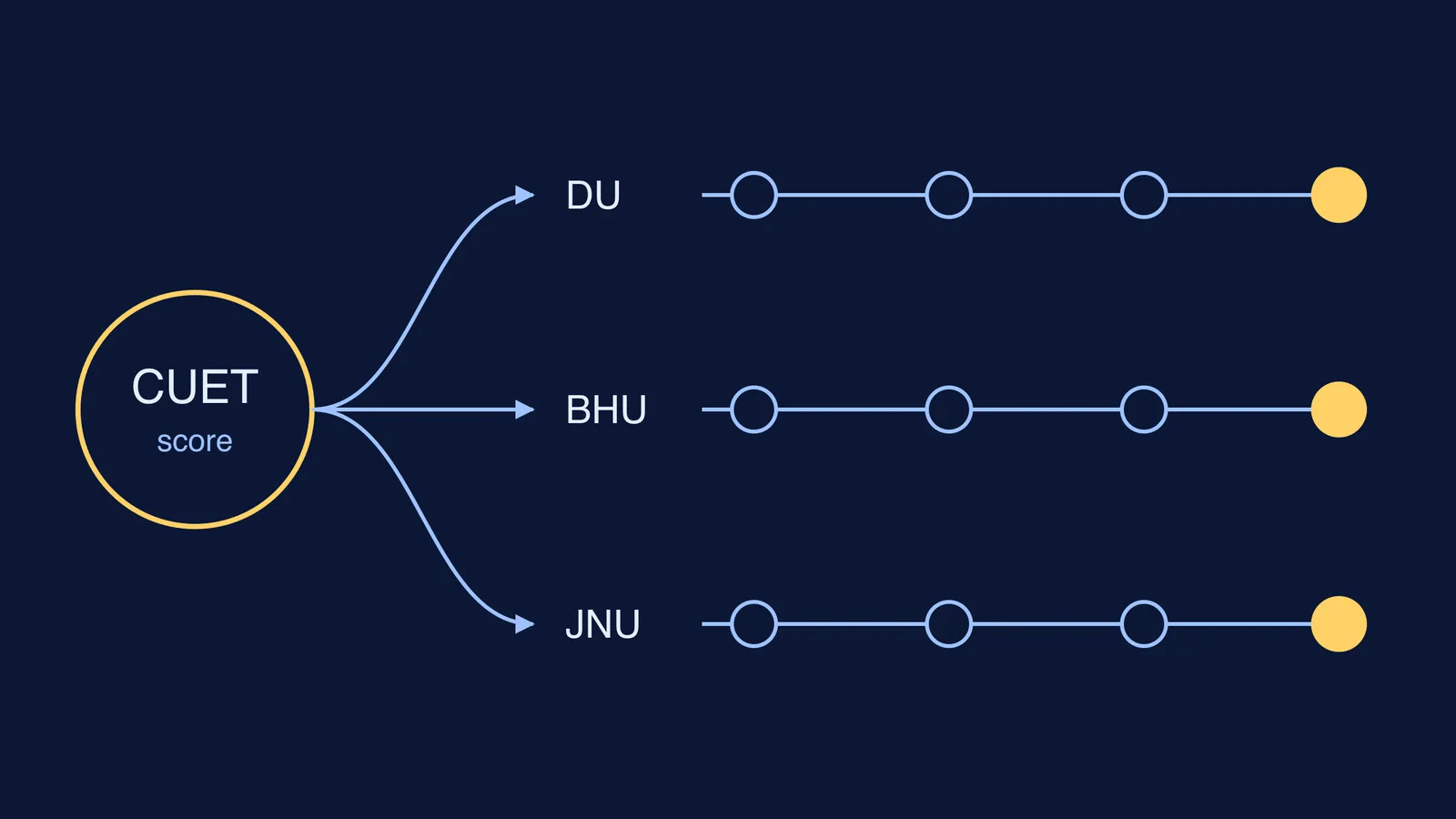
You have your CUET (UG) score card, and nothing happens automatically. The National Testing Agency's CUET page says the scores are used for admission to central and participating universities, but you apply for the seat itself on each university's own website, one at a time.
Why doesn't my CUET score get me a seat by itself?
Because NTA's job ends with the result. The University of Delhi's CSAS (UG) 2026 rules say NTA's role "is limited to the conduct of CUET(UG)-2026, declaration of results, and handling of queries related to the entrance examination." The same document is blunt: "Simply appearing in CUET(UG)-2026 will not be a sufficient condition to secure a seat in UoD."
Each university runs its own process, with its own eligibility rules, seat matrix and rounds. Delhi University offers 73 UG programmes, plus more than a hundred B.A. Programme combinations, across 69 colleges, according to its CSAS (UG) 2026 document, and each programme says which CUET papers it accepts.
How do the DU, BHU and JNU portals differ?
Three universities, three systems:
Delhi University (CSAS-UG). Phase I is the application, with a non-refundable fee of Rs 250 (Rs 100 for SC, ST and PwBD candidates). Phase II opens after CUET results: you map your Class 12 subjects to your CUET papers and rank "Programme + College" combinations. Your last saved list locks automatically at the deadline and is used for every round (DU CSAS-UG 2026).
Banaras Hindu University (CAP-UG). You register through BHU's admission site with your CUET application and roll numbers, complete and lock a profile, then choose preferences and pay the fee. BHU's registration guide warns that your details must exactly match your NTA CUET records, and a locked profile cannot be edited.
Jawaharlal Nehru University. JNU takes a separate application on its admission portal, then publishes merit lists. Its tentative 2026-27 schedule took applications from 12 to 22 July, planned the first merit list for 3 August, and gave 3 to 5 August to pay the fee and block the seat.
Dates and fees change every year, so check the current notice on each university's site. If DU is on your list, our guide to choosing CUET subjects for DU courses explains the subject-mapping step, and getting into BHU through CUET covers BHU in more depth.
How does preference filling work, and what are upgrade and freeze?
DU's process is a useful example. Under the CSAS (UG) 2026 document, you are provisionally allocated the highest possible preference that your merit, category and the available seats allow. You accept the seat, the college checks your documents, and you pay the admission fee.
After paying, you choose. Upgrade keeps you in line for a seat higher on your list; if one comes up, your current seat is cancelled automatically and the new one is accepted for you. Freeze means you stop there. If you got your first preference, there is nothing to upgrade to. DU also warns that once you move up, the seat you held and everything below it on your list "will never be offered again".
Two rules follow from this:
List only combinations you would actually join. At DU, declining an allocated seat, or not acting on it in time, takes you out of later regular rounds.
Rank them in your true order of wanting, not what feels safest; the system already gives you the highest your merit allows.
How do you track several university portals at once?
Make one tracker, a notebook page or a spreadsheet, with a row for each university and these columns:
Portal address, typed in from the university's own website rather than a forwarded link.
Login ID, and where the password is saved.
Application fee paid, with the transaction ID.
Preference deadline, and a tick once your final list is saved.
Every allocation or merit list date.
The accept-by and pay-by deadline for each round.
Your decision for that round: accept, upgrade, freeze or withdraw.
Here is a worked example. Ananya applies to DU and JNU. Using JNU's tentative 2026 schedule, a seat on the first merit list on 3 August would have to be paid for and blocked by 5 August, whatever is happening on DU's portal that week. Her tracker also notes that DU's rules say fees paid on its CSAS portal are valid only for its own listed programmes, so she treats each university's payments as separate.
Parents can help without taking over. Try asking: "Can you show me each dashboard, so we both know the next deadline?" A quick check together after every result is enough.
The weeks between rounds are also a good time to firm up the basics for your course. If you are heading into a B.Sc., the Fermi Concept Library has a lesson for every concept in physics, chemistry, biology, mathematics and computing, so you can find and fix weak spots before your first lecture.
If a deadline does slip past, log in and read the university's latest notices straight away; DU's CSAS document, for example, has a separate chapter on spot admission.