

On this page
Selecting subject papers for the Common University Entrance Test (CUET UG) can determine whether Delhi University accepts your admission application or rejects it outright. Under official regulations published by the University of Delhi, candidates must appear in CUET exclusively in subjects studied and passed in Class 12. Appearing in a subject you did not take in school—even if it directly aligns with the degree you want—means DU will discard that score during Common Seat Allocation System (CSAS) counselling.
What is Delhi University's Class 12 mapping rule?
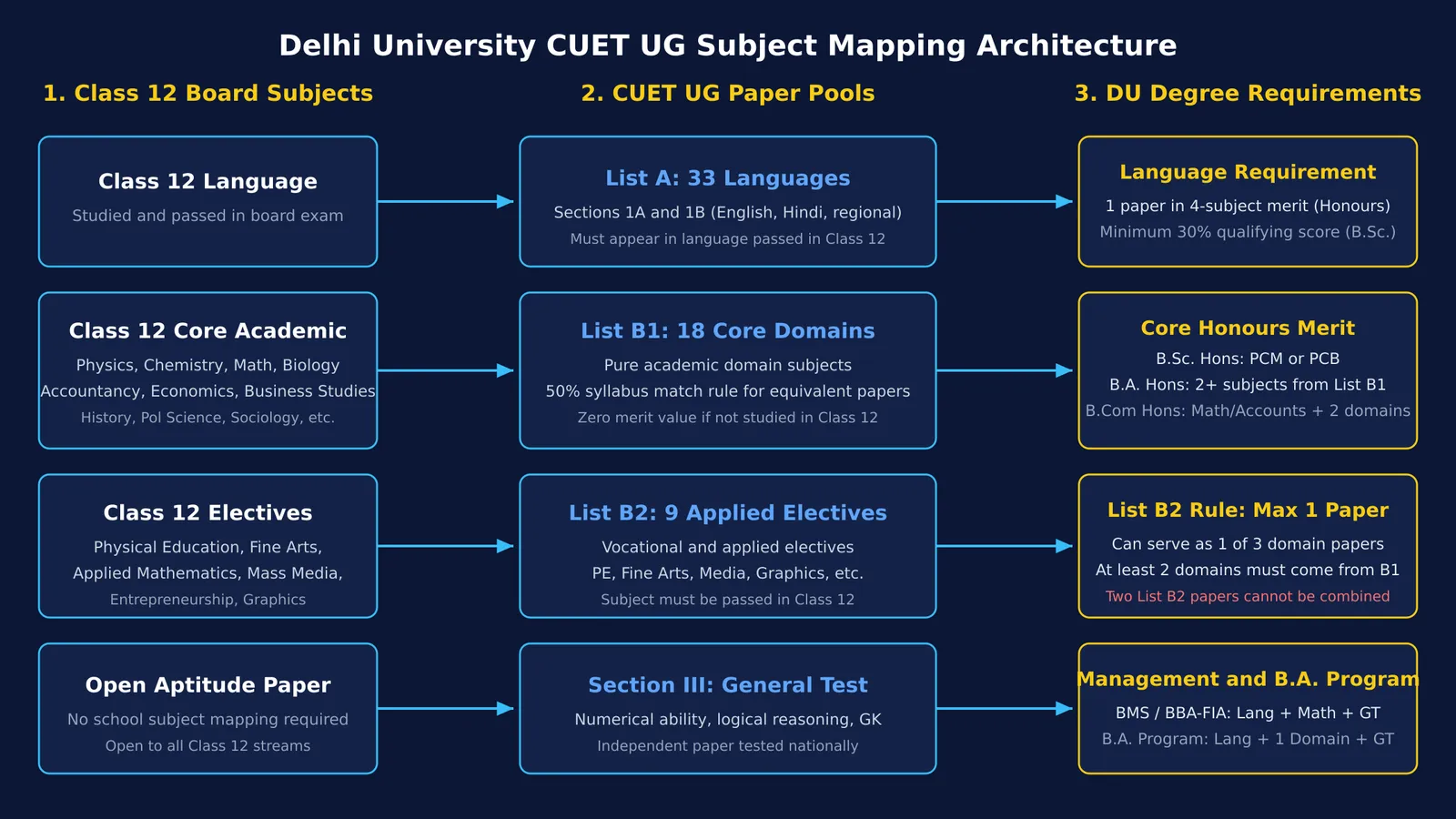
The central pillar of DU undergraduate admissions is strict subject mapping. In Phase II of CSAS registration on the DU admission portal, applicants must map each CUET paper against their Class 12 marksheet subjects. If a student studied Physics, Chemistry, and Mathematics in school but attempts Political Science in CUET to enter a humanities degree, DU assigns zero merit value to that paper.
For subjects not explicitly named in the National Testing Agency syllabus, Delhi University allows choosing a closely related domain subject if at least 50% of the syllabus matches according to DU admission criteria. For example, students with Class 12 Biochemistry must appear in Biology, while those with Applied Mathematics take Mathematics. For students crossing streams, our guide on CUET UG for science students details how to transition safely.
How do List A, List B1, and List B2 work?
To organise entrance combinations across disciplines, the University of Delhi Bulletin of Information sorts CUET test papers into three distinct groups:
List A includes all 33 languages from CUET Sections 1A and 1B, such as English, Hindi, and regional languages. Most courses require at least one language from this list.
List B1 contains 18 traditional academic domain subjects, including Physics, Chemistry, Mathematics, Accountancy, Economics, Business Studies, History, Political Science, and Biology.
List B2 comprises 9 vocational or applied electives, including Physical Education, Fine Arts, Mass Media, Entrepreneurship, Teaching Aptitude, and Engineering Graphics.
Section III is the General Test, which operates as an independent paper testing numerical ability, logical deduction, and general awareness without mapping to a school subject.
A standard DU honours requirement stipulates: One Language from List A + Two subjects from List B1 + One subject from List B1 or B2. This formula caps vocational electives at one paper, preventing candidates from combining two List B2 subjects.
Which subject combinations qualify you for the most DU courses?
Because NTA caps total test papers, strategic combinations aligned with DU admission rules preserve broad eligibility across multiple departments:
The Science Pathway: One language (English) + Physics + Chemistry + Mathematics + Biology or Computer Science. For B.Sc. (Honours) in Physics, Chemistry, or Electronics, DU calculates merit purely on Physics-Chemistry-Mathematics (PCM), requiring a 30% qualifying score in the language paper according to DU science admission criteria. For Biological Sciences, Botany, and Zoology, merit uses Physics, Chemistry, and Biology (PCB). This same combination qualifies you for B.A. (Honours) in History or Political Science, as well as B.Com (Honours), without any stream-change deduction.
The Commerce and Economics Pathway: One language (English) + Mathematics + Accountancy + Economics + Business Studies. This combination satisfies criteria for B.Com (Honours) and B.A. (Honours) Economics. While B.Com (Honours) accepts either Mathematics or Accountancy, B.A. (Honours) Economics strictly requires Mathematics. Adding Section III (General Test) provides eligibility for management programmes like Bachelor of Management Studies (BMS) and BBA in Financial Investment Analysis (FIA).
The Humanities Pathway: One language + two List B1 core subjects (such as History and Political Science) + one elective from List B1 or B2 (such as Economics or Psychology) + General Test. This covers both single-subject honours and interdisciplinary B.A. Program tracks.
What are the most common CUET combination mistakes?
Under official DU admission guidelines, candidates lose eligibility every admissions cycle through avoidable errors:
Taking subjects not passed in Class 12: Choosing CUET History or Sociology without studying them in Class 12 invalidates those scores for DU. Always test in your school subjects.
Omitting Mathematics: B.A. (Honours) Economics, B.Sc. (Honours) Computer Science, and BMS strictly require Mathematics in both Class 12 and CUET.
Missing the language threshold: Scoring below the 30% qualifying mark in your List A language paper disqualifies you from B.Sc. honours programmes regardless of your PCM score.
Overloading unfamiliar papers: Preparing too many new subjects dilutes board and entrance marks. Focus on your core curriculum.
Balancing school examinations with entrance preparation requires steady routines. Resources like using NCERT Exemplar problems build application skills, while teaching structured study planning helps families set manageable revision schedules. In science and mathematics, the Fermi Concept Library organizes every concept in physics, chemistry, biology, mathematics and computing, each with its own lesson and its place in the map, while the Fermi Problem Library provides worked problems with a step-by-step solver that explains the reasoning rather than printing an answer. When balancing multiple subjects, Fermi's AI tutor can work out what you already know and build a plan for the session.


