On this page
A man walks away from a street lamp and his shadow stretches out ahead of him. Related-rates problems in Class 12 calculus and JEE Main practice often ask two questions about this: how fast does the shadow get longer, and how fast does its tip move? You can answer both from one picture, one pair of similar triangles and one derivative. Below we work through it with numbers, then give you a short checklist for the variations.
How do similar triangles link the shadow to the man's distance?
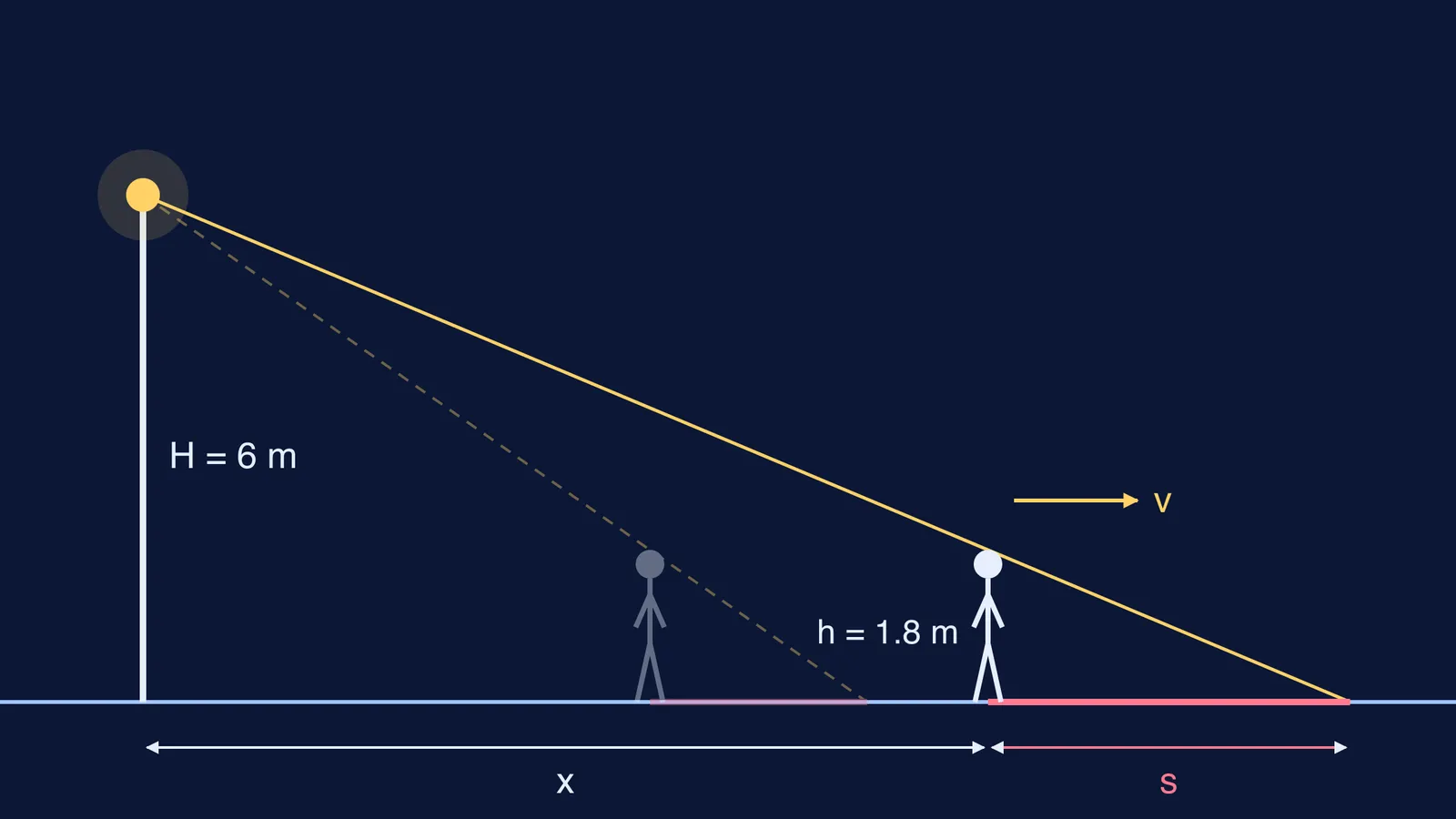
Put the lamp at height H. The man, of height h, stands at distance x from the foot of the pole, and his shadow has length s. The light ray from the lamp just grazes the top of his head and hits the ground at the shadow's tip, at distance x + s from the pole.
That gives two right triangles that share the angle at the tip: a big one (lamp, foot of pole, tip) and a small one (head, feet, tip). Because they are similar, their sides are in proportion:
H / (x + s) = h / s
Cross-multiply to get H·s = h·x + h·s, so s(H − h) = h·x, and
s = h·x / (H − h)
This is the step that is easiest to rush. Write the relation between lengths first, and only then bring in time. The open textbook OpenStax Calculus Volume 1 uses the same order in its related-rates strategy: assign variables and draw a figure, find an equation relating the variables, then differentiate both sides with the chain rule and substitute known values last. If the similar-triangle step feels shaky, our post on finding a pole's height from its shadow covers it without any calculus.
How fast does a man's shadow grow as he walks away from a lamp post?
Differentiate s = h·x/(H − h) with respect to time t. H and h are constants, so
ds/dt = [h / (H − h)] · dx/dt
Worked example: a lamp is 6 m high, and a man 1.8 m tall walks away from it at 1.4 m/s.
Relation: s = 1.8x / (6 − 1.8) = 1.8x / 4.2 = 3x/7.
Differentiate: ds/dt = (3/7) · dx/dt.
Substitute: ds/dt = (3/7) × 1.4 = 0.6 m/s.
His shadow gets 0.6 m longer every second.
How fast does the tip of the shadow move?
The tip is at distance T = x + s from the pole. Using the relation above,
T = x + h·x/(H − h) = H·x / (H − h)
so dT/dt = [H / (H − h)] · dx/dt.
With the same numbers, T = 6x/4.2 = 10x/7, and dT/dt = (10/7) × 1.4 = 2 m/s.
Now check it: the tip speed should equal the man's speed plus the rate at which the shadow grows, and 1.4 + 0.6 = 2 m/s. If your two answers fail this check, one of them is wrong.
Why doesn't the man's distance from the pole matter?
Many versions of the problem say "when he is 10 m from the pole". Here that number does not change the answer. Both rates are constant multiples of dx/dt, because s depends linearly on x. Whether he is 2 m or 20 m away, the shadow grows at 0.6 m/s and the tip moves at 2 m/s, as long as he keeps walking at 1.4 m/s.
That is a useful signal in an exam. When a given value never enters your working, make sure it really is irrelevant (as it is here) and that you haven't dropped a term. In other problems, such as a ladder sliding down a wall, the rate does change with position.
The formulas also make physical sense. As h gets close to H, H − h shrinks towards zero and both rates grow without limit: a person almost as tall as the lamp throws a very long shadow. If the man walks towards the lamp, dx/dt is negative, so ds/dt is negative too and the shadow shrinks.
A checklist for any lamp-post shadow problem
Draw the pole, the person and one ray from the lamp through the head to the ground.
Label H, h, x and s, and mark which ones are constant.
Write the similar-triangle ratio H/(x + s) = h/s before taking any derivative.
Decide what is being asked: the shadow length s, or the tip position x + s.
Differentiate with respect to t, and substitute numbers last.
Check units and signs (walking away is positive), and that tip speed = walking speed + ds/dt.
For practice, try the OpenStax version: a person 6 ft tall walks away from a 10 ft lamppost at 3 ft/s (exercises 10 and 11 in OpenStax section 4.1). Work it yourself before you check: by the formulas above, the tip moves away from the pole at 7.5 ft/s and away from the person at 4.5 ft/s.
If the setup is where you get stuck, the Fermi Problem Library has worked problems with a step-by-step solver that explains the reasoning rather than printing an answer. For the same method applied to balloons, cones and ladders, see our four-step method for related rates problems.