

On this page
You do not need to climb a pole to find its height. You need its shadow, a stick of known height and a sunny morning. The NCERT Class 10 Mathematics chapter on Triangles calls this indirect measurement, based on the similarity of figures, and tests it with a pole question and a lamp-post example.
Why do the Sun's rays make similar triangles?
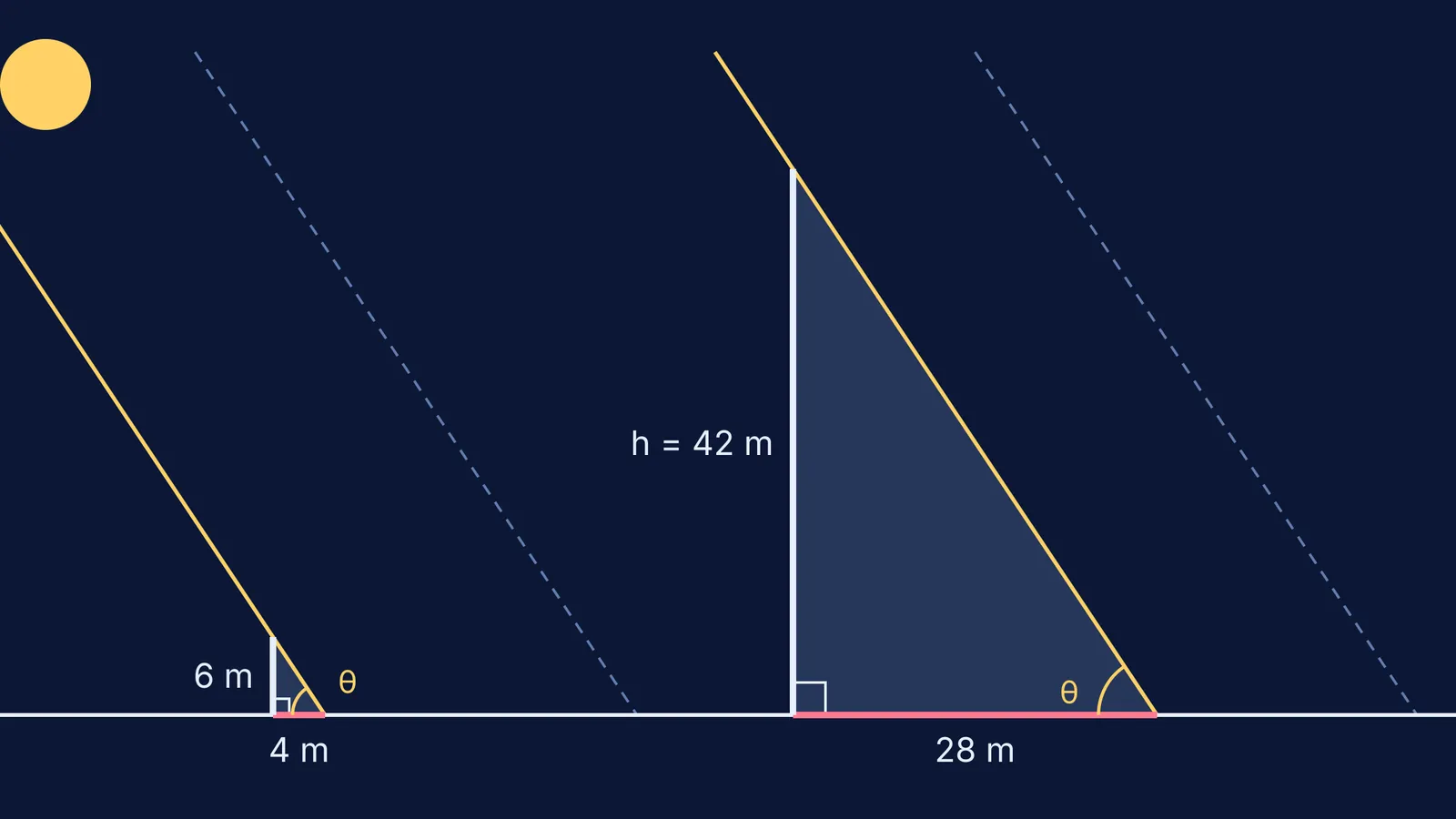
The Sun is about 149 million kilometres from Earth, according to the Smithsonian National Air and Space Museum. Next to that, the few metres between a stick and a pole are nothing, so their rays arrive in effectively the same direction and meet flat ground at the same angle.
Each vertical object makes a 90° angle with the ground, and each sunray makes the same angle at its shadow tip. Two equal angles are enough: if two angles of one triangle equal two angles of another, the triangles are similar, which NCERT calls the AA similarity criterion (NCERT, Chapter 6). So for everything standing in sunlight at one moment, height divided by its own shadow gives the same number.
In Plutarch's account, Thales of Miletus used exactly this, setting a stick at the end of a pyramid's shadow. The MacTutor History of Mathematics archive notes that none of Thales' writing survives and that stories about him must be treated with care, so read this one as tradition.
How do you find the height of a pole using its shadow?
NCERT Exercise 6.3, Question 15: a vertical pole 6 m long casts a 4 m shadow, and at the same time a tower casts a 28 m shadow. Find the tower's height (NCERT).
Name the two triangles: pole with its shadow, tower with its shadow.
Write height over shadow on both sides: h ÷ 28 = 6 ÷ 4.
Solve: h = 28 × 6 ÷ 4 = 42 m.
Sanity check: the pole is 1.5 times its shadow, so the tower must be too, and 28 × 1.5 = 42.
To try it outside, measure both shadows within a minute of each other, from the foot of each object to the shadow tip on level ground. Avoid noon, when shadows are short and small errors matter more; on a Zero Shadow Day a pole can have almost no noon shadow. Shadow tips look slightly fuzzy because the Sun is a disc, not a point of light, so measure to the edge of the dark part for both objects.
How is a lamp-post shadow problem different?
A street lamp is close, so its rays spread out from one point instead of arriving parallel. So you use one small triangle inside one big triangle, sharing the angle at the shadow tip.
NCERT's Example 7: a girl 90 cm tall walks away from a lamp-post at 1.2 m/s, and the lamp is 3.6 m above the ground. Find her shadow after 4 seconds (NCERT).
Distance walked: 1.2 × 4 = 4.8 m.
Small triangle: the girl (0.9 m) and her shadow x.
Big triangle: the lamp (3.6 m) and the full distance from the post's foot to the shadow tip, 4.8 + x.
Both have a right angle and share the tip angle, so by AA: (4.8 + x) ÷ x = 3.6 ÷ 0.9 = 4.
4.8 + x = 4x, so x = 1.6 m.
The usual slip is writing 4.8 ÷ x, which gives 1.2 m. But 4.8 m is the gap between post and girl, not a side of either triangle. The big triangle's base always runs from the post's foot to the shadow tip.
How fast does the tip of a shadow move?
For JEE practice, extend NCERT's Example 7. Let the tip be s metres from the post when she is d metres away. Then s ÷ 3.6 = (s − d) ÷ 0.9, so s = 4d ÷ 3. The tip moves at 4/3 × 1.2 = 1.6 m/s, and her shadow grows at 0.4 m/s. Check against NCERT: after 4 seconds, 0.4 × 4 = 1.6 m.
Sun or lamp: which ratio should you write?
Sun, two objects: height ÷ shadow for one equals height ÷ shadow for the other.
Lamp, one person: lamp height ÷ (distance from post + shadow) equals person's height ÷ shadow.
Sun's angle given instead of a second object: that is trigonometry, tan of the angle of elevation equals height ÷ shadow; see heights and distances visualised.
If you keep putting the wrong side on top, the Fermi Problem Library has worked problems with a step-by-step solver that explains the reasoning rather than printing an answer. If the AA criterion itself feels shaky, the Fermi Concept Library gives it its own lesson.
On your next sunny morning, measure a one-metre stick and a lamp-post's shadow, and work out the post's height with the four steps above.


