

On this page
If you step outside exactly at local noon on certain days of the year, you might notice something strange: perfectly vertical objects like flagpoles, buildings or straight pipes cast no shadow at all. For a brief few minutes, the world can feel slightly two-dimensional.
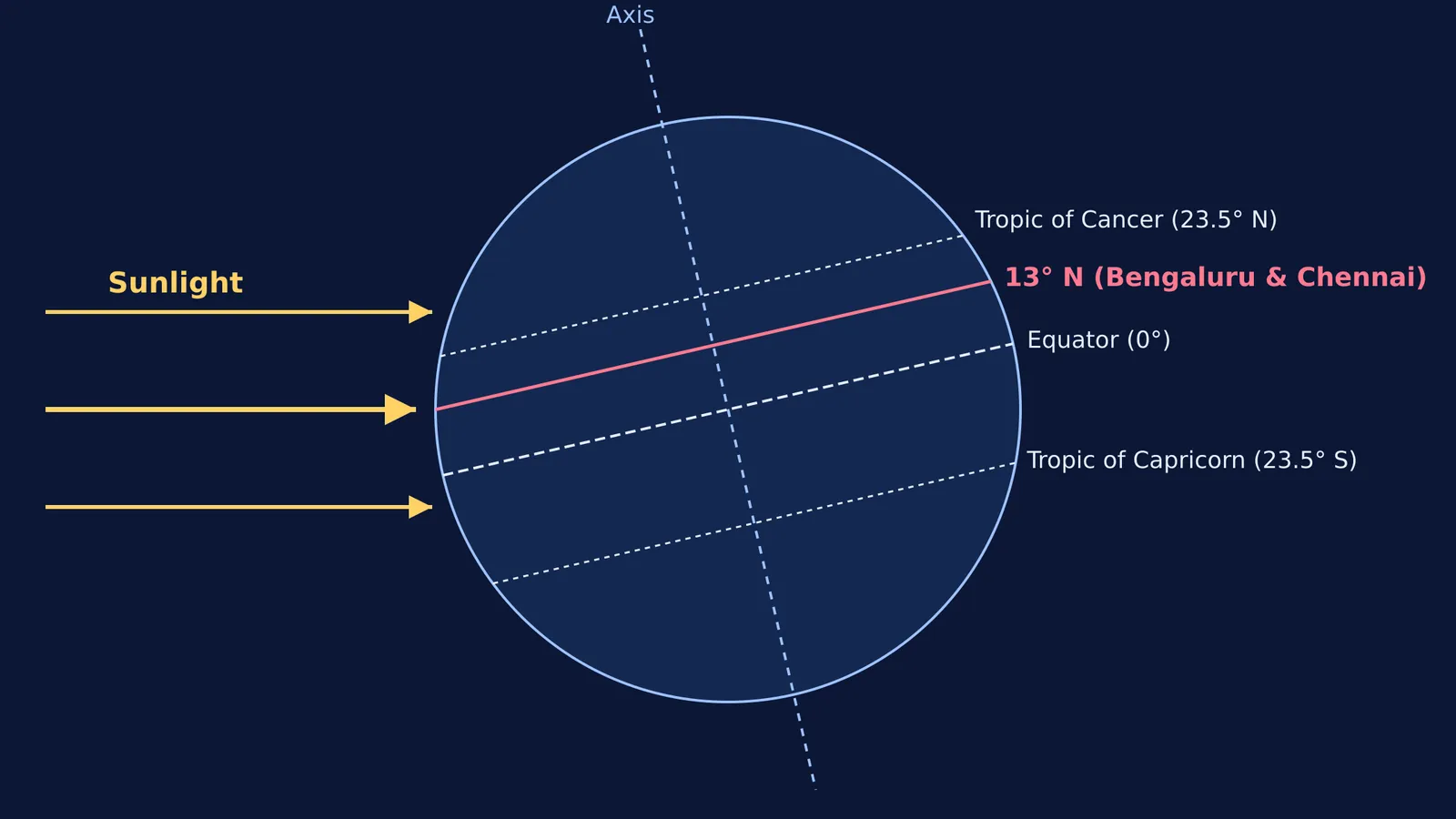
Zero Shadow Day is a celestial event that occurs twice a year for places located between 23.5° N and 23.5° S latitude [[1]](https://astron-soc.in/outreach/zero-shadow-day/). On these specific days, the Sun's declination becomes exactly equal to the location's latitude [[1]](https://astron-soc.in/outreach/zero-shadow-day/). At exact local noon, the Sun sits directly overhead at the zenith, and vertical objects cast no shadow on the ground because the shadow falls entirely beneath their base [[1]](https://astron-soc.in/outreach/zero-shadow-day/).
For cities in this tropical zone, like Bengaluru and Chennai, this is not a random trick of the light. It is a precise intersection of Earth's axial tilt and the apparent seasonal motion of the Sun.
Why does Zero Shadow Day happen?
As Earth revolves around the Sun, its rotational axis remains tilted at an angle of 23.5 degrees relative to its orbital plane [[1]](https://astron-soc.in/outreach/zero-shadow-day/). Because of this tilt, the Sun does not always rise exactly in the east and set exactly in the west, nor does it reach the same maximum height in the sky every day.
In astronomy, declination is the equivalent of latitude on the celestial sphere [[1]](https://astron-soc.in/outreach/zero-shadow-day/). Over the course of a year, the point where the Sun is directly overhead at noon moves northwards to the Tropic of Cancer (+23.5° latitude) and then southwards to the Tropic of Capricorn (−23.5° latitude) [[1]](https://astron-soc.in/outreach/zero-shadow-day/).
When light rays travel straight down from the zenith (a full 90-degree angle), any vertical object hides its own shadow. Locations north of the Tropic of Cancer, such as New Delhi or Jaipur, never experience a Zero Shadow Day because the Sun never reaches a full 90-degree angle above them; it always transits slightly to the south [[1]](https://astron-soc.in/outreach/zero-shadow-day/).
When is Zero Shadow Day in Bengaluru and Chennai?
Bengaluru sits at 12.98° N latitude [[2]](https://en.wikipedia.org/wiki/Bangalore) and Chennai at 13.08° N [[3]](https://en.wikipedia.org/wiki/Chennai). Because they share such a similar latitude, they experience this phenomenon at almost the same time of the year.
The first Zero Shadow Day for these cities happens around 24 April during the Sun's northward journey, traditionally known as Uttarayan [[1]](https://astron-soc.in/outreach/zero-shadow-day/). The Sun continues north until the summer solstice in June, where it appears to pause before turning back south. The second Zero Shadow Day occurs around 18 August during this southward return, or Dakshinayan [[1]](https://astron-soc.in/outreach/zero-shadow-day/).
Because the apparent motion of the Sun slows down near the solstices, cities closer to the Tropic of Cancer experience their two Zero Shadow Days very close together, while cities near the equator have them spaced further apart [[1]](https://astron-soc.in/outreach/zero-shadow-day/).
How can you observe a Zero Shadow Day?
Reading about celestial mechanics is one thing, but verifying it with your own eyes is a powerful exercise in active learning. Connecting the abstract idea of Earth's tilt to a disappearing shadow grounds the physics in reality. Historically, this exact principle allowed the ancient Greek astronomer Eratosthenes to calculate the Earth's circumference by measuring shadow lengths at different latitudes [[1]](https://astron-soc.in/outreach/zero-shadow-day/).
If spatial astronomy and 3D geometry feel hard to picture, you are not alone. Many students struggle to map 2D diagrams to moving planets. The Fermi Simulation Lab provides interactive simulations for the ideas that are easier to see than to read, allowing you to manipulate variables like latitude and time to watch orbital mechanics unfold.
To observe the event yourself, follow this plan:
Find your local noon: Standard time (IST) is a uniform time zone that is offset from local solar time. Check an astronomy app or an online solar calculator to find the exact minute of local noon for your specific city [[1]](https://astron-soc.in/outreach/zero-shadow-day/).
Set up the object: Place a cylindrical object, like a PVC pipe, a bottle or a plumb line, on a completely flat, horizontal surface in open sunlight [[1]](https://astron-soc.in/outreach/zero-shadow-day/).
Watch the shadow shrink: Shortly before local noon, watch the shadow grow shorter as the Sun climbs higher in the sky.
The vanishing point: At exact local noon, the shadow will retreat entirely beneath the base of the object, leaving it seemingly shadowless.


