

On this page
Many heights-and-distances mistakes happen before any trigonometry: the diagram is wrong. Here you build one picture of a tower and an observer, predict how the angle changes as you walk closer, then solve two board-style problems from it. The chapter belongs to the Trigonometry unit, which carries 12 of the 80 marks in the Class X course structure of the CBSE Class 10 mathematics syllabus for 2025-26.
What is the angle of elevation, in one picture?
Stand on level ground and look at the top of a tower. Your line of sight runs from your eye to the top. The angle of elevation is the angle between the horizontal and that line of sight, measured upwards. The angle of depression is the same idea when you look down from a height, measured below the horizontal.
The tower, the ground and the line of sight make a right triangle, so tan θ = height ÷ distance from the foot of the tower. That one line does most of the work in this chapter.
The CBSE syllabus keeps board problems simple: they should not involve more than two right triangles, and angles of elevation or depression should be only 30°, 45° and 60°.
How does the angle of elevation change as you walk closer?
Predict first. A tower is 20√3 m (about 34.6 m) tall. You start 60 m away and walk towards it in equal 10 m steps. Does the angle rise by the same amount each step?
Here is what tan θ = h ÷ d gives, rounded to one decimal place:
60 m away: 30.0°
50 m away: 34.7°
40 m away: 40.9°
30 m away: 49.1°
20 m away: 60.0°
10 m away: 73.9°
The steps are not equal. The first 10 m adds less than 5°; the step from 20 m to 10 m adds almost 14°. Going from 30° to 45° takes about 25.4 m of walking, but 45° to 60° takes only about 14.6 m more.
Why predict? Studying physics lecture demonstrations, Crouch, Fagen, Callan and Mazur (2004) found that students who only watched understood the ideas no better than students who did not see the demonstration at all. Students who predicted the outcome before seeing it showed significantly greater understanding.
Problem 1: how tall is the tower?
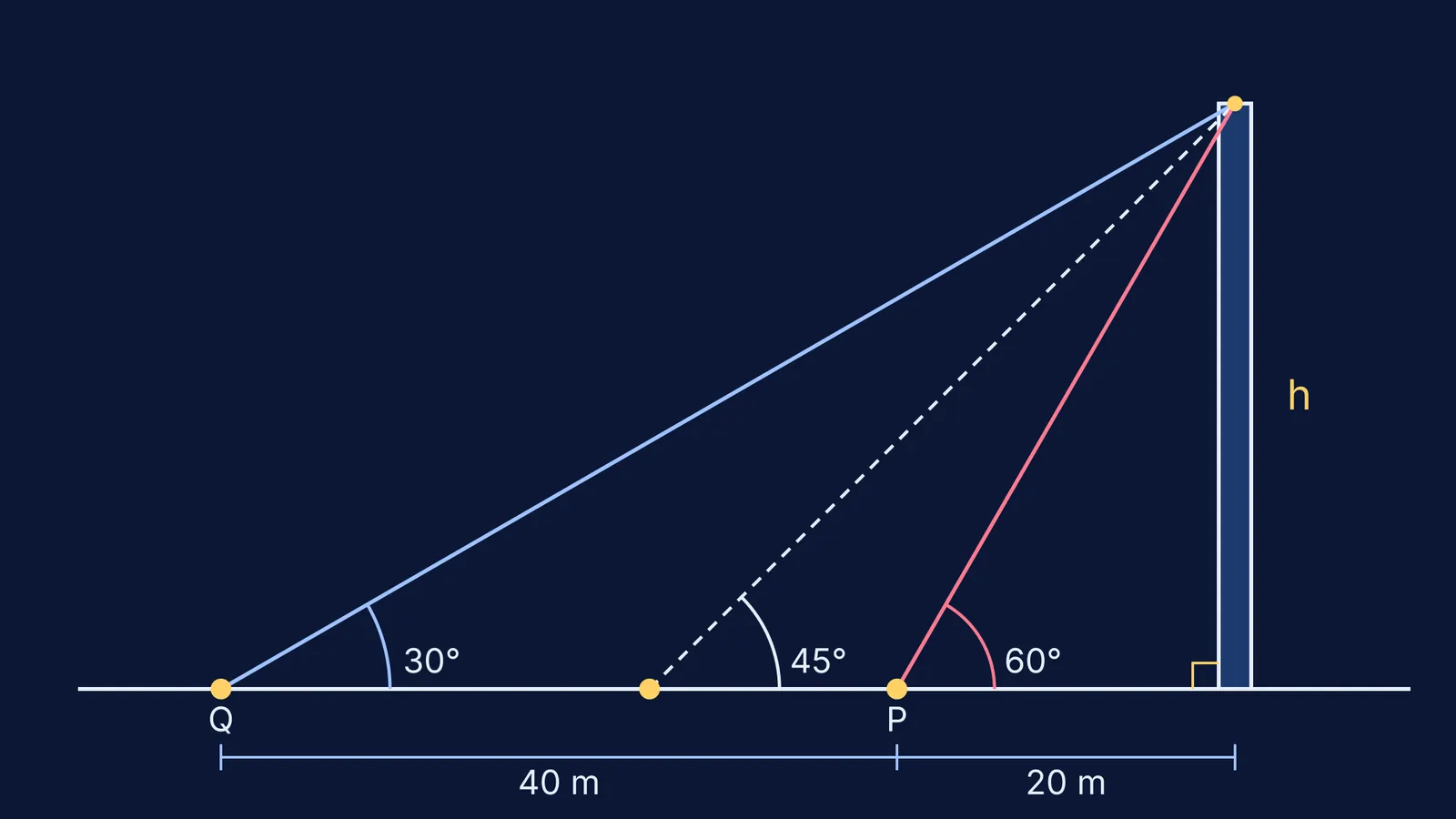
From a point P on level ground, 20 m from the foot of a tower, the angle of elevation of the top is 60°. Find the height of the tower.
Draw the triangle: tower vertical, ground horizontal, right angle at the foot, 60° at P.
The height is opposite the 60° angle and the 20 m is next to it, so use tan.
tan 60° = h ÷ 20, so h = 20 × √3 = 20√3 m.
With √3 ≈ 1.732, h ≈ 34.64 m.
Check against the picture: 60° is steep, so the tower should be taller than 20 m. It is.
How do you solve the two-angle walking problem?
From a point Q on the ground, the angle of elevation of the top of a tower is 30°. After walking 40 m straight towards the tower to a point P, the angle becomes 60°. Find the height of the tower and the distance from P to its foot.
Let the height be h and the distance from P to the foot be x. Then Q is x + 40 from the foot.
Triangle at P: tan 60° = h ÷ x, so h = √3x.
Triangle at Q: tan 30° = h ÷ (x + 40), so h = (x + 40) ÷ √3.
Set the two equal and multiply both sides by √3: 3x = x + 40, so x = 20 m.
Then h = 20√3 m ≈ 34.64 m.
It is the same tower as Problem 1, and Q is 60 m from the foot, exactly where the list above gave 30°. If a question adds the observer's eye height, say 1.5 m, find the part of the tower above eye level, then add 1.5 m.
How can you build this model yourself?
On squared paper, use a scale of 1 cm to 5 m. Draw the tower about 6.9 cm tall.
Mark points 12 cm, 8 cm and 4 cm from its foot (60 m, 40 m and 20 m).
Write your guess for the angle next to each point before you measure anything.
Draw each line of sight to the top and measure with a protractor. You should read close to 30°, 41° and 60°.
Double the tower's height, predict again, then measure.
For ideas like this that are easier to see than to read, the Fermi Simulation Lab has interactive simulations. If two-triangle problems still trip you up, the Fermi Problem Library has worked problems with a step-by-step solver that explains the reasoning rather than printing an answer.
Next, practise with our Class 10 heights and distances problems, revise trigonometric ratios for Class 10, or try predicting projectile motion with a simulation.


