

On this page
A ladder slides down a wall, water fills a cone, a ripple spreads, a shadow stretches. In calculus these are one problem type, and one method solves all of them.
The idea fits in a sentence from OpenStax Calculus Volume 1: "If two related quantities are changing over time, the rates at which the quantities change are related." You know one rate, the question asks for another, and an equation connects them.
Why are related rates problems hard?
For many students the set-up is the hard part. In a 2000 study in the Mathematics Education Research Journal, Tami Martin tested university students in an introductory calculus course on geometric related-rates problems. Overall performance was poor, and the weakest steps were the conceptual ones: translating the prose into a diagram and into symbols. Overall scores were most closely linked to the procedural steps, so both halves matter.
So if you freeze on these, fix the set-up first, then make the routine automatic. That is what the four steps are for.
What are the four steps for solving related rates?
Draw. Sketch the situation. Give every quantity that changes a letter (x, h, r) and write every fixed quantity as a number.
Relate. Write one equation that is true at every instant: Pythagoras, a volume or area formula, or similar triangles. If it has an extra variable, remove it now.
Differentiate. Differentiate both sides with respect to time t. Each variable picks up its own rate (dx/dt, dh/dt) through the chain rule, as in implicit differentiation.
Substitute. Only now put in the values at the moment the question asks about, and solve for the unknown rate.
OpenStax sets out the same method in five steps and adds a warning: substituting a changing quantity's value before differentiating makes it "behave as a constant", so its derivative disappears from your equation (OpenStax, section 4.1).
Worked examples: ladder, cone, circle and shadow
Try each one before reading the working.
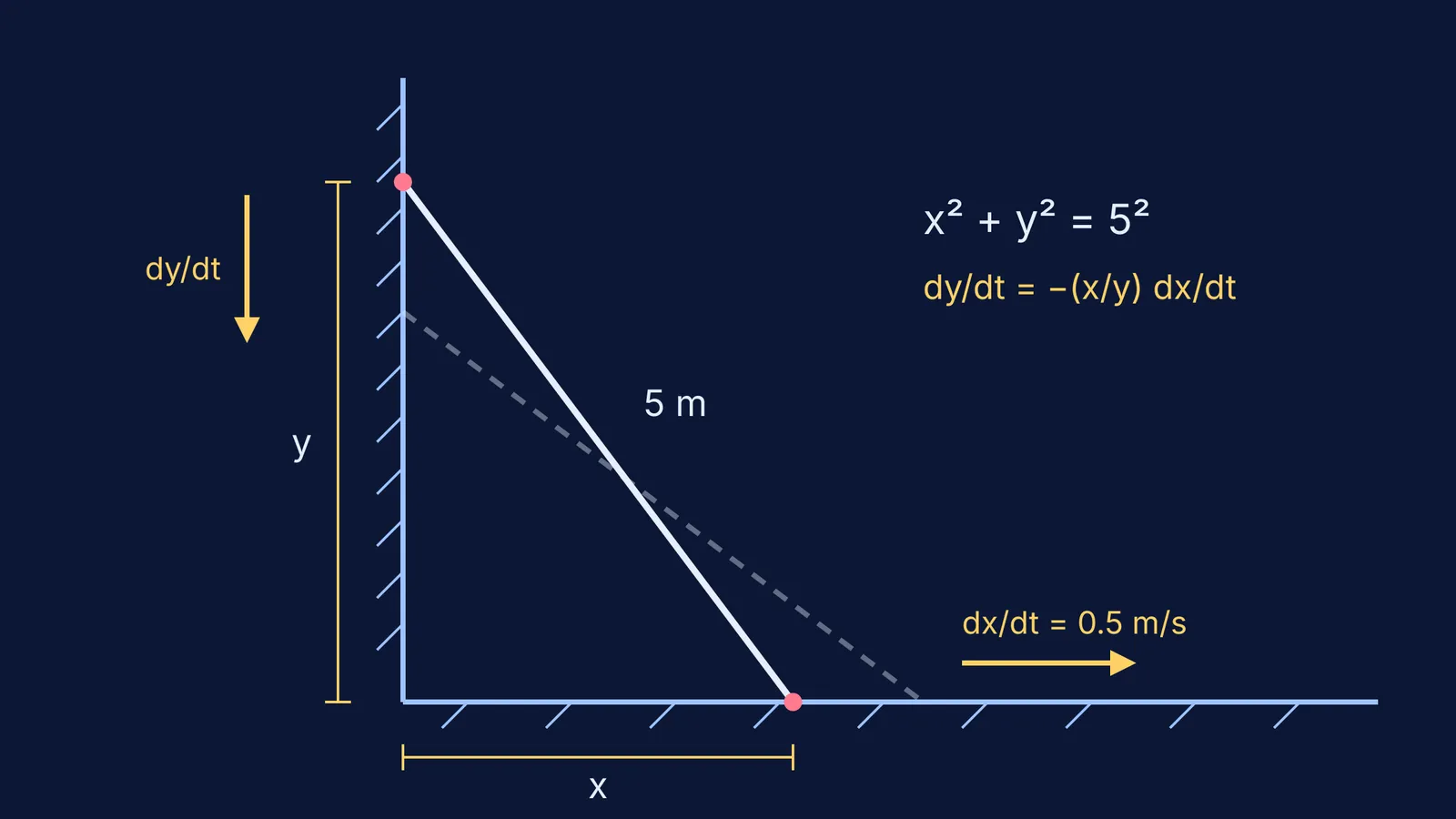
Example 1, the sliding ladder. A 5 m ladder leans on a wall. Its foot slides out at 0.5 m/s. How fast is the top falling when the foot is 3 m from the wall?
Draw: foot x from the wall, top y up the wall, ladder 5.
Relate: x² + y² = 25.
Differentiate: 2x dx/dt + 2y dy/dt = 0.
Substitute: when x = 3, y = 4, so dy/dt = −(3/4)(0.5) = −0.375 m/s. The top falls at 0.375 m/s.
Example 2, the filling cone. A cone-shaped tank, point down, is 4 m deep with a top radius of 2 m. Water flows in at 2 m³/min. How fast is the level rising when the water is 2 m deep?
Draw: water depth h, surface radius r.
Relate: V = (1/3)πr²h, and similar triangles give r = h/2, so V = πh³/12. Remove r before differentiating.
Differentiate: dV/dt = (πh²/4) dh/dt.
Substitute: 2 = (π × 4/4) dh/dt, so dh/dt = 2/π, about 0.64 m/min.
Example 3, the spreading circle. A stone dropped in a pond makes a ripple whose radius grows at 5 cm/s. How fast is the enclosed area growing when the radius is 10 cm?
Relate: A = πr².
Differentiate: dA/dt = 2πr dr/dt.
Substitute: dA/dt = 2π(10)(5) = 100π, about 314 cm²/s.
Example 4, the moving shadow. A 1.6 m tall student walks away from a 6 m lamppost at 1.1 m/s. How fast does the shadow lengthen?
Draw: student's distance from the post x, shadow length s.
Relate: similar triangles give 6/(x + s) = 1.6/s, so 4.4s = 1.6x, or s = (4/11)x.
Differentiate: ds/dt = (4/11) dx/dt.
Substitute: ds/dt = (4/11)(1.1) = 0.4 m/s, whatever x is.
Which mistakes cost marks in related rates?
Substituting too early. Plugging in x = 3 before step 3 makes dx/dt vanish.
Dropping the sign. A falling ladder top or a draining tank has a negative rate. Say "decreasing at" with the positive value, or keep the minus sign.
Answering the wrong rate. In the shadow problem, the shadow lengthens at 0.4 m/s, but its tip moves at 1.1 + 0.4 = 1.5 m/s. Read which one is asked.
Keeping a spare variable. In the cone, differentiating with both r and h leaves you with an unknown dr/dt.
When your answer is off and you cannot see why, the Fermi Problem Library has worked problems with a step-by-step solver that explains the reasoning rather than printing an answer, so you can find where your set-up went wrong.
How should you practise related rates?
Over one week, do two problems of each type above, writing the four step names in the margin before you start. If the chain rule feels shaky, revise it in the Fermi Concept Library first, since every step 3 depends on it.
Once these feel routine, move on to maxima, minima and rates of change and tangents and normals.


