On this page
Most engines burn fuel inside the cylinder. A Stirling engine does not: its gas never leaves the machine, and heat comes through a wall from outside. That choice, plus a part called the regenerator, explains what is special about it.
What is a Stirling engine?
A Stirling engine is "a closed-cycle regenerative heat engine, with a permanent gaseous working fluid" (Wikipedia: Stirling engine). The same gas is used again and again, warmed from outside, so the hot end can be heated by any external heat source. Because the gas is sealed in, designers can pick a gas with suitable properties, such as helium or hydrogen.
The Scottish clergyman Robert Stirling patented his air engine in 1816 (Wikipedia: Stirling engine). We tell his story in Robert Stirling and the hot-air engine.
How does a Stirling engine work, step by step?
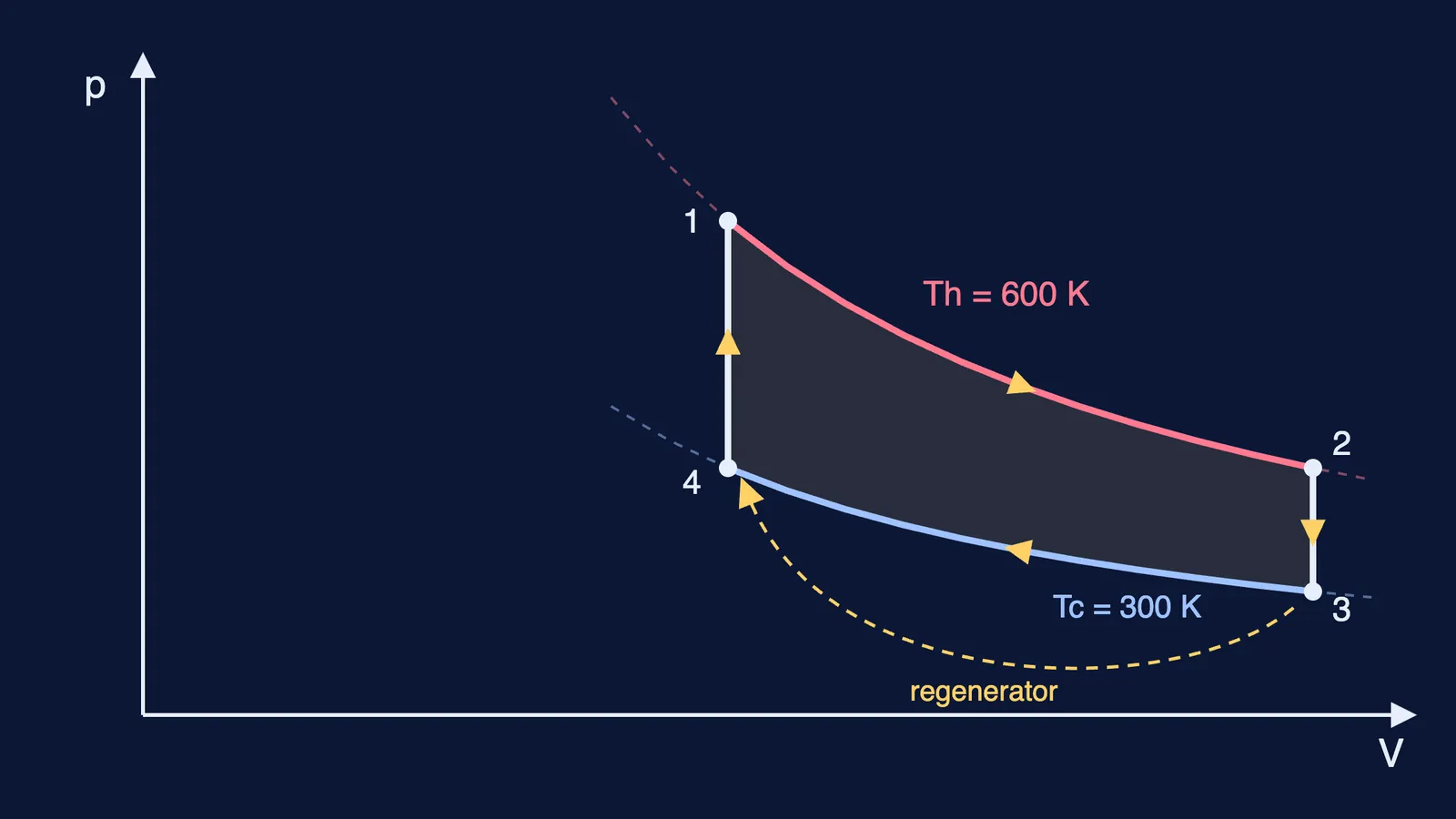
The ideal Stirling cycle has four steps: two at constant temperature and two at constant volume (Wikipedia: Stirling cycle). Follow the numbers on the p–V diagram above.
1 → 2, hot expansion: the gas takes in heat at Th and pushes a piston. This is where the work comes from.
2 → 3, constant-volume cooling: the gas moves to the cold side through the regenerator, which soaks up its heat.
3 → 4, cold compression: the gas is compressed at Tc and gives heat to the cooler. Squeezing cold gas costs less work than the hot gas gave.
4 → 1, constant-volume heating: the gas flows back through the regenerator and picks up the stored heat.
The net work per cycle is the area inside the loop.
What does the regenerator actually do?
The regenerator is an internal heat exchanger and heat store in the gas path. It "stores heat from the working gas during one part of the cycle and returns it during another" (Wikipedia: Stirling engine). NASA puts it the same way: it conserves energy, extracting heat from the gas as it moves from the hot end to the cold end (NASA: dynamic radioisotope power).
Why can a Stirling engine approach Carnot efficiency?
The Carnot efficiency is η = 1 − Tc/Th, with both temperatures in kelvin (Wikipedia: Carnot cycle). No engine working between two fixed temperatures can beat a reversible engine (OpenStax University Physics, Carnot cycle). For the Stirling engine, theoretical thermal efficiency equals that of the ideal Carnot cycle (Wikipedia: Stirling engine). If you still mix up Celsius and kelvin here, read the Celsius-to-kelvin mistake in Carnot efficiency.
Worked example. Take 1 mol of helium, Th = 600 K, Tc = 300 K, and a volume ratio of 2. For an isothermal step of an ideal gas, Q = nRT ln(V2/V1), with R = 8.314 J/(mol K), as in the OpenStax derivation above.
Heat in on the hot curve: 8.314 × 600 × ln 2 ≈ 3,460 J.
Heat out on the cold curve: 8.314 × 300 × ln 2 ≈ 1,730 J.
Net work: about 1,730 J.
With a perfect regenerator: efficiency = 1,730 / 3,460 = 50%, exactly 1 − 300/600.
Without one, the heater must also warm the gas in step 4. For helium, nCvΔT = 1.5 × 8.314 × 300 ≈ 3,740 J. Efficiency falls to 1,730 / 7,200 ≈ 24%.
Same engine, same temperatures: the regenerator roughly doubles the ideal efficiency. Practical Stirling engines deviate substantially from the ideal, because of limited heat transfer, gas friction and mechanical compromises (Wikipedia: Stirling engine). To compare with a petrol engine, see how Otto cycle efficiency depends on compression ratio.
If the four steps still feel abstract, watching a gas trace a loop on a p–V diagram helps; the Fermi Simulation Lab has interactive simulations for ideas that are easier to see than to read.
Where are Stirling engines used today?
Because the heat is supplied from outside, almost any heat source works (Wikipedia: Stirling engine). Uses include:
air-independent propulsion in conventional submarines, including Sweden's Gotland class;
dish-based concentrated solar power;
Stirling-cycle cryocoolers, where the machine runs in reverse to make things cold;
spacecraft power, where NASA has studied small free-piston Stirling engines (NASA: dynamic radioisotope power) to turn heat from the decay of plutonium-238 into electricity (NASA Radioisotope Power Systems).
A five-step checklist for any heat-cycle problem
Convert every temperature to kelvin.
Name each step: isothermal, isochoric, adiabatic or isobaric.
Write Q, W and ΔU for each step (ΔU = 0 on an ideal-gas isotherm).
Ask whether any heat is recycled before adding up heat in.
Check your answer is not above 1 − Tc/Th; only an ideal reversible cycle reaches it.
If you get stuck on a step, the Fermi Problem Library has worked problems with a step-by-step solver that explains the reasoning rather than printing an answer. To see how Fermi's AI tutor works out what you already know and builds a plan for the session, take the tour.