

On this page
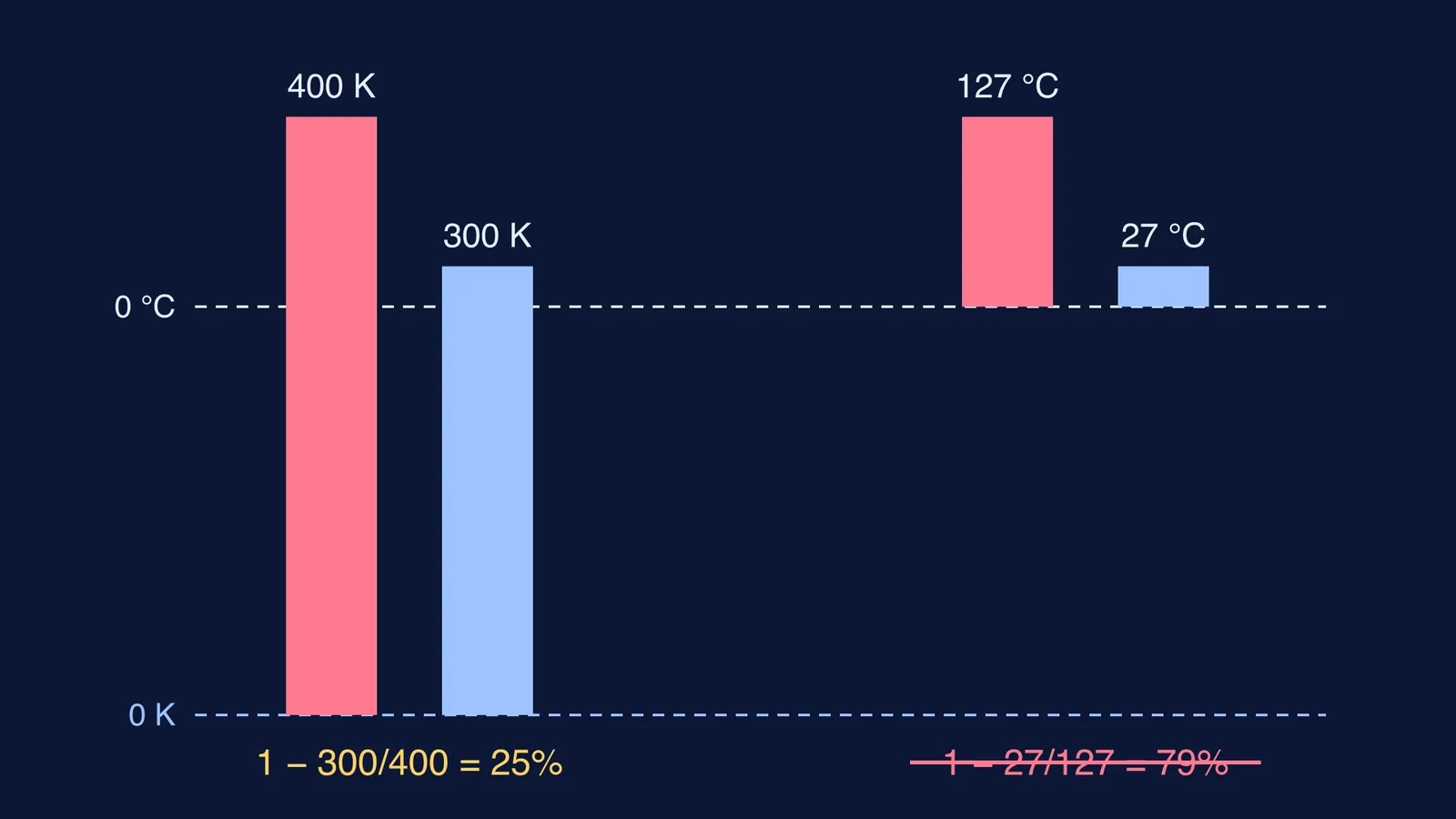
A heat engine runs between 127 °C and 27 °C, and the question asks for its maximum efficiency. You take the Carnot formula η = 1 − T2/T1 from NCERT Class 11 Physics, write η = 1 − 27/127, get 0.787 and answer 78.7%. It is more than three times too big. The correct answer is 25%, and the only thing that changes is the temperature scale.
Why must Carnot efficiency use kelvin, not Celsius?
The NCERT Class 11 Physics textbook gives the efficiency of a Carnot engine working between a source at temperature T1 and a sink at T2 as η = 1 − T2/T1 (NCERT Physics Part 2, Chapter 11: Thermodynamics). The chapter derives this for an ideal gas, using heats such as Q1 = μRT1 ln(V2/V1), which come from PV = μRT. In the gas equation, T is absolute temperature, so every T in the efficiency formula is absolute temperature too.
The deeper reason is that the formula is a ratio. The same NCERT chapter shows that in a Carnot cycle Q1/Q2 = T1/T2, a universal relation that does not depend on the working substance and can be used to define a thermodynamic temperature scale. A ratio only means something when both numbers are measured from a true zero. The kelvin scale starts at absolute zero. The Celsius scale puts its zero near the freezing point of water, a convenient but arbitrary point.
According to NIST, zero degrees Celsius is 273.15 K, one Celsius degree is an interval of 1 K, and 0 K is absolute zero (NIST: SI units of temperature).
Think of measuring two students' heights from the top of a desk instead of the floor: the difference is still right, but "twice as tall" becomes nonsense. Celsius measures from the desk.
How do you calculate Carnot efficiency for 127 °C and 27 °C?
Use the NCERT Carnot formula with both temperatures in kelvin:
Convert the source: T1 = 127 + 273 = 400 K.
Convert the sink: T2 = 27 + 273 = 300 K.
Take the ratio: T2/T1 = 300/400 = 0.75.
Subtract from 1: η = 1 − 0.75 = 0.25, so the maximum efficiency is 25%.
Now the Celsius version: 1 − 27/127 = 100/127, which is about 0.787, or 78.7%.
Here is the interesting part. Write the formula as η = (T1 − T2)/T1. The top line, T1 − T2, is 100 in both scales, because differences survive the change of scale. It is only the bottom line that breaks: 100/400 in kelvin versus 100/127 in Celsius. That is the whole mistake in one fraction.
What happens to the wrong answer when the sink is below 0 °C?
The Celsius error stops looking reasonable. With a sink at 0 °C, 1 − 0/127 gives 100%. NCERT's own summary of the second law says no heat engine can have an efficiency equal to 1 (NCERT Chapter 11). With a sink at −23 °C, the Celsius answer becomes 1 + 23/127, about 118%: more work out than heat in.
In kelvin, −23 °C is 250 K, and η = 1 − 250/400 = 37.5%. A colder sink gives a higher efficiency, still below 1, exactly as the physics says it should. If your answer is 100% or more, you have used Celsius.
Which other formulas need temperature in kelvin?
Use this rule: if T is multiplied, divided or raised to a power, use kelvin. If only a difference ΔT appears, either scale works.
Kelvin needed: the ideal gas equation PV = μRT, and the Carnot relation Q1/Q2 = T1/T2.
Kelvin needed: the coefficient of performance of a Carnot refrigerator, also built from a temperature ratio, as we explain in why a refrigerator works harder in summer.
Either scale: the adiabatic work μR(T1 − T2)/(γ − 1) from the NCERT summary, because only the difference T1 − T2 appears.
For conversions beyond Celsius and kelvin, see how to convert any temperature scale, including a new one.
How do you stop making this mistake in exams?
Run this short routine before substituting:
Circle every temperature in the question before you start.
Convert each one to kelvin and write "K" beside it on your rough sheet.
Ask: does the formula use a difference or a ratio?
Sanity-check the answer: an efficiency must lie between 0 and 1, and a real engine does worse than the Carnot limit.
If you want to see where the work in a cycle comes from, our post on reading work from the PV loop of a heat engine pairs well with this one.
The Fermi Problem Library has worked problems with a step-by-step solver that explains the reasoning rather than printing an answer, so you can follow each step of the method. If absolute temperature itself feels shaky, the Fermi Concept Library gives every concept in physics its own lesson, which is a good place to start.
Next time you see 1 − T2/T1, add 273 before you do anything else.


