

On this page
Temperature conversion questions in Class 11 physics, JEE and school exams look different every time: a "new scale" with odd fixed points, a thermometer that reads wrong, a question about when two scales agree. Underneath, they are all the same straight line.
Why does one formula work for every temperature scale?
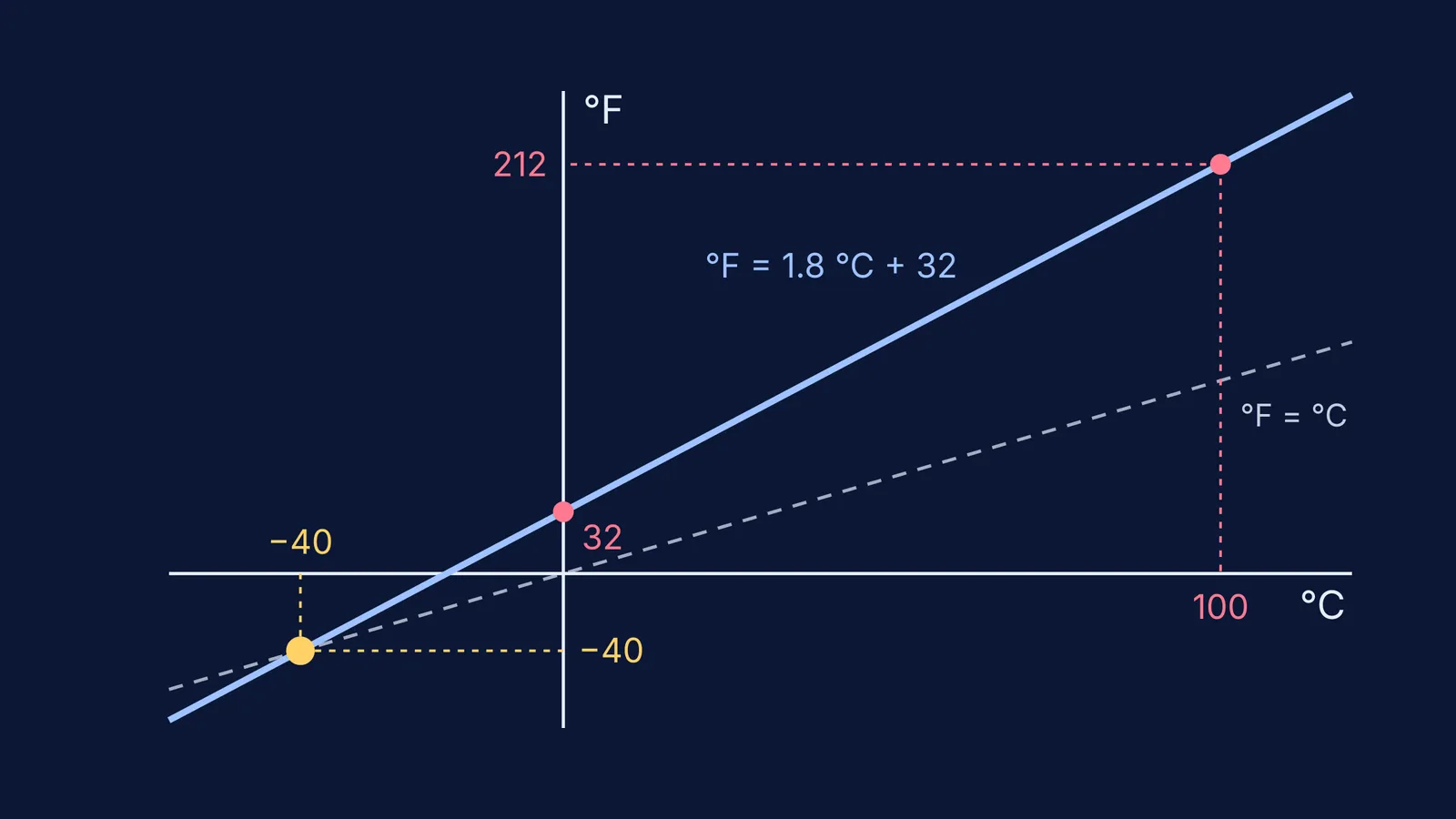
A thermometer scale is fixed by two reference points. The NCERT Class 11 physics chapter on thermal properties of matter (NCERT Physics Part II, Chapter 10) uses the ice point and steam point of water: 0 °C and 100 °C on the Celsius scale, 32 °F and 212 °F on the Fahrenheit scale. Between those points Celsius has 100 equal intervals and Fahrenheit has 180, and NCERT plots one against the other as a straight line.
Because the scales are linear, the fraction of the way from the ice point to the steam point is the same on every scale:
(reading − lower fixed point) ÷ (upper fixed point − lower fixed point) = the same number on every scale
For Celsius and Fahrenheit, NCERT gives this as (tF − 32)/180 = tC/100, which rearranges to °F = (°C × 1.8) + 32, the formula NIST lists for converting Celsius to Fahrenheit. For Kelvin, NCERT gives T = tC + 273.15, and NIST states that 0 °C is 273.15 K.
How do you convert to a new scale with made-up fixed points?
Worked example. A scale X marks the ice point as 20 °X and the steam point as 220 °X. What does it read at 50 °C?
Write the fraction for each scale: (X − 20)/(220 − 20) = (C − 0)/(100 − 0).
Substitute C = 50: (X − 20)/200 = 0.5.
Solve: X − 20 = 100, so X = 120 °X.
Check by plugging in a fixed point: at C = 100 the formula should give 220, and it does.
Why do Celsius and Fahrenheit meet at −40?
Two scales agree where their lines cross. Put °F = °C = x into the NIST conversion formula, °F = 1.8 °C + 32: x = 1.8x + 32, so −0.8x = 32 and x = −40. So −40 °C and −40 °F are the same temperature, which is the yellow point in the diagram at the top of this page.
The same trick works for any pair. For scale X above, set X = C: (C − 20)/200 = C/100 gives C = −20. Kelvin and Celsius never agree, because they differ by the same 273.15 at every temperature.
How do you solve faulty thermometer questions?
A faulty thermometer is just another linear scale with misplaced fixed points. Treat its wrong readings as its own ice and steam points.
Worked example. A thermometer reads 2° in melting ice and 98° in steam. What is the true temperature when it reads 26°, and at what temperature is it correct?
The faulty scale has 98 − 2 = 96 divisions between its fixed points.
True temperature: (26 − 2)/96 = C/100, so C = 25 °C.
Where it is correct: set the reading R equal to C, so (R − 2)/96 = R/100. Then 100R − 200 = 96R and R = 50. It reads correctly only at 50 °C.
Subtracting the 2° error gives 24 °C, which is wrong: 96 marks cover what should be 100 degrees, so the spacing is off too.
Is a temperature difference converted the same way as a temperature?
No, and mixing the two up is an easy slip in calorimetry and thermal expansion problems. A reading needs the offset (+32 or +273.15). A difference does not, because the offsets cancel when you subtract.
A change of 1 °C equals a change of 1 K: NIST states that one Celsius degree is an interval of 1 K.
A change of 1 °C equals a change of 1.8 °F. NIST says so on the same page, and the NCERT graph shows 100 Celsius intervals spanning 180 Fahrenheit intervals.
So a rise from 20 °C to 30 °C is a rise of 10 K and 18 °F, not 283 K or 50 °F.
On a made-up scale, differences convert by the interval ratio alone: on scale X, ΔX = 2 × ΔC.
What should you practise next?
Invent two scales with odd fixed points, convert both ways, and find where they agree. Then redo one calorimetry problem in kelvin and confirm that ΔT does not change.
For background, read why heat and temperature are not the same thing and how a constant volume gas thermometer works. To catch unit slips in longer numericals, try using dimensions to check your physics answers.
When a conversion goes wrong and you cannot see which step broke, the Fermi Problem Library has worked problems with a step-by-step solver that explains the reasoning rather than printing an answer. For the theory behind absolute temperature, the Fermi Concept Library gives each physics concept its own lesson and its place in the map.


