

On this page
A liquid-in-glass thermometer works well for everyday temperatures, but it relies on the uneven expansion of alcohol or mercury and freezes in extreme cold. For precise scientific measurements and calibrations, physicists rely on the constant volume gas thermometer.
By using the reliable, linear expansion of gases, this instrument not only gives us a standard reference scale but also physically demonstrates the existence of absolute zero. In fact, many national standards laboratories use highly calibrated versions of these thermometers as the ultimate reference to check the accuracy of other temperature-measuring devices used in industry and research.
What is the principle behind the gas thermometer?
The thermometer operates on Gay-Lussac's Law, which states that for a fixed mass of an ideal gas kept at a constant volume, the pressure is directly proportional to its absolute temperature (Wikipedia).
If you heat the gas, its molecules gain kinetic energy. They move faster and hit the walls of their container more frequently and with greater force, increasing the pressure. Because the volume of the container is never allowed to change, every single degree of temperature rise produces a perfectly proportional and predictable rise in pressure. This predictability makes it superior to liquid thermometers, whose expansion rates can vary slightly across different temperature ranges.
How does the constant volume gas thermometer work?
A standard constant volume gas thermometer consists of two main parts:
The bulb: A flask usually made of a robust material like glass, platinum, or a metal alloy, filled with a highly ideal gas such as hydrogen or helium. This bulb is placed directly into the substance or environment whose temperature you want to measure.
The manometer: A U-shaped tube containing mercury is connected to the bulb.
As the gas in the bulb heats up, it tries to expand and pushes the mercury down on one side of the tube. To keep the volume of the gas constant, an experimenter raises the open side of the manometer until the mercury on the bulb's side returns to a fixed, permanent reference mark. You then measure the difference in height between the two mercury columns. This height difference tells you the exact gas pressure, which you can mathematically convert into a temperature reading.
Extrapolating to absolute zero
The most profound historical use of the constant volume gas thermometer was discovering the lowest possible temperature in the universe.
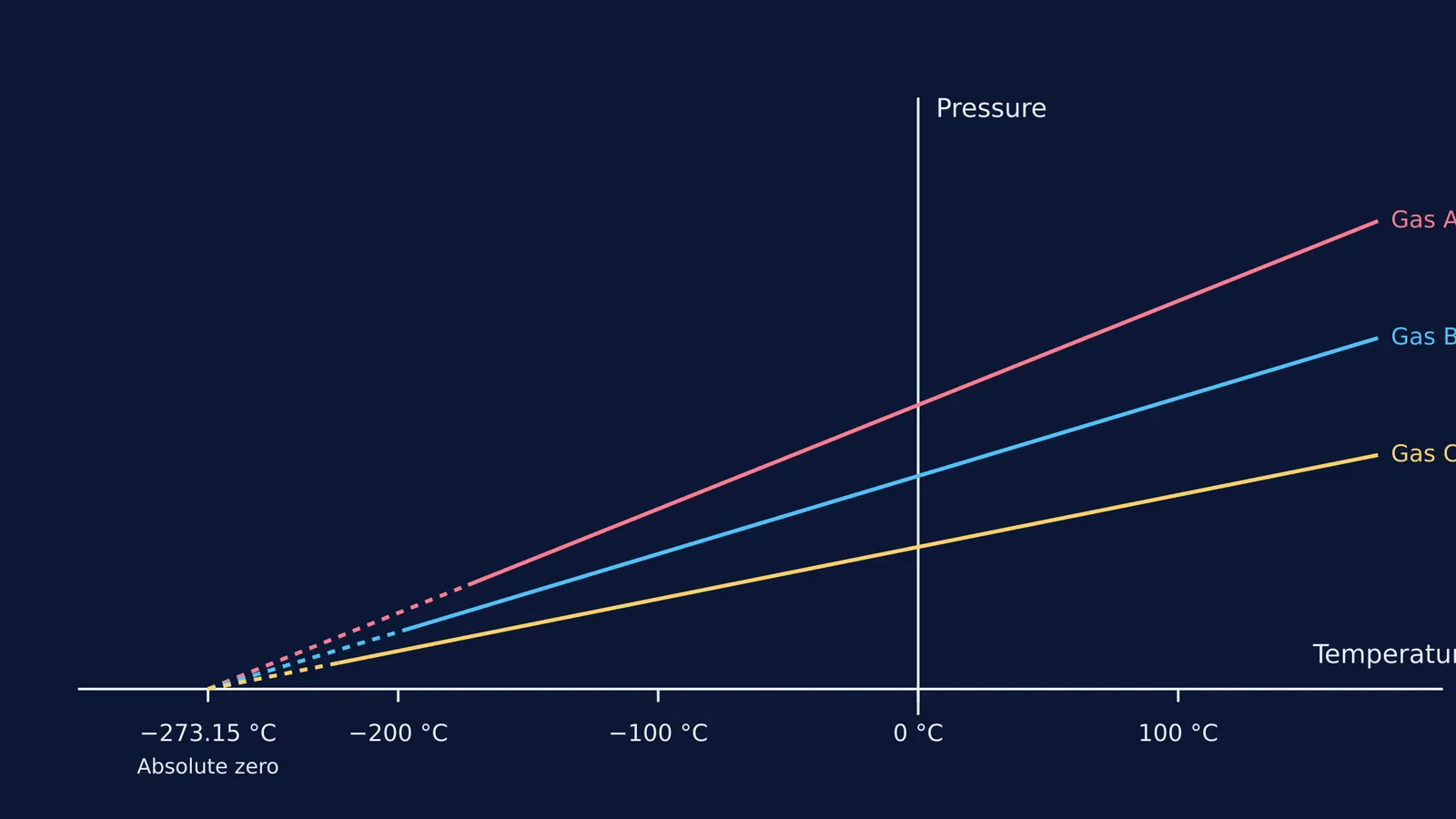
If you take several different gases and plot their pressure against temperature on a graph, you get a series of straight lines with different slopes. Real gases eventually condense into liquids when they get too cold, so you cannot physically measure their pressure all the way down. However, if you draw a dashed line to extrapolate the straight graphs backwards, something remarkable happens: the lines for every single gas intersect the horizontal axis at exactly −273.15 °C (Wikipedia).
At this theoretical point, the pressure of an ideal gas would be mathematically zero because all kinetic motion of the gas molecules has stopped entirely. This is defined as absolute zero, or 0 K on the Kelvin scale.
If you are trying to picture how different gas laws and graphs connect to absolute zero, the Fermi Concept Library maps out every law in thermodynamics so you can trace the history and the math step by step.
The single reference point formula
Historically, thermometers were calibrated using two points, like the freezing point and boiling point of water. Today, a constant volume gas thermometer uses a single, highly precise reference point: the triple point of water, defined exactly as 273.16 K (Wikipedia).
To find an unknown temperature T, you measure the gas pressure at that temperature (P) and compare it to the pressure of the same gas at the triple point (P_tp). The working formula is: T = 273.16 × (P / P_tp)
Worked example: Calculating the temperature
Using the baseline definition of the triple point from Wikipedia, if a constant volume gas thermometer records a pressure of 50 kPa when placed in a water bath at the triple point (273.16 K), what is the temperature of a hot liquid that causes the pressure to rise to 65 kPa?
Identify the given values: P_tp = 50 kPa, P = 65 kPa.
Apply the formula: T = 273.16 × (65 / 50)
Calculate the ratio: 65 / 50 = 1.3
Multiply: T = 273.16 × 1.3 = 355.108 K
To convert this absolute temperature back to the Celsius scale, subtract 273.15, which gives you 81.96 °C.
When you solve gas law calculations in the Fermi Problem Library, the AI tutor writes out each step of the conversion rather than just printing the final answer, ensuring you do not drop marks on unit errors.


