

On this page
A heat engine takes heat from something hot, turns part of it into work and dumps the rest into something cold. On a pressure-volume (pV) diagram, one full trip of the gas is a closed loop that holds two core ideas of Class 11 thermodynamics: how much work you get, and the ceiling on how much you could get.
What does the area inside a PV loop tell you?
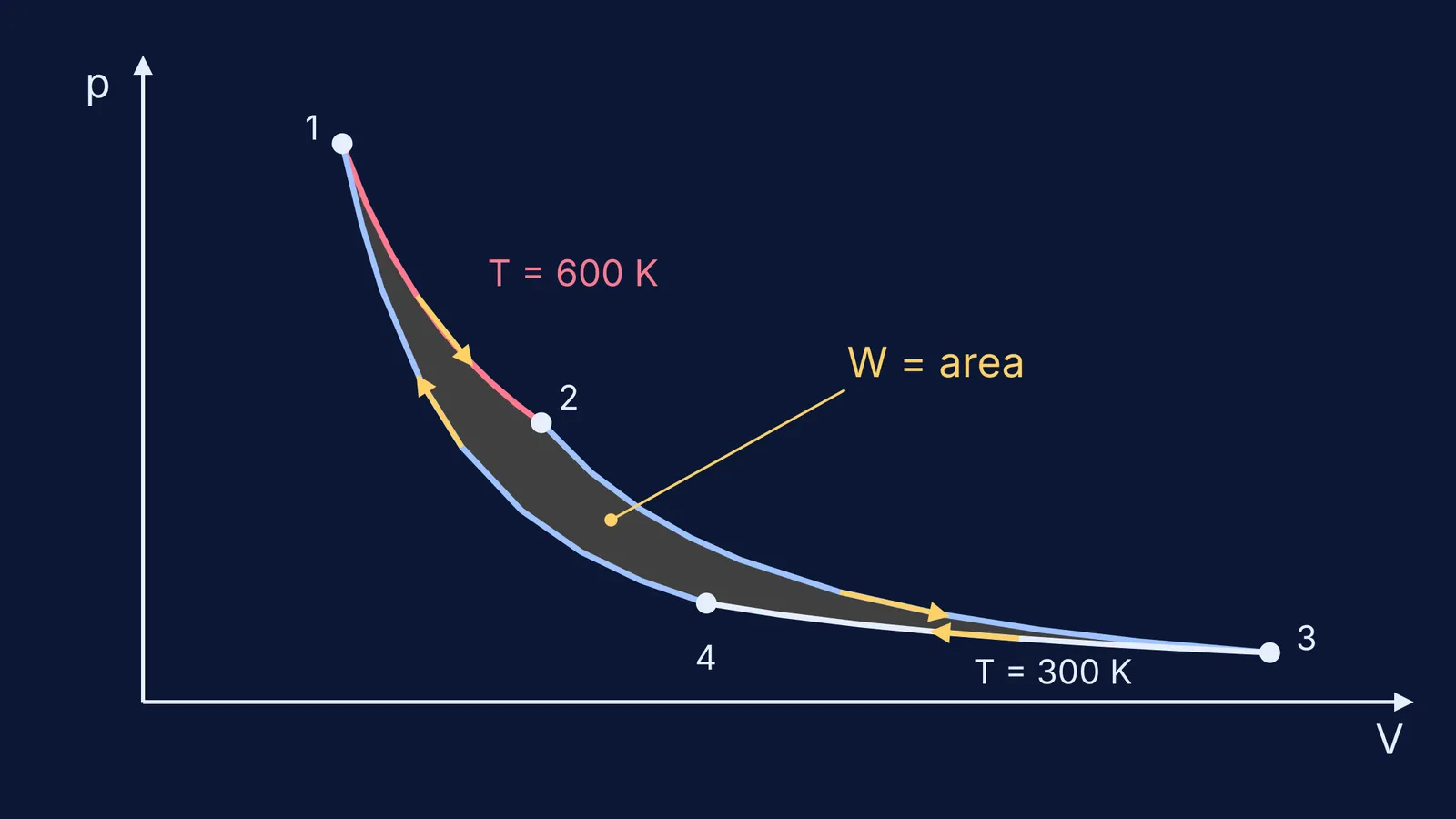
For a single process, the work done by the gas is the area under its pV curve, positive when the gas expands and negative when it is compressed (OpenStax University Physics Volume 2, section 3.2). Go round a closed loop and the expansion areas minus the compression areas leave only the inside of the loop. For the Carnot cycle, the total work done by the gas equals the area enclosed by the loop (OpenStax, section 4.5).
Because the gas ends where it started, its internal energy change over one cycle is zero, so the net work is W = Qh − Qc and the efficiency is e = W/Qh = 1 − Qc/Qh (OpenStax, section 4.2).
How do you run a four-step cycle in a simulation?
The Carnot cycle has four steps (OpenStax, section 4.5):
Isothermal expansion at Th: the gas absorbs heat Qh and does work.
Adiabatic expansion: the gas is insulated and cools from Th to Tc.
Isothermal compression at Tc: the gas gives heat Qc to the cold reservoir.
Adiabatic compression: the gas is insulated and warms back to Th.
A worked example you can rebuild in any simulation that draws a pV diagram, using two relations from the same OpenStax page: Qh = nRTh ln(V2/V1) for the hot isotherm, and TV^(γ−1) = constant on each adiabat. Take 1 mol of a monatomic ideal gas (γ = 5/3), Th = 600 K and Tc = 300 K.
Step 1: expand from 10 L to 20 L at 600 K. Qh = 8.314 × 600 × ln 2 ≈ 3,458 J.
Step 2: halving the temperature on an adiabat multiplies the volume by 2^1.5 ≈ 2.83, taking 20 L to about 56.6 L.
Step 3: compress at 300 K from 56.6 L to 28.3 L. Qc = 8.314 × 300 × ln 2 ≈ 1,729 J.
Step 4: the adiabat from 28.3 L lands exactly back at 10 L and 600 K.
Net work is 3,458 − 1,729 ≈ 1,729 J, so e ≈ 0.50, which matches 1 − 300/600.
Why can't a heat engine reach 100% efficiency?
The Carnot efficiency is e = 1 − Tc/Th, where both temperatures are absolute (OpenStax, section 4.5). The same page states Carnot's principle: no engine working between two reservoirs at constant temperatures can be more efficient than a reversible engine. An efficiency of 1 would need Tc = 0 K, which no real reservoir can reach.
In a simulation, keep the volumes fixed and raise Tc towards Th: the loop shrinks, and when Tc equals Th the two isotherms coincide and the enclosed area, the work, falls to zero.
Which helps more: a hotter source or a colder sink?
Use e = 1 − Tc/Th from the OpenStax Carnot section and change one temperature at a time:
Th = 600 K, Tc = 300 K: e = 50%.
Raise Th by 100 K to 700 K: e = 1 − 3/7 ≈ 57%.
Lower Tc by 100 K to 200 K instead: e = 1 − 1/3 ≈ 67%.
To get 67% by heating alone, Th must reach 900 K.
Efficiency depends on the ratio Tc/Th, so a 100 K change matters more to the smaller temperature. Predict it, then test it.
A 20-minute prediction plan
Set Th and Tc. Write down the Carnot limit before you start.
Sketch the loop and mark its direction. Predict the sign of the net work.
Count grid squares to estimate the area, then run one cycle and compare.
Change only Tc. Predict the new efficiency, run, check.
Change only Th by the same amount. Predict which change helped more.
Build a rectangle from two constant-volume and two constant-pressure steps. Since work is area on a pV diagram, a 100 kPa by 10 L rectangle encloses 1,000 J; check that the simulation agrees.
For the theory behind each curve, see work done in isothermal and adiabatic processes, then practise with Carnot cycle efficiency problems for JEE. Unsure a simulation is worth the time? Read what studies found on simulations versus static diagrams.
If a loop is hard to picture, the Fermi Simulation Lab has interactive simulations for ideas that are easier to see than to read. Fermi's AI tutor can also run the simulation with you and check your understanding as it goes.


