On this page
Yuri Gagarin was 27 when he became the first person to fly in space. His flight went round the planet once and ended under a parachute in a Russian field. Here is what happened, and how to check the physics with Class 11 gravitation.
Who was the first human in space?
The first human in space was Soviet cosmonaut Yuri Gagarin (9 March 1934 to 27 March 1968), according to Royal Museums Greenwich. The Smithsonian's National Air and Space Museum says he was a young Soviet air force pilot when he was picked with 20 others for cosmonaut training in 1960.
Vostok 1 lifted off at 9:07 am Moscow time on 12 April 1961, according to NASA's StarChild page. The launch site was the Soviet rocket base at Baikonur, and after one orbit Gagarin re-entered and parachuted to safety, says the European Space Agency.
How did Vostok 1 fly its one orbit?
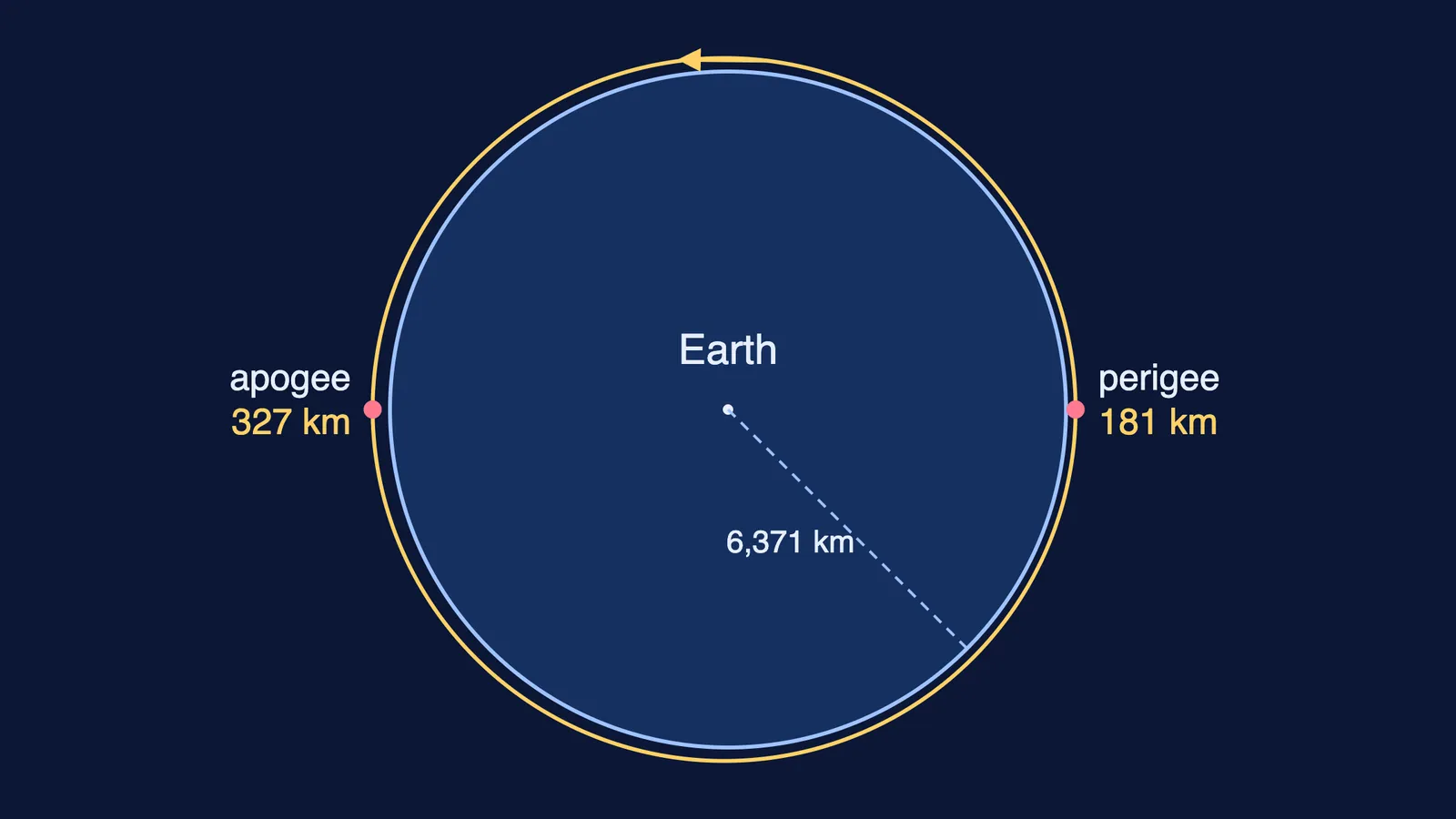
The orbit was an ellipse that came within 181 km of the ground and rose to 327 km, the figures published in Pravda after the flight and collected by space historian Anatoly Zak at RussianSpaceWeb. The plan had been 180 km by 230 km, so the high point of the orbit was about 100 km higher than intended.
NASA says Vostok 1 circled Earth at 27,400 km per hour, with the flight lasting 108 minutes. At that height you are not out of Earth's gravity at all; you are falling round the planet fast enough to keep missing it.
Why did Gagarin eject instead of landing in the capsule?
The ball-shaped Vostok capsule used parachutes, but the cosmonaut had to eject at 7,000 metres to survive the landing, explains the Smithsonian. Early Soviet reports left this detail out.
The way down was rougher than the way up. According to RussianSpaceWeb's landing chapter:
The braking engine fired at about 10:25 Moscow time for roughly 40 seconds.
A valve in the engine had not shut fully, so the burn ended a little early. Escaping gas set the spacecraft spinning, and the capsule did not separate from its equipment module on schedule.
The two modules finally parted at around 10:35 to 10:36, over the Mediterranean.
At 10:42, at a height of 7 km, the hatch blew off and Gagarin ejected.
He landed near the village of Smelovka, near Saratov, at 10:53, according to a 1961 post-flight report published in 2011.
From the launch just before 9:07 to that 10:53 landing is 106 minutes, which is why RussianSpaceWeb's Vostok 1 mission page says the flight lasted 106 minutes, not 108.
What happened to Laika before Gagarin flew?
Laika, a dog, became the first animal to orbit Earth aboard Sputnik 2 on 3 November 1957, says Royal Museums Greenwich. The capsule carried enough food for seven days, but with inadequate oxygen and food supplies her death was expected from the outset. In 1999 several Russian sources said she died on her fourth orbit when the temperature controls failed.
NASA's Sputnik chronology lists Sputnik 1 (83.6 kg) on 4 October 1957 and Sputnik 2 (508.3 kg), carrying Laika, a month later. Laika went first; Gagarin was the first to go and come back.
Can you check Gagarin's orbit with Class 11 physics?
Yes. Kepler's third law gives the time for one orbit, T = 2π√(a³/GM), where a is the semi-major axis (half the long axis of the ellipse). NASA's Earth fact sheet gives Earth's mean radius as 6,371 km and GM as 398,600 km³/s².
Semi-major axis: a = 6,371 + (181 + 327)/2 = 6,625 km.
a³ ≈ 2.908 × 10¹¹ km³. Divide by GM: about 7.295 × 10⁵ s².
Square root: about 854 s. Multiply by 2π: about 5,366 s, or 89.4 minutes.
Compare: the first TASS announcement gave 89.1 minutes for a slightly lower orbit of 175 km by 302 km, as RussianSpaceWeb records. Put those two heights through the same steps and you also get about 89.1 minutes.
Average speed: 2πa ÷ T ≈ 7.76 km/s, about 27,900 km/h, close to the 27,400 km/h NASA quotes.
One puzzle: the same RussianSpaceWeb timeline has the spacecraft leaving its rocket at about 9:18 and the braking burn starting at 10:25:48. That is only about 68 minutes of coasting, less than one 89-minute period. The climb to orbit and the long, falling re-entry covered the rest of the trip.
If orbits still feel like formulas to memorise, the Fermi Simulation Lab has interactive simulations for ideas that are easier to see than read. For more practice, the Fermi Problem Library works through problems with a step-by-step solver that explains the reasoning.
To go further, see how to derive orbital velocity and time period, why rockets have multiple stages, and how India plans to keep its own astronauts safe with Gaganyaan's crew escape system.