On this page
Picture moving 1,000 tonnes of cement across north India by truck, by goods train or by barge on the Ganga. The barge burns the least fuel, and the reasons are school physics: buoyancy, drag and power.
Why is water transport cheaper than road?
Fuel is one of the main running costs of moving freight, so a mode that burns less fuel per tonne per kilometre starts with a big cost advantage. A 2022 update of the Texas A&M Transportation Institute's modal comparison study found that a barge moves one ton of cargo 675 miles on a gallon of fuel, a train 472 miles and a truck 151 miles (Marine Log article on the study, April 2022). The study was done for the National Waterways Foundation, which promotes inland waterways, and the article is by the foundation's chairman. It uses 2019 US data, so treat the exact figures as American and the ranking as the lesson.
Three things put the barge ahead:
Water carries the weight. Buoyancy holds a floating hull up, so the engine is not fighting tyres flexing under a heavy load. It only pushes the hull through the water.
It goes slowly. Drag grows fast with speed, so a slow barge loses little energy per kilometre.
It is big. The same article says one 15-barge river tow carries as much as 1,050 trucks or 216 rail cars (Marine Log, April 2022), so one crew and one set of engines share the work.
How much farther does a barge move a tonne per litre?
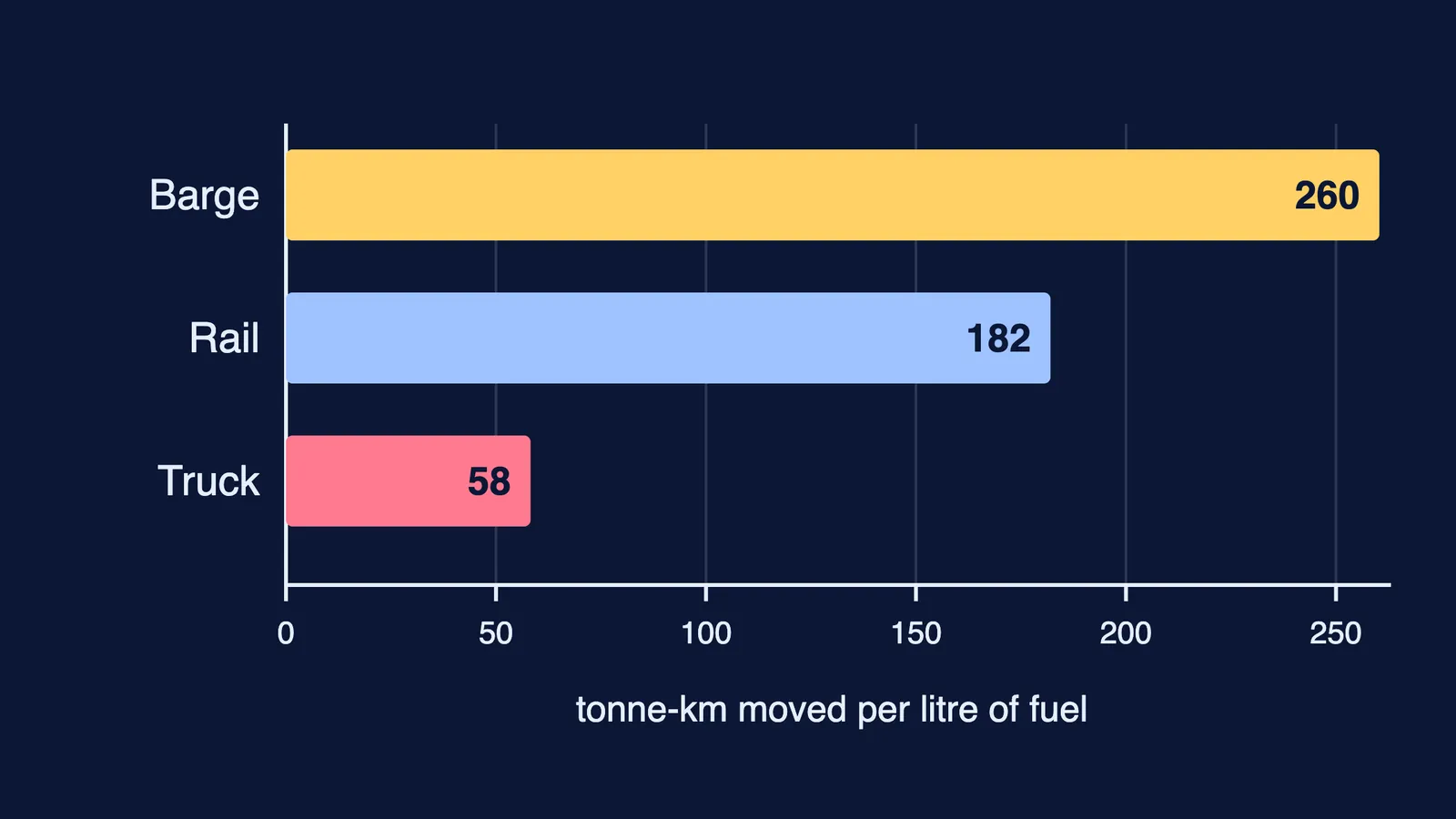
First, convert the US units. One short ton is 0.907 tonne, one mile is 1.609 km and one US gallon is 3.785 litres, so 1 ton-mile per gallon equals 0.907 × 1.609 ÷ 3.785 ≈ 0.386 tonne-km per litre. Applied to the Texas A&M figures:
Barge: 675 × 0.386 ≈ 260 tonne-km per litre
Rail: 472 × 0.386 ≈ 182 tonne-km per litre
Truck: 151 × 0.386 ≈ 58 tonne-km per litre
A litre of diesel moves a tonne about 4.5 times farther by barge than by truck.
Now a worked example. Say you move 100 tonnes of rice 1,000 km, which is 100,000 tonne-km.
By barge: 100,000 ÷ 260 ≈ 385 litres
By rail: 100,000 ÷ 182 ≈ 549 litres
By truck: 100,000 ÷ 58 ≈ 1,724 litres
Why does moving slowly save so much fuel?
The drag force on a body moving through a fluid is F = ½CρAv², where ρ is the fluid's density, A the area facing the flow, C the drag coefficient and v the speed (OpenStax University Physics, section 6.4). OpenStax explains that drag grows with the square of speed for large objects that are not moving too slowly; only very small or very slow objects feel drag proportional to v itself, as in Stokes' law.
In this simple model, fuel burned per kilometre pays for the work done against drag per kilometre, and work per distance is just the force: W/d = F, which grows as v². The engine power needed is force times speed, P = Fv, which grows as v³.
Go 1.5 times faster and drag per kilometre rises 1.5² = 2.25 times.
The engine power needed rises 1.5³ ≈ 3.4 times.
Go half as fast and drag per kilometre falls to a quarter.
Water is far denser than air, so ρ is large and speed is expensive on water, which is why barges go slowly. The same cube law decides how hard a cyclist works against the wind, as our post on why the power to beat air drag grows with the cube of speed shows, and the shape side of the story is in fluid friction and why fish, birds and planes are streamlined.
If v² and v³ are hard to picture, the Fermi Simulation Lab has interactive simulations for ideas that are easier to see than to read.
What is National Waterway 1?
National Waterway 1 is the 1,620 km stretch of the Ganga-Bhagirathi-Hooghly river system from Allahabad (Prayagraj) to Haldia, and it is India's longest waterway (Ministry of Ports, Shipping and Waterways). It runs through Uttar Pradesh, Bihar, Jharkhand and West Bengal, and it is one of 111 waterways declared national under the National Waterways Act, 2016 (Ministry of Shipping list of national waterways).
To raise the river's freight capacity, the government has implemented the Jal Marg Vikas Project on the Haldia-Varanasi stretch, with technical and financial help from the World Bank, at an estimated cost of Rs 5,369.18 crore (Ministry of Ports, Shipping and Waterways).
Physics gives barges the fuel advantage, but rivers set the limits: a barge needs enough water under it all year, terminals at both ends, and usually a truck or train for the first and last leg.
If you get stuck turning a real-world claim like this into equations, Fermi's AI tutor works out what you already know and builds a plan for the session, drawing the figure and checking understanding as it goes.