On this page
Ride a bicycle into the wind and you feel it: the faster you go, the harder the air pushes back. A review in Sports Biomechanics notes that when cycling on level ground faster than 14 m/s (about 50 km/h), about 90% of the rider's total mechanical power output is needed to overcome aerodynamic drag (Debraux et al., 2011).
Why does air drag grow with the square of speed?
NASA's drag equation is D = ½ · Cd · ρ · A · v², where Cd is the drag coefficient, ρ is air density, A is the reference area and v is the speed (NASA Glenn Research Center).
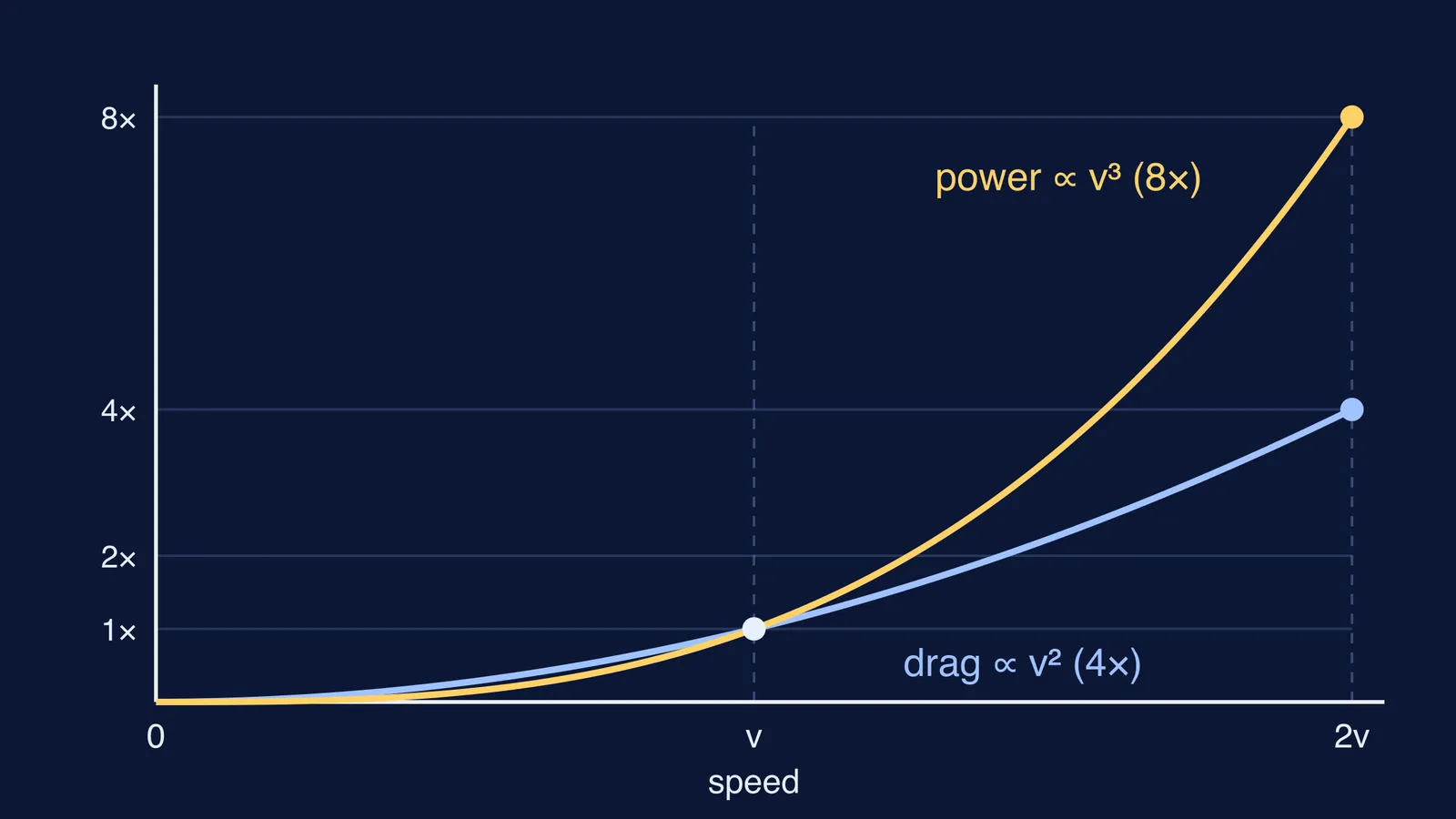
A simple picture explains the square. Go twice as fast and you hit twice as much air every second, and you throw each parcel of air aside twice as hard. Two factors of v give v², so drag quadruples when speed doubles.
Small, slow objects in thick fluids follow a different, linear law; our post on terminal velocity with linear vs quadratic drag compares the two.
Why does power increase with the cube of speed?
At a steady speed on flat ground, the push from your legs balances drag and the other resistive forces. Power is force times velocity, P = F · v, so multiplying the drag equation by v gives the power spent on drag:
P = ½ · Cd · ρ · A · v³
Double v and v³ becomes 2³ = 8 times larger. Drag goes up 4 times, and you are pushing against that larger force while covering ground twice as fast.
There is a second way to see it. The energy needed per kilometre is force times distance, so it grows as v²: four times the energy for each kilometre. But you finish that kilometre in half the time. Four times the energy in half the time is eight times the power. If P = F · v still feels shaky, our worked example on power for a car moving up an incline at constant speed uses the same idea.
How much power does a cyclist need against drag? A worked example
We need two real inputs. A 2025 study measured a mean drag area (Cd × A) of 0.208 m² for ten male cyclists riding in an indoor velodrome (Hopker et al., European Journal of Sport Science). NASA gives sea-level air density as about 1.229 kg/m³ (NASA Glenn Research Center); we round it to 1.2.
First combine the constants: ½ × 1.2 × 0.208 ≈ 0.125 kg/m. Then drag ≈ 0.125 v² newtons and power ≈ 0.125 v³ watts.
At 5 m/s (18 km/h): drag ≈ 3.1 N, power ≈ 16 W.
At 10 m/s (36 km/h): drag ≈ 12.5 N, power ≈ 125 W.
At 15 m/s (54 km/h): drag ≈ 28 N, power ≈ 420 W.
At 20 m/s (72 km/h): drag ≈ 50 N, power ≈ 1000 W.
Compare rows 1 and 2, or rows 2 and 4: each time the speed doubles, drag rises 4 times and power 8 times. Riding 10% faster needs 1.1³ ≈ 1.33, or about a third more power.
These figures cover drag alone, using a drag area measured on riders in a velodrome. Someone sitting upright on a commuter bike has a larger drag area. Tyres and chain also take some power, which is why the roughly 90% share of power going to drag applies only at high speed (Debraux et al., 2011); at slow speeds the total power grows by a bit less than eight times.
Wind changes the picture too, because drag depends on your speed relative to the air. Ride at 5 m/s into a 5 m/s headwind and the air rushes past at 10 m/s. Drag is now about 12.5 N, and the power is 12.5 × 5 ≈ 62 W, about four times the still-air value.
What mistakes do students make with drag and power?
Check these slips against the drag equation before you write the final ratio in JEE or board exams:
Writing 4 times for power because "drag goes as v²". Power is drag times speed, which adds one more v.
Using ground speed in the drag formula on a windy day. Drag uses speed relative to the air; power uses that drag times your speed over the ground.
Squaring speeds in km/h and then mixing them with SI constants. Convert to m/s (divide by 3.6) first. For a pure ratio question, units cancel.
Reversing the cube wrongly. Doubling the power against drag raises speed by the cube root of 2, about 1.26, so only about 26% faster.
If you want to practise ratio questions like these, the Fermi Problem Library has worked problems with a step-by-step solver that explains the reasoning rather than printing an answer. If the gap is in the ideas behind them, the Fermi Concept Library gives every concept in physics its own lesson.
Next time you ride a little faster than usual and feel it get much harder, that is v³ at work.