

On this page
To calculate the power needed for a car moving up an incline at a constant speed, use the formula P = (mg sin θ + friction) × v. The engine must provide enough forward force to overcome both the downhill pull of gravity and any resistive forces, multiplied by the car's velocity. According to OpenStax University Physics, a 1200 kg car climbing an 8.53° slope at 25 m/s, with 25% of its power used against air resistance and friction, requires a total power of 58 kW.
When you drive a car along a flat road at a steady speed, the engine only needs to work against air drag and rolling resistance. But the moment the road tilts upwards, you can feel the engine strain. The steepness of the hill, the mass of the car, and the speed you want to maintain all dictate exactly how much power the engine must deliver.
In mechanics, solving for this power is a classic application of Newton's laws and the work-energy theorem.
What are the forces on a car climbing an incline?
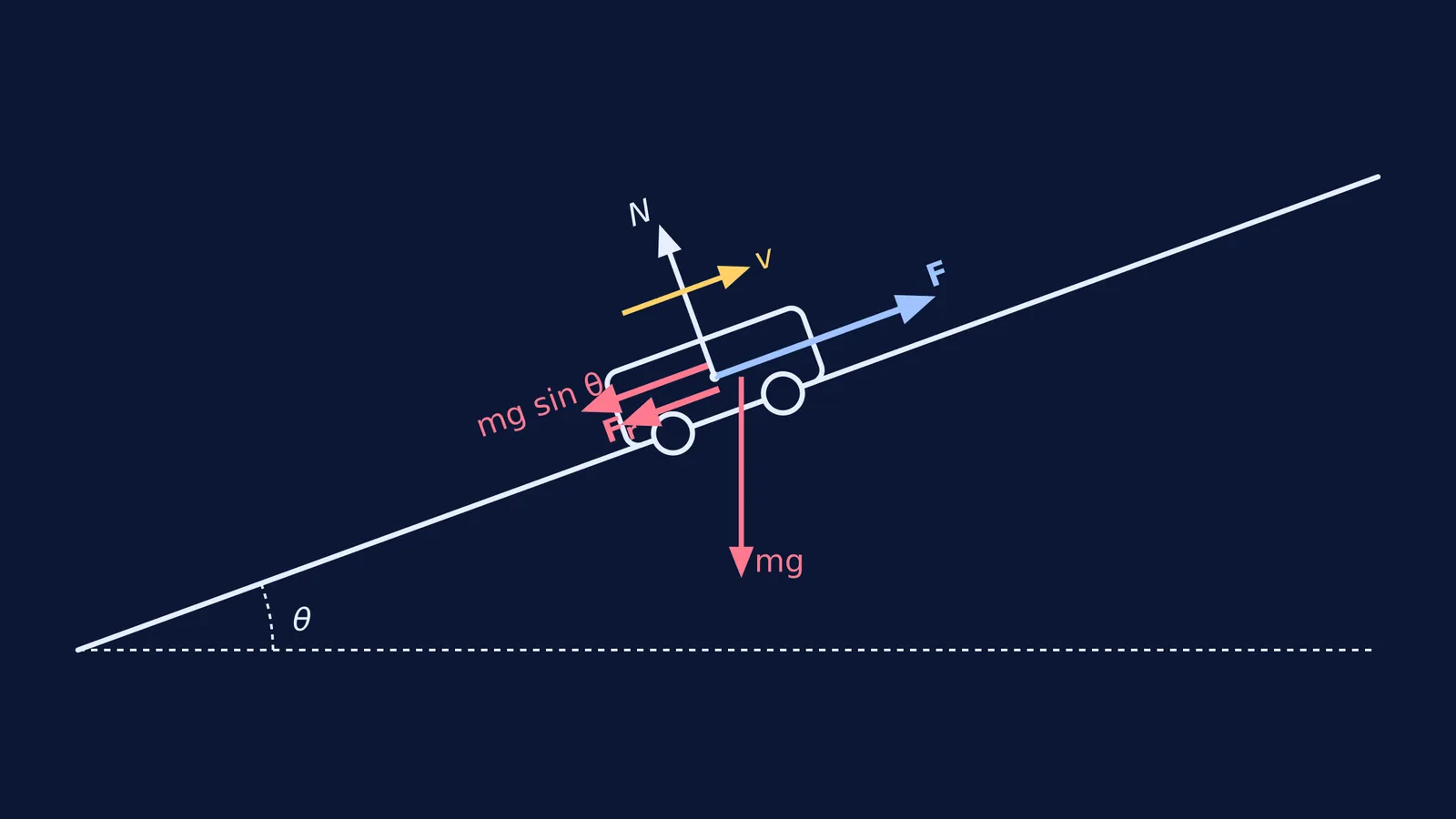
When a car moves up a slope at a constant speed, its acceleration is zero. By Newton's second law, this means the net force acting on the car is also zero.
To keep the car moving, the engine must supply a forward force (F) that perfectly balances all the forces pushing it backward down the slope. These opposing forces fall into two categories:
Gravity: The car's weight acts straight down, but on an incline of angle θ, part of this weight pulls the car backward down the slope. This component is mg sin θ, where m is the car's mass and g is the acceleration due to gravity (9.8 m/s²).
Resistive forces: This includes rolling friction from the tyres and aerodynamic drag pushing against the car's body. We group these together as a single frictional force, Fr.
So, the total force the engine must exert is: F = mg sin θ + Fr
If you want to review how these components are derived from a free-body diagram, reading about a block sliding down a rough incline is a great place to start.
What is the formula for power needed for a car moving up an incline at constant speed?
Power (P) is the rate at which work is done. If an object is moving at a constant velocity v while being pushed by a force F in the same direction, the power delivered is: P = F × v
Substituting the engine force we found earlier into this equation gives the final formula for the power required: P = (mg sin θ + Fr) × v
This equation tells you three things:
Heavier cars require proportionally more power to maintain the same speed on a hill.
The steeper the incline (larger θ), the greater the mg sin θ term, demanding more power.
Power scales directly with velocity. Doubling your speed up the same hill requires twice the power.
A worked example: calculating the engine power
Let's put numbers to the formula to see how it works in practice, using an example from OpenStax University Physics.
First, we calculate the power required just to overcome gravity:
P_gravity = (mg sin θ) × v
P_gravity = (1200 kg × 9.8 m/s² × sin 8.53°) × 25 m/s
P_gravity ≈ 43.5 kW
Since 43.5 kW represents 75% of the total power required, we divide by 0.75 to find the total power. The calculation shows the car requires a total power of 58 kW.
That 58 kW (about 78 horsepower) is just the mechanical power delivered to the wheels to keep the car moving. A real engine must generate even more power internally to make up for heat and mechanical losses in the drivetrain.
Why does top speed drop on a steeper slope?
Every car engine has a maximum power output. If you rewrite the power equation to solve for velocity, you get: v = P / (mg sin θ + Fr)
When the engine delivers its maximum power, this equation gives the car's top speed. As the slope gets steeper (θ increases), the denominator grows larger, which means the maximum speed v must decrease. This is why you have to shift into a lower gear and drive slower to get a heavy vehicle up a mountain pass. It is a limitation of power, not just force. Similar principles apply when a car drives over uneven terrain, such as a car going over a hump, where you must consider normal force and lifting.
Checking your physics reasoning
Mechanics problems often throw multiple forces and angles at you, making it easy to mix up sines and cosines or forget a resistive force. The Fermi Concept Library explains every concept in physics, chemistry, biology, mathematics and computing, each with its own lesson and its place in the map.
When you are stuck on a tough homework question, Fermi's AI tutor does not just hand you the answer. It teaches — it holds a line of reasoning across a whole session, notices where a student is stuck, and decides whether to explain, ask, or show. It draws the figure, checks your equations step by step, and ensures you understand exactly why mg sin θ opposes the motion.


