

On this page
Push your open hand through the water in a pool or bucket. Hold it flat, palm facing forward, and the water shoves it back hard. Turn it edge-on and the push almost disappears. Only the shape the water meets has changed, and that one idea explains why a mackerel, a swift and an aircraft all end up looking alike.
What is fluid friction, or drag?
Physicists call liquids and gases fluids, and both resist anything moving through them. NASA's Glenn Research Center defines drag as "the aerodynamic force that opposes an aircraft's motion through the air", and the same idea applies to a fish in water.
The same NASA page splits drag into two main parts:
Skin friction: the fluid rubbing along the surface. A smooth surface gives less of it than a rough one, and it depends on the fluid's viscosity.
Form (pressure) drag: the push that comes from the pressure differences around the body. This part depends on the object's shape.
In school problems "fluid friction" usually means all of this together. Unlike friction between two solid blocks, it is not a fixed number: it changes with speed.
What does drag depend on?
NASA's drag equation sums it up as D = Cd × ρ × V² × A / 2, where ρ is the fluid's density, V the speed, A the reference area and Cd the drag coefficient.
Read it term by term and you have a checklist:
Speed, squared. Double your speed and drag becomes four times larger.
Density. Denser fluid, more drag. Water is about 1 g/cm³, or 1000 kg/m³, according to the USGS, while standard sea-level air is 1.229 kg/m³ according to NASA. That makes water roughly 800 times denser than air, which is why wading is so slow.
Area. A bigger face meeting the flow means more drag.
Shape, through Cd. This is the term nature and engineers can change most.
If you want the version of drag that grows linearly with speed for tiny, slow objects (Stokes' law), our post on linear and quadratic drag in terminal velocity problems sets the two side by side.
Why are fish, birds and planes streamlined?
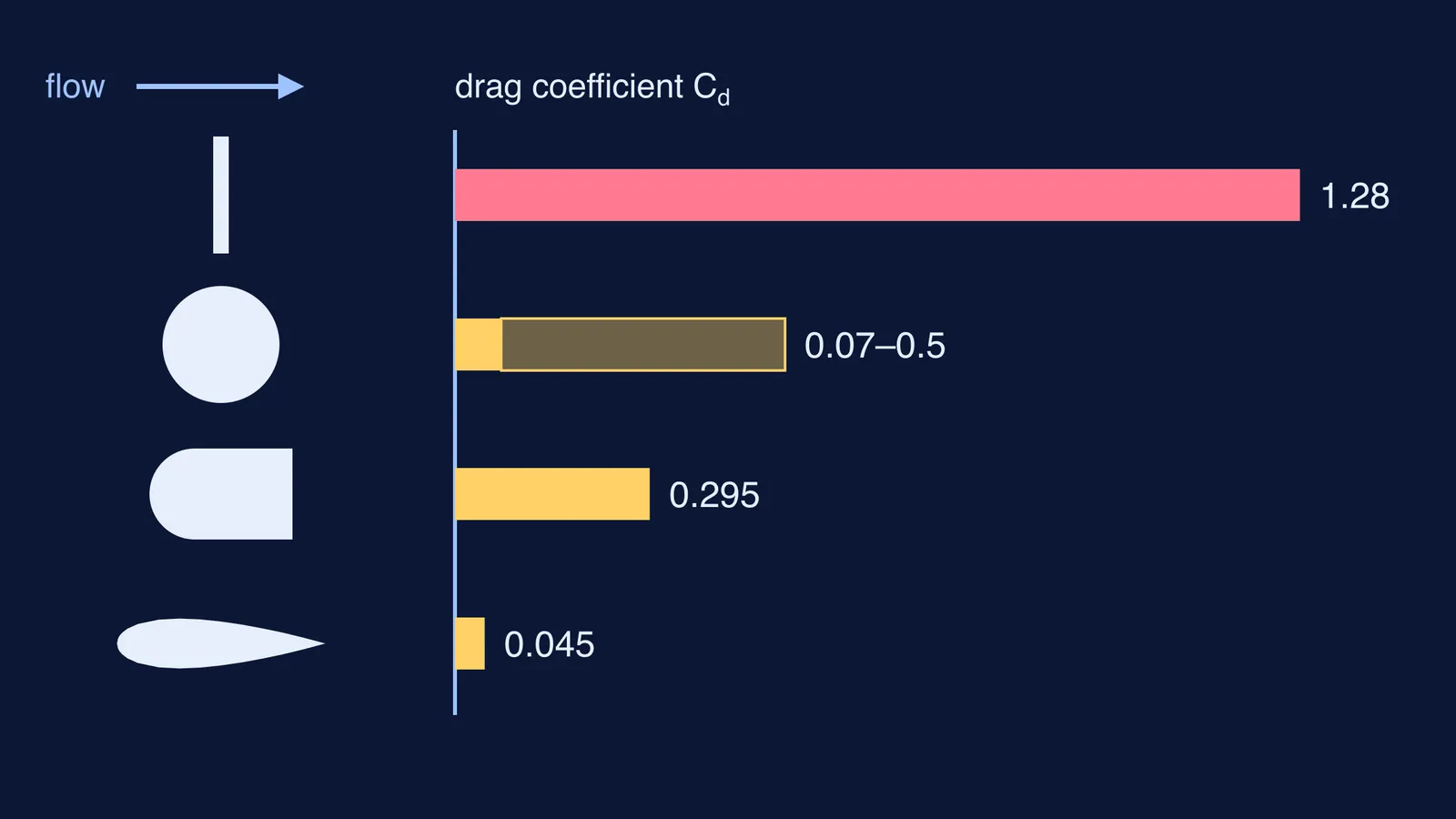
NASA's page on shape effects on drag lists drag coefficients for a few simple shapes:
Flat plate facing the flow: Cd = 1.28
Sphere: Cd varying from 0.07 to 0.5
Bullet: Cd = 0.295
Typical airfoil: Cd = 0.045
The same page notes that a streamlined symmetric airfoil gives the lowest drag, by a factor of almost 30 compared with the flat plate, and that reshaping the back of a body is one way to reduce drag. A streamlined body is rounded at the front and tapers gently to a narrow tail, so the fluid closes in smoothly behind it instead of breaking into a wide, swirling wake.
That is the shape you see in a fish's spindle-shaped body, a diving bird with its wings tucked in, and an aircraft fuselage. Animals that must move fast through a fluid all day, and machines that burn fuel to do it, are pushed towards the same answer. Our post on how a fish's streamlined body and fins work together follows the biology side, and the story of George Cayley, who helped define lift, drag and thrust, shows how engineers came to the same idea.
A worked example: plate versus airfoil
Use the NASA drag coefficients above. Take two objects with the same frontal area, A = 0.5 m², moving at 20 m/s (72 km/h) through sea-level air, ρ = 1.229 kg/m³.
Work out ρ × V² / 2 = 1.229 × 400 / 2 ≈ 246 N/m².
Multiply by the area: 246 × 0.5 ≈ 123 N.
Flat plate: 123 × 1.28 ≈ 157 N.
Airfoil: 123 × 0.045 ≈ 5.5 N.
Same size, same speed, about 28 times less drag. Now double the speed to 40 m/s: both forces become four times larger, about 629 N and 22 N.
Finally, put the same two shapes in water at just 2 m/s, with ρ = 1000 kg/m³ (USGS). Then ρ × V² / 2 = 2000 N/m², times 0.5 m² gives 1000 N. The plate feels about 1280 N and the airfoil about 45 N. Walking pace in water beats highway speed in air, which is why streamlining matters so much to a fish.
If a drag or terminal-velocity numerical keeps going wrong at the same step, the Fermi Problem Library has worked problems with a step-by-step solver that explains the reasoning rather than printing an answer. For ideas that are easier to see than to read, the Fermi Simulation Lab has interactive simulations.
Next time you are in a pool, try the hand test again, flat and then edge-on, and you will feel Cd change in your palm.


