

If you have ever tried to run waist-deep in a swimming pool, you know how hard it is to move through water. To survive and thrive, aquatic animals have to overcome this immense resistance without exhausting all their energy.
The solution, which you might first encounter in your Class 6 science textbook, is a combination of a highly specific body shape and a set of specialized fins. It is a biological design that perfectly solves a physics problem, allowing aquatic animals to move with incredible efficiency.
Why are fish streamlined?
Liquid water is incredibly dense—about 1 gram per cubic centimetre. Because water is so dense, any object moving through it faces severe friction and pressure, known in physics as drag.
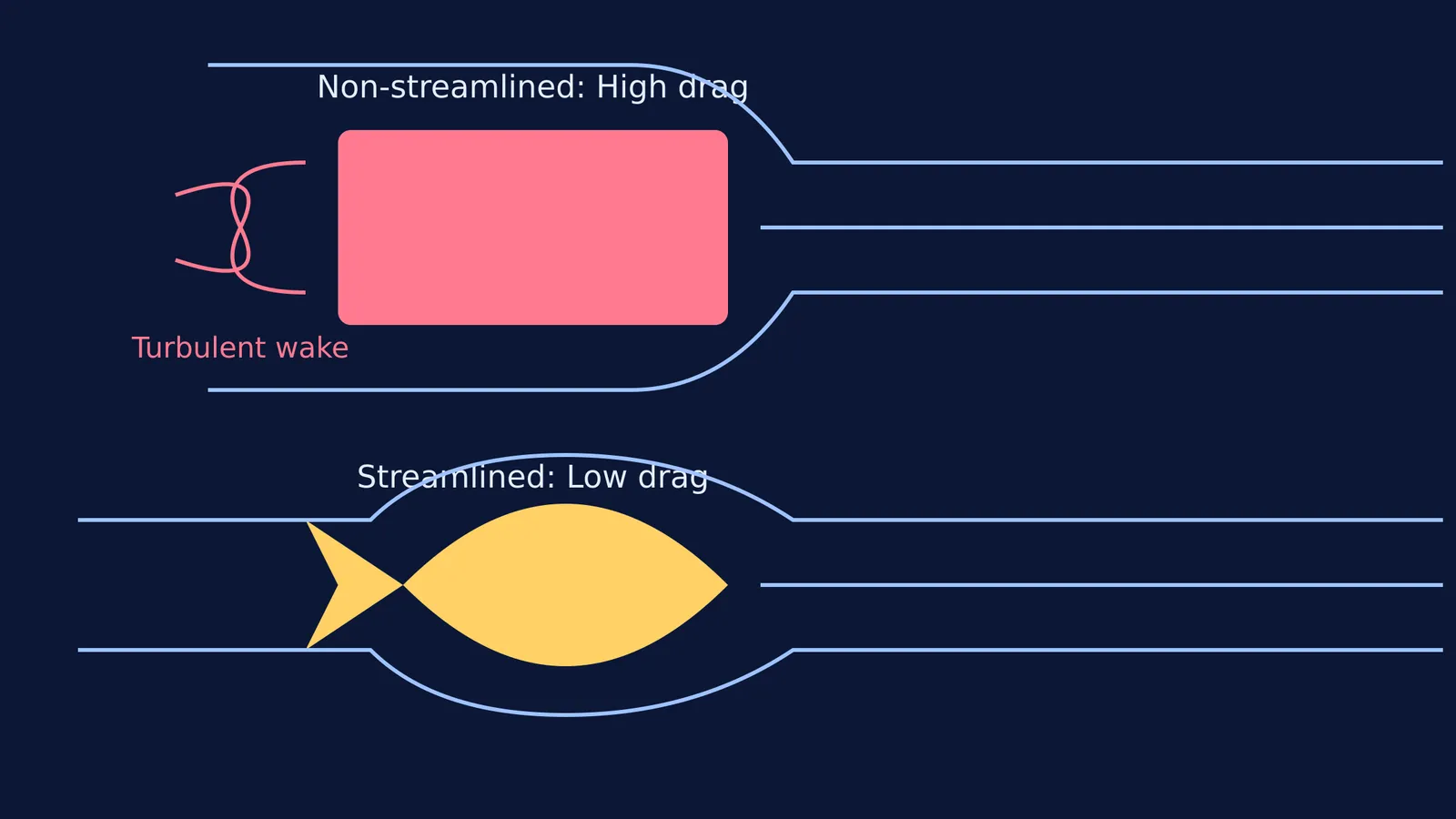
To beat this drag, most fish have a streamlined, or fusiform, body. A streamlined body is thickest in the middle and tapers to a narrow point at both the head and the tail. When a fish moves forward, this shape allows the dense water to part smoothly at the inflexible head and flow neatly along the gentle curves of the sides, closing cleanly behind the tail without creating excessive drag.
The external surface of a fish is also highly adapted. The scales of a fish typically overlap and point backwards. This precise arrangement allows water to pass over the fish smoothly without unnecessary obstruction or friction. Furthermore, their bodies are often covered in a slippery layer of mucus, which reduces skin friction even further.
If a fish were shaped like a rectangular box, the water hitting its flat front would create massive pressure resistance. As the water rushed past the sharp corners of the box, it would separate from the surface and break into swirling, chaotic eddies behind the object. This area of low pressure and turbulence is called a wake, and it effectively pulls the object backwards. By being streamlined, a fish prevents this turbulent wake, saving the precious energy it needs to hunt prey or escape predators over long distances. When you look closely at how a fish glides, you are really watching a masterclass in turbulence in fluid flow—a subject that physicists spend decades mapping.
How do the tail and fins help a fish swim?
While the streamlined shape makes movement easier, the fish still needs a motor and a steering wheel. That is where the muscles, tail, and fins come in.
A fish generally swims by contracting strong muscles along its sides. It curves the front part of its body to one side, while the tail swings toward the opposite side. Then, it quickly reverses the curve. This rapid side-to-side, wave-like sequence pushes against the water.
The caudal fin (tail): This is the main engine of propulsion, providing the raw power for the fish to move forward. When the fish's body flexes from side to side, the broad surface of the tail sweeps backward against the dense water. The shape of the tail even tells you how the fish swims. For example, high-speed swimmers like tuna use large, powerful, crescent-shaped tails where virtually all movement is concentrated. In contrast, other species might only oscillate the tail fin rapidly while keeping the rest of the body stiff.
The dorsal and anal fins: Located on the top (dorsal) and bottom (anal) edges of the fish, these unpaired median fins act as stabilizers. They keep the fish upright and primarily reduce rolling or yawing (side-to-side swinging) as it pushes forward. In some species, like the bowfin or knifefish, these fins undulate to generate propulsion.
The pectoral and pelvic fins: These are the paired fins on the sides and bottom of the fish. A fish uses them for fine control and maneuvering. Pectoral fins act as pivots for rapid turning, steering, and braking. Together with pelvic fins, they control pitching (up-and-down movement). Some sharks even use their pectoral fins like airplane wings to create dynamic lift, maintaining their depth in the water. To fully understand how these traits serve an animal's survival, biologists ask questions about adaptation and function, much like Niko Tinbergen and the four questions of animal behaviour.
When you are studying biomechanics, the way forces act on an object can sometimes feel abstract. If you want to explore the physics of drag and fluid mechanics further, the Fermi Concept Library has a lesson for every concept in physics and its place in the map.


