On this page
Ask "why does a gull chick peck at its parent's beak?" and you can get four correct answers that sound nothing alike. One is about what the chick sees, one about how the habit develops, one about what it gains and one about its ancestors. Niko Tinbergen saw that biologists kept talking past each other because they mixed these up. This post covers who he was, the experiments behind his ideas and how his four questions can make your own biology answers clearer.
Who was Niko Tinbergen?
His Nobel Prize facts page records that he was born in The Hague on 15 April 1907 and died in Oxford on 21 December 1988. He shared the 1973 Nobel Prize in Physiology or Medicine with Konrad Lorenz and Karl von Frisch "for their discoveries concerning organization and elicitation of individual and social behaviour patterns".
In his Nobel autobiography he admits he "only just scraped through" school and university, preferring camping, bird watching, skating and hockey. As a boy he kept two small aquaria in the backyard and watched sticklebacks build nests each spring. His PhD thesis, on how digger wasps called beewolves find their way home, ran to just 32 pages and passed "only after grave doubts".
He met Lorenz at a 1936 symposium in Leiden and spent four months at Lorenz's home near Vienna. He describes their partnership as Lorenz's vision combined with his own "irrepressible urge to check our 'hunches' by experimentation". During the Second World War he spent two years in a German hostage camp. Afterwards he moved to Oxford, where he built a research group in animal behaviour and was elected a Fellow of the Royal Society in 1962. The Royal Society's biographical memoir, by Robert Hinde, adds that his family produced two Nobel laureates: Niko, and his eldest brother in economics.
How did dummy experiments work?
Tinbergen's method was to make simple models and see which features an animal responds to. The Nobel Foundation's summary notes one of his findings from the late 1930s: birds preferred to brood eggs with exaggerated markings of size, spots and colour.
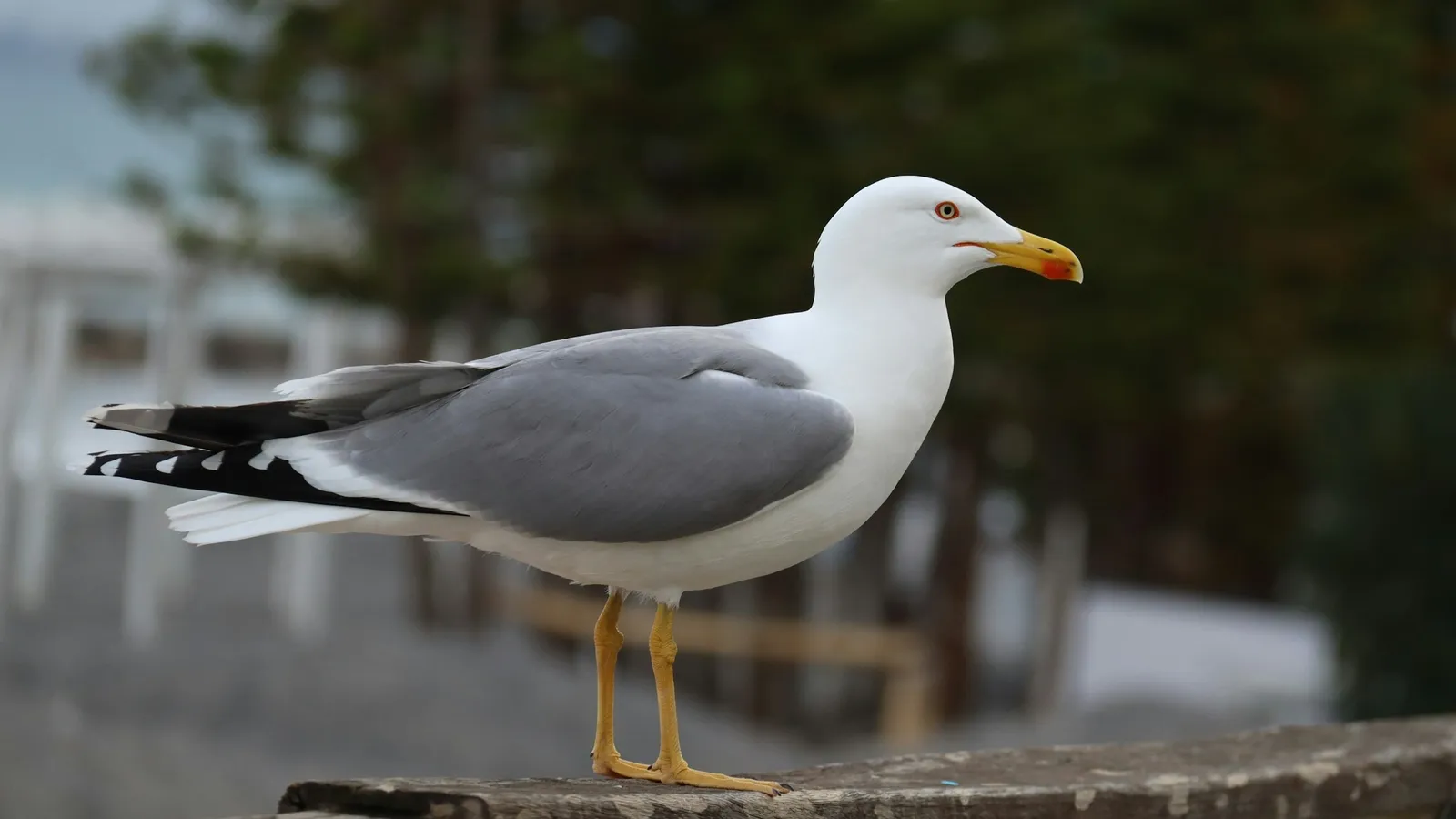
His best-known study, with A. C. Perdeck, looked at newly hatched herring gull chicks, which peck at the tip of a parent's bill to beg for food. Their paper in the journal Behaviour reports that the response is innate and that the bill supplies the key stimuli; the shape, colour and size of the head were irrelevant. What mattered included the bill's movement, its long thin shape, how low and close it was held, and the red spot near its tip, which worked through its red colour and its contrast with the bill. By exaggerating some of these features they made a "supernormal" dummy that worked even better than a real bill.
What are the four questions?
In 1963 Tinbergen published On aims and methods of Ethology. Its German summary says that behaviour can be studied as rigorously as any other life process: its survival value as systematically as its causation, its development in the same way as the development of body form, and its evolution in parallel with the evolution of structure. The same summary credits Lorenz with showing how to apply biological thinking to behaviour. Those are the four questions:
Causation: what triggers the behaviour right now, and what happens inside the animal?
Development: how does the behaviour appear and change as the animal grows?
Survival value (function): how does it help the animal survive and reproduce?
Evolution: how did it arise in the animal's ancestors?
Bateson and Laland's 2013 review in Trends in Ecology and Evolution, titled "Tinbergen's four questions: an appreciation and an update", shows the framework was still being discussed half a century later.
Worked example: the gull chick, four ways
Causation: the sight of a moving, low, thin bill with a red spot triggers pecking, as the dummy experiments showed.
Development: the paper calls the response innate; it is present in newly hatched chicks.
Survival value: pecking makes the parent bring up food, so the chick is fed.
Evolution: this asks how the response and the red spot arose in gull ancestors. Tinbergen and Perdeck argued that the red spot, unlike other bill features, should be seen as an adaptation for this signalling role.
The common mistake is to answer one question when another was asked. "The chick pecks because it is hungry" is causation. "The chick pecks to get food" is survival value. Both are true, but they are different answers.
Is this in the NEET or CBSE syllabus?
Animal behaviour has no chapter of its own in the current NCERT Class 11 and 12 biology books, as our post on Konrad Lorenz and imprinting notes after checking all the chapter PDFs. The four questions belong to university zoology and psychology. But the habit of separating "how it works" from "what it is for" helps in every chapter. When NCERT asks why the heart has valves, it wants function; when it asks what makes the valves close, it wants causation. If you cannot tell which kind of explanation a question wants, Fermi's AI tutor notices where you are stuck and decides whether to explain, ask or show, so you can practise the distinction on real questions.
Was Tinbergen always right?
No. In his 1973 Nobel lecture he turned to early childhood autism, arguing from observation that "neither for genetic abnormalities nor for gross brain damage was there any convincing, direct evidence". Later research does not support that view: the World Health Organization says evidence points to many factors, including genetic ones. Careful observation is powerful, but it cannot replace evidence from other methods.
What can a student take from Tinbergen?
Watch first. He called his method "watching and wondering", and it started with two aquaria in a backyard.
Then test. He was the one who turned Lorenz's hunches into experiments.
Name the question. Before you answer "why", decide which of the four kinds of why you mean.
Read about his co-laureate in Karl von Frisch and the waggle dance, then try the next step: write one line for each of the four questions about the honeybee waggle dance.