

On this page
A honeybee that finds a good patch of flowers flies home and, within minutes, many more bees from her hive arrive at the same flowers. How do they know where to go? Karl von Frisch spent decades answering that question. This post explains his experiments, how to read a waggle dance yourself, and what his way of working can teach you.
Who was Karl von Frisch?
His Nobel Prize facts page records that von Frisch was born in Vienna on 20 November 1886 and died in Munich on 12 June 1982. He shared the 1973 Nobel Prize in Physiology or Medicine with Konrad Lorenz and Nikolaas Tinbergen for their work on behaviour patterns. The Nobel Foundation's summary says that at the end of the 1920s he showed that bees which find nectar perform a kind of dance that shows other bees where to find it.
His Nobel biography lists papers on the bee's sense of colour, smell and taste, and his book The Dance Language and Orientation of Bees, published in English by Harvard University Press in 1967.
How did he start?
In his Nobel lecture, Decoding the Language of the Bee, von Frisch explains that many biologists then thought bees were colour-blind. He did not believe it, because bright flower colours only make sense if visitors can see them. He put a coloured paper among grey papers with a dish of sugar syrup on it and showed that bees could be trained to find the colour.
Then he noticed something odd. When he let the dish run empty, only a few scouts kept checking. But as soon as one scout found it full again and flew home, the whole group came back within minutes. Had she told them? To find out, he moved a small colony into an observation hive with glass windows and marked individual bees with coloured dots.
What does the dance say?
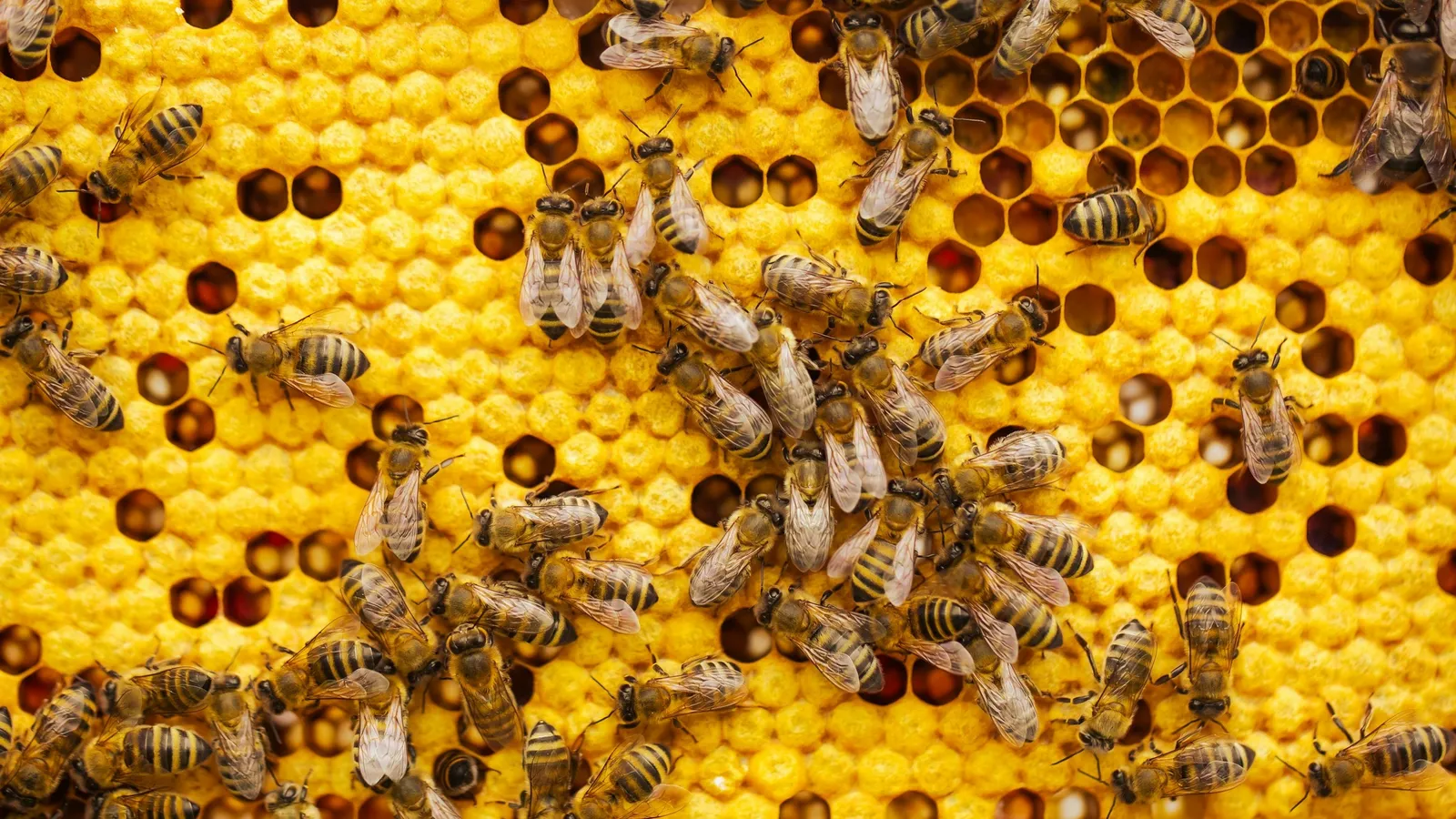
Through the glass he saw returning foragers run in small circles, alternately right and left: the round dance, which sent marked bees back out. For food farther away, bees performed a figure-of-eight with a straight run in the middle, marked by tail-wagging and a buzzing sound. This is the waggle dance.
Distance: longer distances mean longer waggle runs. In the lecture, for food 200 to 4,500 m away, the waggle run lasted from about 0.5 second to about 4 seconds.
Direction: on the vertical comb, straight up stands for the direction of the sun. If the food is 40 degrees to the left of the sun, the waggle run points 40 degrees to the left of vertical.
Where the round dance stops: the switch distance differs between honeybee races, from about 50 m in the Carniolan bee he mostly used down to 7 m in another race, citing work by R. Boch.
A worked example: read the dance
Suppose it is morning and the sun is due east of the hive. A forager's waggle run points 90 degrees to the right of vertical.
Straight up on the comb means "towards the sun", so towards the east.
90 degrees to the right of the sun's direction: facing east and turning 90 degrees right, you face south.
So the food is to the south.
Now distance. From the lecture's figures, going from 200 m to 4,500 m multiplies distance by 4,500 ÷ 200 = 22.5, but the waggle run grows only from about 0.5 to about 4 seconds, which is 4 ÷ 0.5 = 8 times. So run time is not simply proportional to distance. Read the dance as "longer means farther", not as an exact ruler.
Did everyone believe him?
No, and he answered critics with experiments. A group led by the American biologist A. M. Wenner argued that recruits found food by scent alone. In the lecture, von Frisch describes laying the hive on its side so the comb was horizontal and the sky was screened. The dancers became disoriented and recruits searched scented plates in all directions. When the hive was turned upright again, new recruits headed towards the feeding place within minutes.
Final confirmation came after his death. In 2005, a team using harmonic radar tracked the actual flight paths of recruited bees. Their paper in Nature, The flight paths of honeybees recruited by the waggle dance, notes that almost all biologists are now convinced von Frisch was correct, and provides a measured description of how well recruits translate the dance into flight.
Bee dances are not part of the current NCERT Class 11 and 12 biology books, but the link between flowers and the insects that visit them is. Our post on outbreeding devices and pollination covers the syllabus side.
What can a student take from von Frisch?
He doubted a claim that did not fit the evidence (colour-blind bees visiting colourful flowers), built a simple test, and then followed a surprise wherever it led. He also changed one condition at a time, such as the angle of the hive, to separate competing explanations. Angles and directions are easier to see than read; the Fermi Simulation Lab has interactive simulations for ideas that are easier to see than read, so you can practise turning a description into a picture.
Try it: draw a comb, mark the sun's direction, and sketch the waggle run for food 30 degrees to the left of the sun.


