

On this page
Orbital rockets such as India's PSLV are built from stages: a big rocket at the bottom with smaller rockets stacked on top. The reason follows from the conservation of momentum, and you can work it out yourself in a few lines.
Why do rockets have multiple stages?
A rocket has to lift its own tanks and engines as well as its fuel. When the first stage burns out, its empty tanks and engines are useless, but they are still heavy. Staging means letting them fall away. NASA Glenn Research Center's page on rocket staging puts it plainly: the upper stages are more efficient "simply because they do not have to carry the expired engines and empty propellant tanks that make up the first stage."
The idea is old. The same NASA page credits the 16th-century fireworks maker Johann Schmidlap with attaching smaller rockets to the tops of larger ones. In 1903 the Russian schoolteacher Konstantin Tsiolkovsky published his report on rocket-propelled vehicles, as NASA's history of 20th-century rocketry notes. He argued that a rocket's speed and range were limited only by the exhaust velocity of its gases.
How does a rocket speed up in empty space?
A rocket does not push against the air. It throws hot exhaust gas backwards, and because the total momentum of rocket plus exhaust stays the same, the rocket gains forward momentum.
Add up all those small pushes as the rocket gets lighter and you get the ideal rocket equation. NASA Glenn's ideal rocket equation page writes it as Δu = V_eq ln(MR), where MR is the mass ratio: the rocket's full mass divided by its empty mass.
The log is the part that hurts. Doubling the fuel does not double the final speed, because the extra fuel must also be lifted and sped up by the fuel burned before it.
How much fuel does a rocket need to reach orbit?
NASA's same rocket equation page works a real case. With a hydrogen-oxygen engine (specific impulse about 350 seconds) and a speed of about 17,000 mph needed for a 200-mile orbit, the mass ratio comes out at 10. That means about 90% of a rocket going to orbit is propellant, and the payload is only about 1% of the launch weight, according to NASA Glenn. 17,000 mph is about 7.6 km/s.
A mass ratio of 10 is very hard to build in one piece, because tanks, engines and structure all weigh something. Staging gets you there in steps instead.
A worked example: one stage or two?
We picked the numbers for clear arithmetic; they are not from a real rocket. Take an exhaust speed of 3 km/s and ignore gravity and air drag.
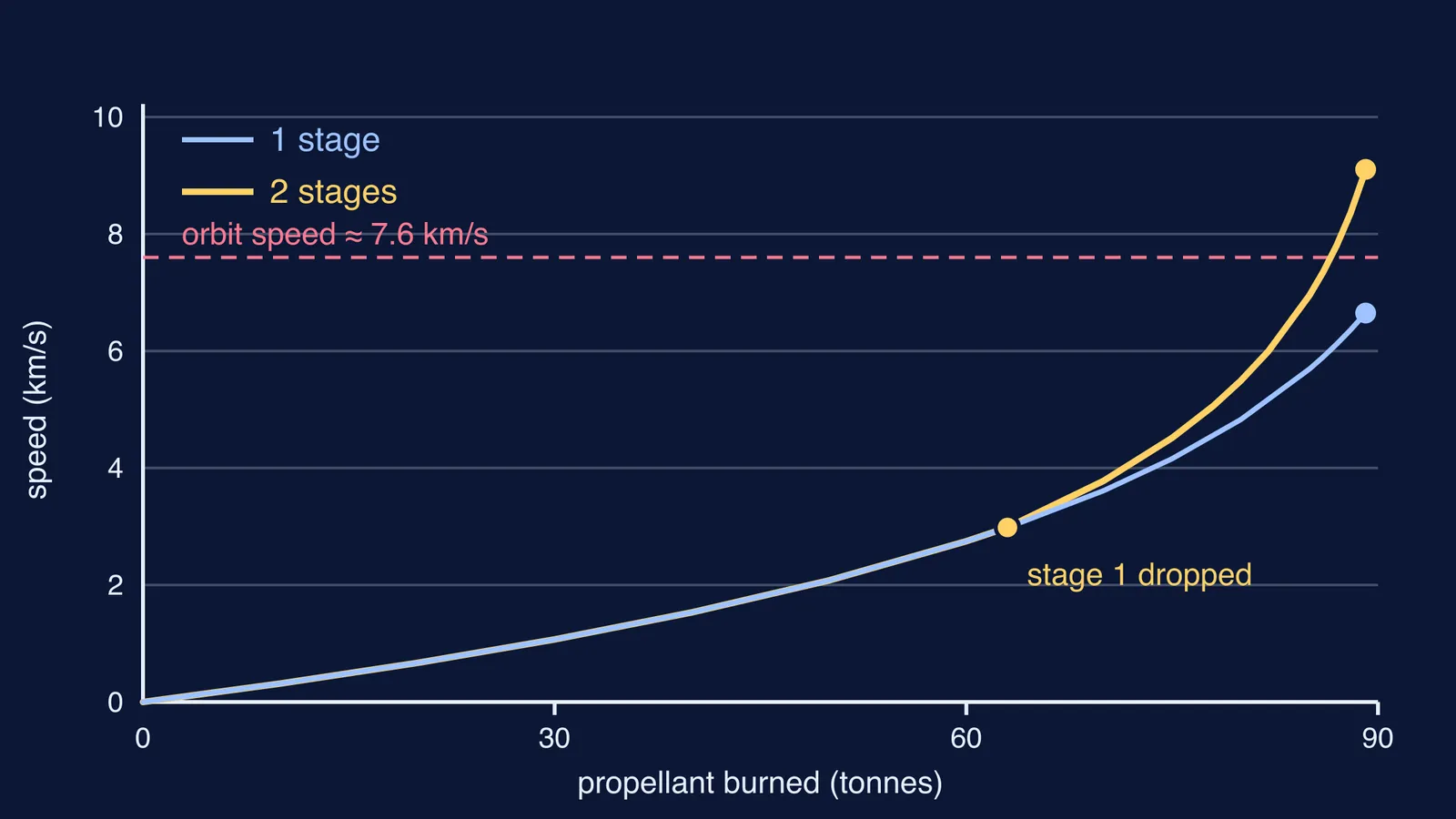
One stage. The rocket has a total mass of 100 tonnes: 1 t of payload, 89.1 t of propellant and 9.9 t of tanks and engines. Burnout mass is 10.9 t. Speed gained = 3 × ln(100 ÷ 10.9) ≈ 6.6 km/s. That is short of 7.6 km/s.
Two stages, same materials. Split the same propellant and structure into a 70 t first stage (63 t propellant, 7 t structure) and a 29 t second stage (26.1 t propellant, 2.9 t structure), plus the 1 t payload.
First burn. 100 t falls to 37 t. Speed gained = 3 × ln(100 ÷ 37) ≈ 3.0 km/s.
Drop the 7 t empty first stage. The rocket is now 30 t. Its speed does not change, but its mass does.
Second burn. 30 t falls to 3.9 t. Speed gained = 3 × ln(30 ÷ 3.9) ≈ 6.1 km/s.
Total. About 9.1 km/s, with exactly the same fuel and structure as the one-stage rocket.
The diagram at the top plots both rockets from these numbers: the curves match until the first stage drops away, then the two-stage rocket pulls clear.
How does India's PSLV use staging?
ISRO's PSLV page lists four stages that alternate between solid fuel (stages 1 and 3) and liquid fuel (stages 2 and 4). The PSLV-XL has a lift-off mass of 320 tonnes and stands 44 m tall, according to ISRO. The lower stages burn, empty and fall away in turn, so the fourth stage pushes only itself and the satellite.
How to check you really understand staging
In board exams, JEE Main, JEE Advanced and olympiads, this comes up as a variable-mass or momentum question. Use this checklist:
Can you explain, in three sentences and without the word "staging", why dropping empty tanks helps?
Can you derive Δv = v ln(m₀/m₁) from momentum conservation for a small burn of mass dm?
In the worked example, change the first stage's structure from 7 t to 14 t. Does the two-stage rocket still win?
Watch for the common slip: staging does not make the engines stronger; it makes the rocket lighter.
If ideas like momentum are easier to see than to read, explore them in the Fermi Simulation Lab, which has interactive simulations for exactly that. To revisit the momentum basics first, use the Fermi Concept Library, which gives each physics concept its own lesson.


