

On this page
On 21 October 2023, ISRO launched a single-stage test rocket, triggered an emergency abort in mid-air, and let an uncrewed Gaganyaan crew module escape. A government press release from that day called it a test of the safety mechanism that lets the crew escape if a mission is aborted because of a malfunction.
What is a crew escape system?
ISRO defines the crew escape system as "an emergency escape measure designed to quickly pull the crew module along with the astronauts to a safe distance from the launch vehicle in the event of a launch abort" (ISRO).
On Gaganyaan's human-rated LVM3 rocket, it is powered by "quick acting, high burn rate solid motors" and covers an emergency on the launch pad or during the climb, according to ISRO's Gaganyaan page.
How does a crew escape system save astronauts in a failed launch?
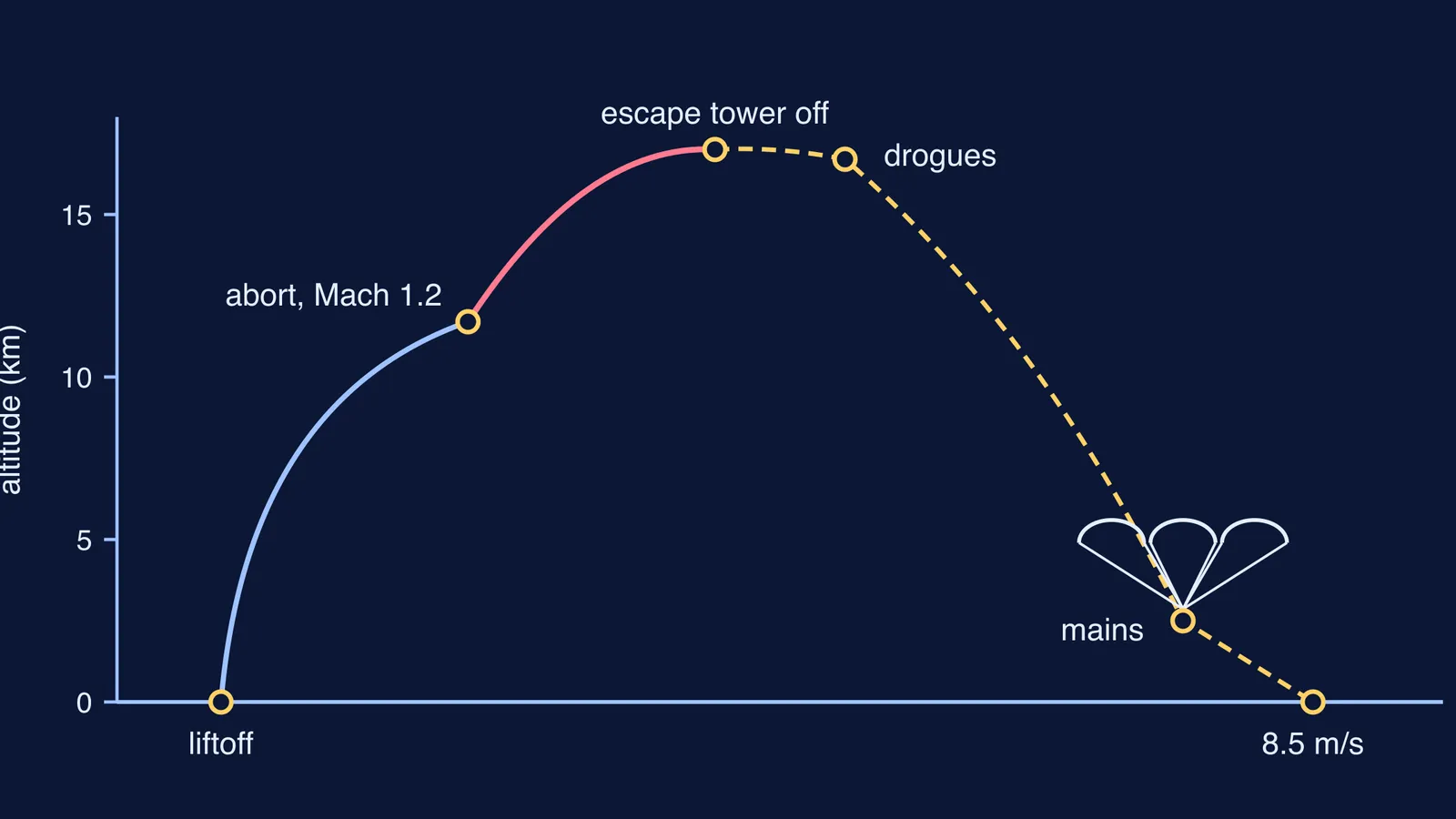
ISRO's TV-D1 mission page lists the sequence the 2023 test flew:
The test vehicle climbs to 11.7 km at Mach 1.2, faster than sound, and the abort is triggered.
The escape motors fire and pull the crew module up and away from the rocket.
At about 17 km and Mach 0.5, the crew module separates from the escape system.
Drogue parachutes open at 16.7 km.
The main parachutes open below 2.5 km.
The module touches the sea at a nominal 8.5 m/s.
The same page gives the module's mass as 4,520 kg, with 10 parachutes on board. Its altitude rose from 11.7 km at the abort to 17 km at separation: the motors pushed it up and away, then it coasted.
What forces act on the crew module during an escape?
Take the module as your system, with upward as positive. Three forces matter: thrust T from the escape motors, weight mg, and air drag D opposing the motion. Newton's second law gives a = (T − mg − D)/m.
Worked example. In ISRO's 2018 pad abort test, seven quick-acting solid motors lifted the escape system and a simulated crew module, 12.6 tonnes together at lift-off, and took the module to nearly 2.7 km. Using g = 9.8 m/s² (NASA Glenn Research Center):
Weight = 12,600 kg × 9.8 m/s² ≈ 123,000 N, about 123 kN.
So the motors together had to push with more than 123 kN just to leave the pad.
ISRO says the motors reach a safe distance "without exceeding the safe g-levels". More thrust escapes faster, but too much acceleration harms the crew.
That limit connects to why astronauts feel heavier during a launch. For where a motor's thrust comes from, see the rocket thrust formula u dm/dt.
How do parachutes bring the crew module down safely?
Drag grows with the square of speed, and when drag equals weight there is no net force, so the object falls at a steady terminal velocity, as NASA Glenn's guide explains. A parachute makes that steady speed small.
Gaganyaan uses 10 parachutes of 4 types, opened in order (ISRO, Integrated Air Drop Test):
2 apex cover separation parachutes, 2.5 m across, which pull off the protective cover
2 drogues, 5.8 m across
3 pilot parachutes, 3.4 m across, which pull out the mains
3 main parachutes, 25 m across
In that test on 24 August 2025, an Indian Air Force Chinook dropped a simulated 4.8-tonne crew module from about 3 km, and the mains slowed it to about 8 m/s.
Worked example, using those numbers:
At a steady 8 m/s, drag = weight = 4,800 kg × 9.8 m/s² ≈ 47 kN.
Main canopy area: 3 × π × (12.5 m)² ≈ 1,470 m². Drogues: 2 × π × (2.9 m)² ≈ 53 m². The mains have about 28 times the area.
Terminal speed goes as 1/√A, so with everything else equal, the mains would settle at a speed about √28 ≈ 5 times lower than the drogues.
Hitting water at 8 m/s is like jumping from h = v²/2g = 64/19.6 ≈ 3.3 m.
Why not open the mains first? Because drag goes as v², a 25 m canopy opened at high speed would take an enormous load. The drogues stabilise the module and cut its speed first, says ISRO's drogue test report.
You can test the area idea at home with this parachute size experiment. The Fermi Simulation Lab has interactive simulations for the ideas that are easier to see than to read.
What does the escape system teach about safety design?
Four design ideas worth borrowing:
Plan for failure at every stage: the escape system covers the pad and the climb.
Back yourself up: the TV-D1 module had dual redundant avionics (ISRO).
Test pieces before the whole: ISRO lists air drop tests, pad abort tests and test vehicle flights as precursors to a crewed flight (ISRO).
Respect the human limit: faster is not safer if the g-forces harm the crew.
If the free-body step is where you get stuck, the Fermi Problem Library has worked problems with a step-by-step solver that explains the reasoning rather than printing an answer.
Next time you watch an ISRO launch, look at the tip of the rocket: the escape motors sit there, and everyone hopes they never fire.


