

On this page
It all comes down to the physics of apparent weight. When you sit in a chair on Earth, gravity pulls you down, and the chair pushes up on you with a force equal to your weight. This upward push is called the normal force, and it is what you actually feel as your weight.
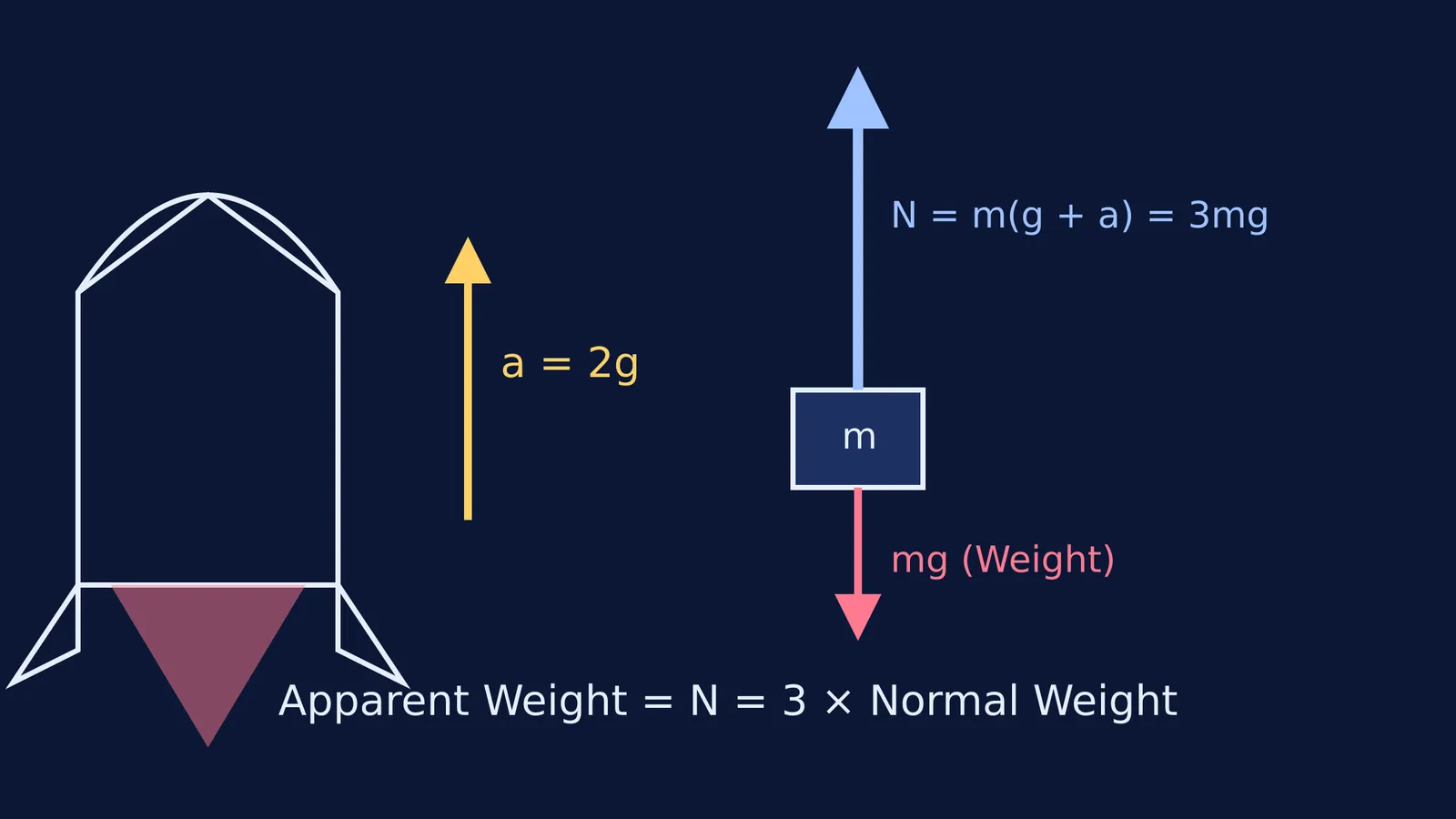
During a rocket launch, the spacecraft is accelerating rapidly upwards. According to Newton's second law, for an astronaut to accelerate at the same rate as the rocket, the net force on them must be equal to their mass multiplied by that acceleration (ma). Because gravity is still pulling down with a constant force of mg, the seat must push upwards with an even greater force to overcome gravity and simultaneously provide the necessary acceleration to lift them into orbit.
Why do astronauts feel so heavy?
When balancing the forces, the normal force (N) pushing up on the astronaut becomes N = m(g + a). This equation means the astronaut's apparent weight is their normal resting weight plus the extra force required to accelerate their mass.
For example, if a rocket accelerates upwards at exactly twice the acceleration of gravity (2g), the equation becomes N = m(g + 2g), which simplifies to a normal force of 3mg. Because the seat is pushing against the astronaut with three times the force they are used to, the astronaut feels exactly three times as heavy as they do on Earth. Their arms and legs become extremely difficult to lift, and every movement requires immense effort.
How many Gs do astronauts experience?
The maximum G-force an astronaut feels depends heavily on the rocket's design and the specific mission profile.
During the era of the Space Shuttle, NASA deliberately capped the maximum acceleration to protect both the astronauts and the orbiter's delicate structure. The main engines were actively throttled down during the final minute of ascent to limit the G-force to exactly 3 Gs. At this level, the intense pressure makes every movement require immense effort, but it is still comfortable enough to allow crews to monitor the flight instruments and communicate with mission control.
What happens to the body under high acceleration?
When an astronaut is subjected to high G-forces, the primary concern is the cardiovascular system. If a person were seated upright like in a typical chair, the intense upward acceleration would force blood down toward their feet. Because the human heart is not strong enough to pump blood up to the brain against such a high apparent weight, the brain would quickly run out of oxygen. This leads to a condition known as G-force induced loss of consciousness, or G-LOC.
To prevent this dangerous scenario, spacecraft designers position the seats so that the acceleration force acts across the astronaut's chest (front-to-back), rather than from head to toe. In this supine position, the blood is not forced vertically away from the brain. This allows the crew to remain completely conscious and alert even when they feel multiple times their normal weight pressing them into their seats. This is why astronauts spend the entire launch sequence lying on their backs with their legs elevated toward the control panel.
Why do rockets throttle down?
As a rocket climbs through the Earth's atmosphere, it burns through hundreds of tonnes of liquid and solid fuel every minute. This means the rocket gets progressively lighter and lighter as it flies toward space.
If the engines kept pushing with the same constant maximum thrust, Newton's second law dictates that the decreasing mass would cause the acceleration to spike dangerously high. If left unchecked, the rapidly climbing G-forces could easily crush the astronauts and tear the vehicle apart. To prevent this, the rocket's flight computers slowly throttle the engines down—gradually reducing the thrust—to maintain a steady, safe G-limit until they reach the vacuum of space and enter orbit.
If you struggle to set up free-body diagrams for moving objects, the Fermi Concept Library explains how to balance forces for objects in elevators and rockets. You can also explore how these equations change in different scenarios, such as how a weighing scale reading changes in an accelerating lift, or whether a stranded astronaut can throw an object to move back to a spaceship.


