

On this page
If you build a toy parachute out of a plastic bag and it drops to the floor too fast, the obvious fix is to make a bigger canopy. Common sense suggests that if you double the area of the parachute, it should catch more air and fall much slower. We are trained to think in direct proportions.
But if you actually time the drop, you will find that the physics of air resistance does not work like a simple fraction. The speed drops, but it does not halve.
What does the parachute size effect on falling speed experiment show?
When an object falls, gravity pulls it down while air resistance, or drag, pushes back up. The moment you release a parachute, it accelerates downwards due to gravity. But as the object speeds up, it collides with more air molecules every second, which increases the upward drag force.
Eventually, the upward push of the air exactly matches the downward pull of gravity. The net force becomes zero. The parachute stops accelerating and falls at a steady, constant speed, which is known as its terminal velocity.
According to the NASA Glenn Research Center, the terminal velocity of a falling object is given by the formula:
v = √(2mg / ρAC_d)
Here, m is the total mass, g is gravity, ρ is the air density, A is the parachute's area, and C_d is the drag coefficient (a number describing how effectively the shape catches air). Because the area (A) sits under a square root, the relationship between area and speed is not a straight line.
Why does terminal speed fall but not halve?
According to the terminal velocity formula, the drag force holding the parachute up is proportional to the square of its speed (v²).
If you double the parachute's area, it suddenly generates twice as much drag at the same speed. To restore the balance with the unchanging force of gravity, the speed must decrease. But because the drag force depends on the square of the speed, the speed only needs to drop by a factor of √2 (about 1.41) to bring the forces back into equilibrium. Using the NASA formula above, we can predict the exact change for any parachute:
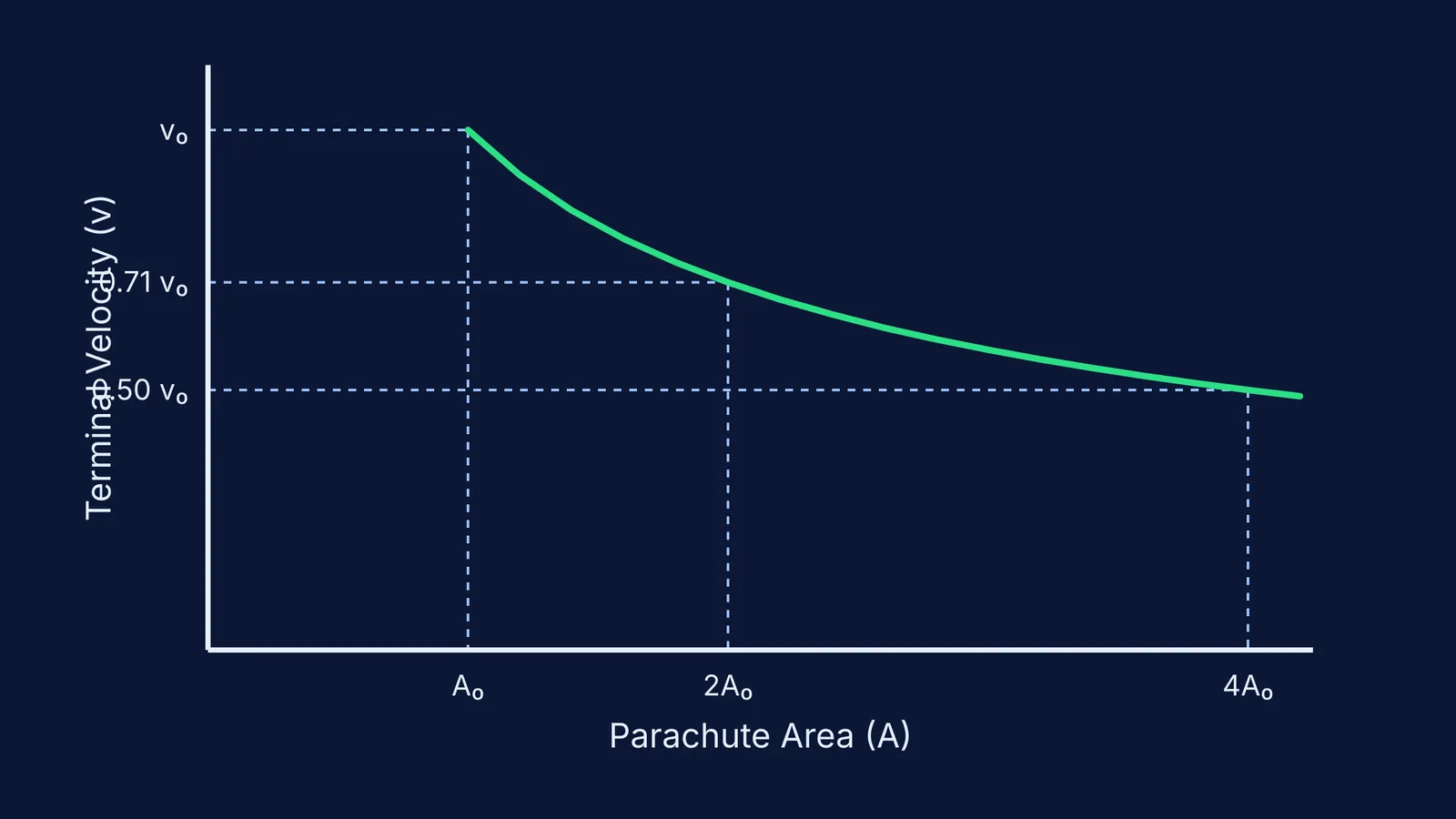
Original parachute area: falls at 100% of its speed.
Double the area (2x): falls at 71% of its original speed.
Quadruple the area (4x): falls at 50% of its original speed.
Nine times the area (9x): falls at 33% of its original speed.
This non-linear relationship is exactly what you see when you examine terminal velocity equations, where drag forces scale quadratically with speed rather than linearly.
How to set up a parachute size effect on falling speed experiment?
You can test this square-root relationship at home. The Science Buddies parachute science project recommends using a lightweight plastic bin bag and cutting squares of different sizes to test the theory.
Make the canopies: Cut two squares from a flat plastic bin bag. Make the first square 20 cm by 20 cm (area = 400 cm²). Make the second square 28.3 cm by 28.3 cm (area = 800 cm²). The second parachute now has exactly twice the area of the first.
Add a spill hole: Cut a tiny 1 cm hole in the exact centre of both canopies. This allows a small stream of air to escape from the top, which stops the parachute from violently rocking side to side as it falls.
Attach the strings: Tape a 40 cm piece of string to each of the four corners of both parachutes.
Add the payload: Tie the free ends of the strings on the first parachute to one metal washer or two coins. You must use the exact same payload for both drops so that mass (m) remains constant.
Time the drop: Drop the first parachute from a high point, such as a staircase landing or a balcony (at least 2 metres high). Record the fall time with a phone stopwatch. Repeat this three times to find the average fall time. Then do the same for the second parachute.
If your first parachute took 2.0 seconds to hit the ground, the second parachute will not take 4.0 seconds. Instead, the timer will read roughly 2.8 seconds (2.0 seconds × 1.41).
When you want to explore how projectile motion with air resistance behaves without having to cut plastic bags and climb stairs, you can use the Fermi Simulation Lab. Instead of guessing how variables like canopy area, air density and mass change the outcome, you can explore interactive simulations for the ideas that are easier to see than to read.
Testing your first instinct against the actual maths of air resistance is the most reliable way to understand why simple proportionality rarely applies to motion in fluids, which is why learning physics from first principles is so effective.


