

On this page
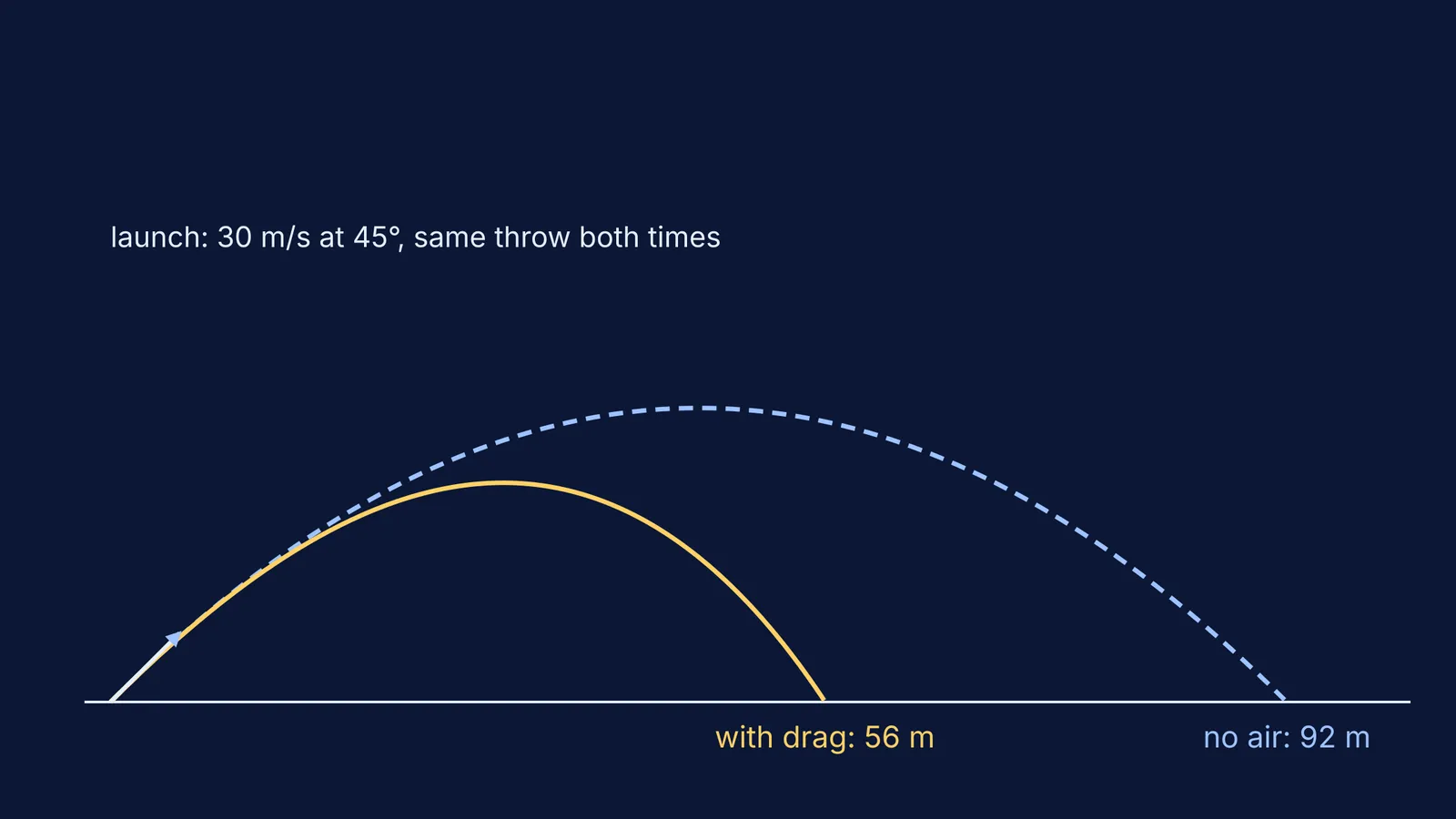
Every Class 11 student learns that a projectile on level ground goes farthest at 45°. That result assumes there is no air. Here is what changes when there is. If you want the drag-free formulas first, start with our guide to range, height and time of flight on level ground.
How does air resistance change projectile motion?
NASA's Glenn Research Center gives the drag equation as D = Cd × ρ × V² × A / 2, where Cd is the drag coefficient, ρ the air density, V the speed and A the reference area (NASA Glenn: the drag equation). Because drag depends on the square of the speed, doubling a ball's speed makes the drag four times larger. For a sphere, NASA gives a drag coefficient that varies from 0.07 to 0.5, because the drag on a sphere depends strongly on the Reynolds number (NASA Glenn: shape effects on drag).
Drag points opposite to the velocity, which gives three changes:
It slows the horizontal motion, so horizontal velocity is no longer constant.
It adds to gravity on the way up, so the ball rises less high.
The path is no longer a parabola: the ball comes down more steeply than it went up.
Why is the optimal angle less than 45 degrees with air resistance?
Without air, 45° balances horizontal speed (large at low angles) against time in the air (large at high angles). Drag tips that balance: a high throw stays up longer, so drag has more time to eat its horizontal speed.
P. S. Chudinov of the Moscow Aviation Institute derived an equation for the best angle under quadratic drag, first published in the Indian Journal of Physics in 2003 and summarised in a 2004 ballistics symposium paper (Chudinov, arXiv version). In his model the drag force is mgkV², and the best angle depends on a single number, p = kV₀². His graph shows the best angle falling steadily from 45° at p = 0 to about 38° at p = 2.5.
To read p: drag equals weight when mgkV² = mg, so terminal speed is 1/√k and p is (launch speed ÷ terminal speed)². For heavy, slow objects p is near zero and 45° still works.
Below 45° is the usual answer, not a law of nature. Richard Price and Joseph Romano showed in the American Journal of Physics that for some ways drag can depend on speed, the range-maximising angle is greater than 45° (Price and Romano, 1998). Spin matters too: a 2026 preprint by Kazuhiro Tsuboi, using a simplified (linearised) model, found that both drag and the lift from spin lower the best angle, with lift having the stronger effect (Tsuboi, arXiv).
How much does drag cut range and height? A worked example
Take the baseball drag factor Chudinov uses, k = 0.000548 s²/m², with a launch speed of 40 m/s, so p ≈ 0.88 (Chudinov). His approximate formula for maximum height is H = V₀² sin²θ / [g(2 + p sinθ)]. Set k = 0 and it becomes the textbook V₀² sin²θ / 2g, which is a good check. We put the numbers through his approximate formulas for height, flight time and range, with g = 9.81 m/s²:
No drag, 45°: height 40.8 m, range 163.1 m.
Drag, 45°: height 31.1 m, range about 100.6 m.
Drag, 40°: height 26.3 m, range about 101.4 m.
Drag, 35°: height 21.4 m, range about 99.7 m.
Drag cuts the range at 45° by about 38%, but the height by only about 24%. And 40° now beats 45°, and Chudinov's graph puts the best angle at p ≈ 0.88 near 41°. Finally, the range curve is flat near its peak: a few degrees either side costs only a metre or two, so launch speed matters far more than the exact angle.
How can you test this in a projectile motion simulation?
Use any simulation with an air resistance switch, and predict before you look.
Predict the best angle with drag on, and say why.
With drag off, fire at 30°, 40°, 45°, 50° and 60° at one speed. Record range and height.
Turn drag on and repeat. Find where range peaks.
Double the launch speed and repeat. The best angle should drop further.
Try a heavier ball of the same size. It should behave more like the drag-free case.
Sketch one drag trajectory and explain why the descent is steeper.
This builds on our six predictions to test in a projectile motion simulation. You can also build a projectile simulation in Python and add the drag term yourself: in Chudinov's notation, each velocity component gets an extra acceleration of −gkV times that component, where V is the speed.
Ideas like this are what the Fermi Simulation Lab is for: interactive simulations for the ideas that are easier to see than to read. If the drop in angle still feels slippery, Fermi's AI tutor can draw the figure, run the simulation and check your understanding as it goes.
Run the six steps once, and 45° will look like what it is: a special case.


